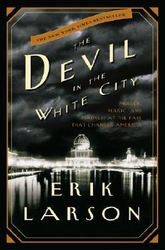
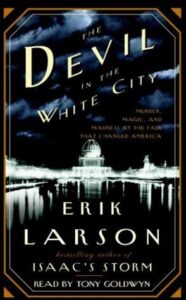
Author Erik Larson imbues the incredible events surrounding the 1893 Chicago World's Fair with such drama that readers may find themselves checking the book's categorization to be sure that 'The Devil in the White City' is not, in fact, a highly imaginative novel. Larson tells the stories of two men: Daniel H. Burnham, the architect responsible for the fair's construction, and H.H. Holmes, a serial killer masquerading as a charming doctor.
Burnham's challenge was immense. In a short period of time, he was forced to overcome the death of his partner and numerous other obstacles to construct the famous "White City" around which the fair was built. His efforts to complete the project, and the fair's incredible success, are skillfully related along with entertaining appearances by such notables as Buffalo Bill Cody, Susan B. Anthony, and Thomas Edison.
The activities of the sinister Dr. Holmes, who is believed to be responsible for scores of murders around the time of the fair, are equally remarkable. He devised and erected the World's Fair Hotel, complete with crematorium and gas chamber, near the fairgrounds and used the event as well as his own charismatic personality to lure victims.
Combining the stories of an architect and a killer in one book, mostly in alternating chapters, seems like an odd choice but it works. The magical appeal and horrifying dark side of 19th-century Chicago are both revealed through Larson's skillful writing. - John Moe
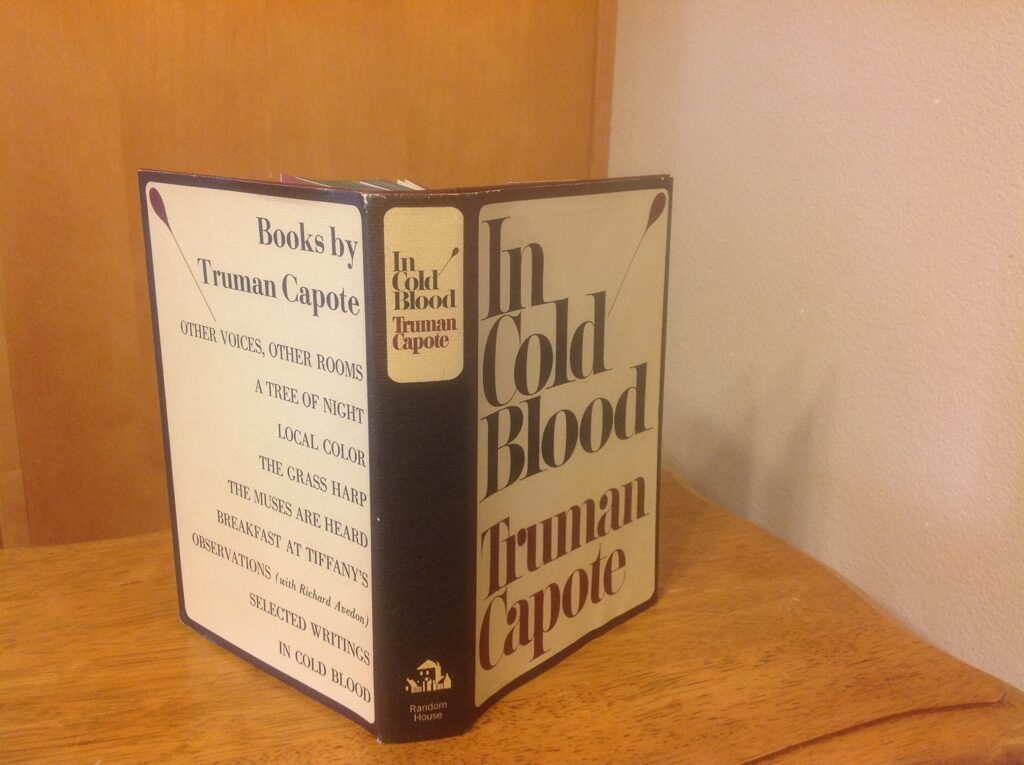
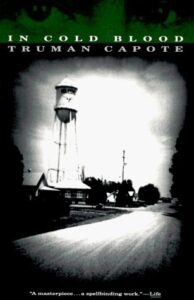
On November 15, 1959, in the small town of Holcomb, Kansas, four members of the Clutter family were savagely murdered by blasts from a shotgun held a few inches from their faces. There was no apparent motive for the crime, and there were almost no clues.
As Truman Capote reconstructs the murder and the investigation that led to the capture, trial, and execution of the killers, he generates both mesmerizing suspense and astonishing empathy. In Cold Blood is a work that transcends its moment, yielding poignant insights into the nature of American violence.
Shots rang out in Savannah's grandest mansion in the misty, early morning hours of May 2, 1981. Was it murder or self-defense? For nearly a decade, the shooting and its aftermath reverberated throughout this city of moss-hung oaks and shaded squares. John Berendt's narrative reads like a thoroughly engrossing novel, and yet it is a work of nonfiction. Berendt interweaves a first-person account of life in this isolated remnant of the Old South with the unpredictable twists and turns of a landmark murder case.
The story is peopled by a gallery of remarkable characters: the well-bred society ladies of the Married Woman's Card Club; the turbulent young redneck gigolo; the hapless recluse who owns a bottle of poison so powerful it could kill every man, woman, and child in Savannah; the aging and profane Southern belle who is the "soul of pampered self-absorption"; the uproarious black drag queen; the acerbic and arrogant antiques dealer; the sweet-talking, piano-playing con artist; young blacks dancing the minuet at the black debutante ball; and Minerva, the voodoo priestess who works her magic in the graveyard at midnight. These and other Savannahians act as a Greek chorus, with Berendt revealing the alliances, hostilities, and intrigues that thrive in a town where everyone knows everyone else.
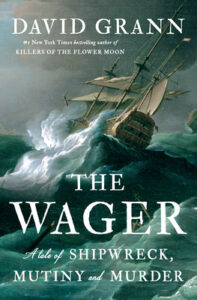
From the #1 New York Times bestselling author of Killers of the Flower Moon, a page-turning story of shipwreck, survival, and savagery, culminating in a court martial that reveals a shocking truth. The powerful narrative reveals the deeper meaning of the events on the Wager, showing that it was not only the captain and crew who ended up on trial, but the very idea of empire.
On January 28, 1742, a ramshackle vessel of patched-together wood and cloth washed up on the coast of Brazil. Inside were thirty emaciated men, barely alive, and they had an extraordinary tale to tell. They were survivors of His Majesty's Ship the Wager, a British vessel that had left England in 1740 on a secret mission during an imperial war with Spain. While the Wager had been chasing a Spanish treasure-filled galleon known as "the prize of all the oceans," it had wrecked on a desolate island off the coast of Patagonia. The men, after being marooned for months and facing starvation, built the flimsy craft and sailed for more than a hundred days, traversing nearly 3,000 miles of storm-wracked seas. They were greeted as heroes.
But then . . . six months later, another, even more decrepit craft landed on the coast of Chile. This boat contained just three castaways, and they told a very different story. The thirty sailors who landed in Brazil were not heroes - they were mutineers. The first group responded with countercharges of their own, of a tyrannical and murderous senior officer and his henchmen. It became clear that while stranded on the island the crew had fallen into anarchy, with warring factions fighting for dominion over the barren wilderness. As accusations of treachery and murder flew, the Admiralty convened a court martial to determine who was telling the truth. The stakes were life-and-death--for whomever the court found guilty could hang.
The Wager is a grand tale of human behavior at the extremes told by one of our greatest nonfiction writers. Grann's recreation of the hidden world on a British warship rivals the work of Patrick O'Brian, his portrayal of the castaways' desperate straits stands up to the classics of survival writing such as The Endurance, and his account of the court martial has the savvy of a Scott Turow thriller. As always with Grann's work, the incredible twists of the narrative hold the reader spellbound.
On January 15, 1947, the torture-ravished body of a beautiful young woman is found in a vacant lot. The victim makes headlines as the Black Dahlia—and so begins the greatest manhunt in California history. Caught up in the investigation are Bucky Bleichert and Lee Warrants Squad cops, friends, and rivals in love with the same woman. But both are obsessed with the Dahlia—driven by dark needs to know everything about her past, to capture her killer, to possess the woman even in death. Their quest will take them on a hellish journey through the underbelly of postwar Hollywood, to the core of the dead girl's twisted life, past the extremes of their own psyches—into a region of total madness.
Murder, Magic, and Madness at the Fair That Changed America
Erik Larson's gifts as a storyteller are magnificently displayed in this rich narrative of the master builder, the killer, and the great fair that obsessed them both.
Two men, each handsome and unusually adept at his chosen work, embodied an element of the great dynamic that characterized America's rush toward the twentieth century. The architect was Daniel Hudson Burnham, the fair's brilliant director of works and the builder of many of the country's most important structures, including the Flatiron Building in New York and Union Station in Washington, D.C. The murderer was Henry H. Holmes, a young doctor who, in a malign parody of the White City, built his "World's Fair Hotel" just west of the fairgrounds—a torture palace complete with dissection table, gas chamber, and 3,000-degree crematorium. Burnham overcame tremendous obstacles and tragedies as he organized the talents of Frederick Law Olmsted, Charles McKim, Louis Sullivan, and others to transform swampy Jackson Park into the White City, while Holmes used the attraction of the great fair and his own satanic charms to lure scores of young women to their deaths. What makes the story all the more chilling is that Holmes really lived, walking the grounds of that dream city by the lake.
The Devil in the White City draws the reader into a time of magic and majesty, made all the more appealing by a supporting cast of real-life characters, including Buffalo Bill, Theodore Dreiser, Susan B. Anthony, Thomas Edison, Archduke Francis Ferdinand, and others. In this book the smoke, romance, and mystery of the Gilded Age come alive as never before.
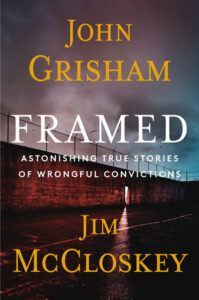
Ten harrowing true stories of wrongful convictions. Impeccably researched and grippingly told, Framed offers an inside look at the injustice faced by the victims of the United States criminal justice system.
A fundamental principle of our legal system is a presumption of innocence, but once someone has been found guilty there is very little room to prove doubt. Framed shares ten true stories of men who were innocent but found guilty and forced to sacrifice friends, families, wives, and decades of their lives to prison while the guilty parties remained free. In each of the stories, John Grisham and Jim McCloskey recount the dramatic hard-fought battles for exoneration. They take a close look at what leads to wrongful convictions in the first place, and the racism, misconduct, flawed testimony, and the corrupt court system that can make them so hard to reverse.
Told with page-turning suspense as only John Grisham can deliver, Framed is the story of overcoming adversity when the battle already seems lost, and the deck is stacked against you.
This is the frighteningly true story of two young cops and two young robbers whose separate destinies fatally cross one March night in a bizarre execution in a deserted Los Angeles field.
Welcome Back!
Track your reading progress and sync your library.