This is a reproduction of the original artefact. Generally these books are created from careful scans of the original. This allows us to preserve the book accurately and present it in the way the author intended. Since the original versions are generally quite old, there may occasionally be certain imperfections within these reproductions. We’re happy to make these classics available again for future generations to enjoy!
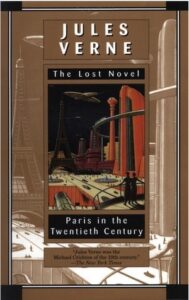
In 1863 Jules Verne, famed author of 20,000 Leagues Under the Sea and Journey to the Center of the Earth, wrote a novel that his literary agent deemed too far fetched to be published. More than one hundred years later, his great-grandson found the handwritten, never-before published manuscript in a safe. That manuscript was Paris in the Twentieth Century, and astonishingly prophetic view into the future by one of the most renowned science fiction writers of our time. . . .
Praise for Paris in the Twentieth Century
“Jules Verne was the Michael Crichton of the 19th century.” — The New York Times
“For anyone interested in the history of speculative fiction . . . this book is an absolute necessity.” —Ray Bradbury
“Verne's Paris is a bustling, overcrowded metropolis teeming with starving homeless and ‘vehicles that passed on paved roads and moved without horses.’ Years before they would be invented, Verne has imagined elevators and faxmachines. It was a vision Verne's editor flatly rejected. Contemporary readers know better.” — People
“An excellent extrapolation, founded on 19th-century technical novelties, of a future culture.” — The Washington Post Book World
“Verne published nearly seventy books, many of them now considered classics. But this little jewel catches him just reaching stride as a writer of science fiction, a genre that he, of course, helped put on the literary map.” — The Denver Post
Jean-Baptiste Clamence is a soul in turmoil. Over several drunken nights in an Amsterdam bar, he regales a chance acquaintance with his story. From this successful former lawyer and seemingly model citizen a compelling, self-loathing catalogue of guilt, hypocrisy and alienation pours forth.
The Fall (French: La Chute) is a philosophical novel by Albert Camus. First published in 1956, it is his last complete work of fiction. The Fall explores themes of innocence, imprisonment, non-existence, and truth. In a eulogy to Albert Camus, existentialist philosopher Jean-Paul Sartre described the novel as "perhaps the most beautiful and the least understood" of Camus' books.
Simply written, but powerful and unforgettable, The Man Who Planted Trees is a parable for modern times. In the foothills of the French Alps the narrator meets a shepherd who has quietly taken on the task of planting one hundred acorns a day in an effort to reforest his desolate region. Not even two world wars can keep the shepherd from continuing his solitary work. Gradually, this gentle, persistent man's work comes to the region is transformed; life and hope return; the world is renewed.
After the relative intimacy of the first two volumes of In Search of Lost Time, The Guermantes Way opens up a vast, dazzling landscape of fashionable Parisian life in the late nineteenth century, as the narrator enters the brilliant, shallow world of the literary and aristocratic salons. Both a salute to, and a devastating satire of a time, place, and culture, The Guermantes Way defines the great tradition of novels that follow the initiation of a young man into the ways of the world. This elegantly packaged new translation will introduce a new generation of American readers to the literary richness of Marcel Proust. First time in Penguin Classics
A Penguin Classics Deluxe Edition with french flaps and luxurious design
Penguin Classics' superb new edition of In Search of Lost Time is the first completely new translation of Proust's masterwork since the 1920s
The complex moral ambiguities of seduction and revenge make Les Liaisons dangereuses (1782) one of the most scandalous and controversial novels in European literature. The subject of major film and stage adaptations, the novel's prime movers, the Vicomte de Valmont and the Marquise de Merteuil, form an unholy alliance and turn seduction into a game - a game which they must win. This new translation gives Laclos a modern voice, and readers will be able a judge whether the novel is as "diabolical" and "infamous" as its critics have claimed, or whether it has much to tell us about the kind of world we ourselves live in. David Coward's introduction explodes myths about Laclos's own life and puts the book in its literary and cultural context.
À la suite d'une explosion, sans doute nucléaire, qui a selon toute vraisemblance ravagé la Terre entière, Emmanuel Comte et ses six compagnons font du château de Malevil, dont la profonde cave leur a permis de survivre, la base de départ de leurs efforts de reconstruction de la civilisation, qui passera également par l'affrontement avec d'autres groupes de survivants, que ce soient des bandes errantes ou des groupes structurés nomades ou sédentaires.
La qualification de science-fiction peut être considérée comme exagérée, concernant ce roman, puisque seule la situation de départ (la destruction de la civilisation humaine par une explosion d'origine inconnue) rejoint le thème post-apocalyptique, alors très populaire en science-fiction. Tout le reste du roman raconte comment un groupe de survivants miraculés relève le défi de la reconstruction d'une société humaine. De ce point de vue, on peut dire que le roman relève du genre de la robinsonade.
De nombreux thèmes sont abordés dans ce roman : la religion, la politique, la place des femmes dans la société, le monde rural, le rôle du chef, certes sous l'angle d'une mini-communauté mais qui renvoient à notre société.
Madame Bovary is the debut novel of French writer Gustave Flaubert, published in 1856. The character lives beyond her means in order to escape the banalities and emptiness of provincial life. When the novel was first serialized in La Revue de Paris between 1 October 1856 and 15 December 1856, public prosecutors attacked the novel for obscenity. The resulting trial in January 1857 made the story notorious. After Flaubert's acquittal on 7 February 1857, Madame Bovary became a bestseller in April 1857 when it was published in two volumes. A seminal work of literary realism, the novel is now considered Flaubert's masterpiece, and one of the most influential literary works in history.
The elegant, haunting story of the forgotten people and places of Paris from the reigning Nobel Laureate.
Four narrators, a student from a café, a private detective hired by an aggrieved husband, the heroine herself and one of her lovers, construct a portrait of Jacqueline Delanque, otherwise known as Louki.
The daughter of a single mother who works in the Moulin Rouge, Louki grows up in poverty in Montmartre. Her one attempt to escape her background fails when she is rejected from the Lycée Jules-Ferry. She meanders on through life, into a cocaine habit, and begins frequenting the Café Condé, whose regulars call her "Louki". She drifts into marriage with a real estate agency director, but finds no satisfaction with him or his friends and so makes the simple decision not to return to him one evening. She turns instead to a young man almost as aimless and adrift as she, but who perhaps loves her all the same.
Ever-present through this story is the city of Paris, almost another character in her own right. This is the Paris of 'no-man's-lands', of lonely journeys on the last metro, or nocturnal walks along empty boulevards; of cafés where the lost youth wander in, searching for meaning, and the older generation sift through their memories of their own long-gone adolescence.
Welcome Back!
Track your reading progress and sync your library.