This was no ordinary war. This was a war to make the world safe for democracy. And if democracy was made safe, then nothing else mattered – not the millions of dead bodies, nor the thousands of ruined lives…
This is no ordinary novel. This is a novel that never takes the easy way out: it is shocking, violent, terrifying, horrible, uncompromising, brutal, remorseless and gruesome… but so is war.
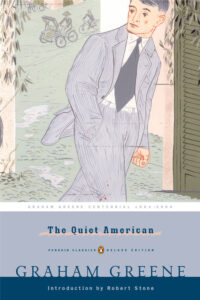
Graham Greene's classic exploration of love, innocence, and morality in Vietnam
"I never knew a man who had better motives for all the trouble he caused," Graham Greene's narrator Fowler remarks of Alden Pyle, the eponymous "Quiet American" of what is perhaps the most controversial novel of his career. Pyle is the brash young idealist sent out by Washington on a mysterious mission to Saigon, where the French Army struggles against the Vietminh guerrillas. As young Pyle's well-intentioned policies blunder into bloodshed, Fowler, a seasoned and cynical British reporter, finds it impossible to stand safely aside as an observer. But Fowler's motives for intervening are suspect, both to the police and himself, for Pyle has stolen Fowler's beautiful Vietnamese mistress.
First published in 1956 and twice adapted to film, The Quiet American remains a terrifiying and prescient portrait of innocence at large. This Graham Greene Centennial Edition includes a new introductory essay by Robert Stone.
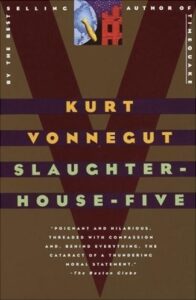
Slaughterhouse-Five, an American classic, is one of the world’s great antiwar books. Centering on the infamous World War II firebombing of Dresden, the novel is the result of what Kurt Vonnegut described as a twenty-three-year struggle to write a book about what he had witnessed as an American prisoner of war. It combines historical fiction, science fiction, autobiography, and satire in an account of the life of Billy Pilgrim, a barber’s son turned draftee turned optometrist turned alien abductee. As Vonnegut had, Billy experiences the destruction of Dresden as a POW. Unlike Vonnegut, he experiences time travel, or coming “unstuck in time.”
An instant bestseller, Slaughterhouse-Five made Kurt Vonnegut a cult hero in American literature, a reputation that only strengthened over time, despite his being banned and censored by some libraries and schools for content and language. But it was precisely those elements of Vonnegut’s writing—the political edginess, the genre-bending inventiveness, the frank violence, the transgressive wit—that have inspired generations of readers not just to look differently at the world around them but to find the confidence to say something about it.
Fifty years after its initial publication at the height of the Vietnam War, Vonnegut's portrayal of political disillusionment, PTSD, and postwar anxiety feels as relevant, darkly humorous, and profoundly affecting as ever, an enduring beacon through our own era’s uncertainties.
In 1937 Ernest Hemingway traveled to Spain to cover the civil war there for the North American Newspaper Alliance. Three years later he completed the greatest novel to emerge from "the good fight," For Whom the Bell Tolls. The story of Robert Jordan, a young American in the International Brigades attached to an antifascist guerilla unit in the mountains of Spain, it tells of loyalty and courage, love and defeat, and the tragic death of an ideal. In his portrayal of Jordan's love for the beautiful Maria and his superb account of El Sordo's last stand, in his brilliant travesty of La Pasionaria and his unwillingness to believe in blind faith, Hemingway surpasses his achievement in The Sun Also Rises and A Farewell to Arms to create a work at once rare and beautiful, strong and brutal, compassionate, moving and wise. "If the function of a writer is to reveal reality," Maxwell Perkins wrote to Hemingway after reading the manuscript, "no one ever so completely performed it." Greater in power, broader in scope, and more intensely emotional than any of the author's previous works, it stands as one of the best war novels of all time.
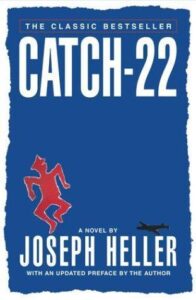
Fifty years after its original publication, Catch-22 remains a cornerstone of American literature and one of the funniest—and most celebrated—books of all time. In recent years it has been named to “best novels” lists by Time, Newsweek, the Modern Library, and the London Observer.
Set in Italy during World War II, this is the story of the incomparable, malingering bombardier, Yossarian, a hero who is furious because thousands of people he has never met are trying to kill him. But his real problem is not the enemy—it is his own army, which keeps increasing the number of missions the men must fly to complete their service. Yet if Yossarian makes any attempt to excuse himself from the perilous missions he’s assigned, he’ll be in violation of Catch-22, a hilariously sinister bureaucratic rule: a man is considered insane if he willingly continues to fly dangerous combat missions, but if he makes a formal request to be removed from duty, he is proven sane and therefore ineligible to be relieved.
This fiftieth-anniversary edition commemorates Joseph Heller’s masterpiece with a new introduction by Christopher Buckley; a wealth of critical essays and reviews by Norman Mailer, Alfred Kazin, Anthony Burgess, and others; rare papers and photos from Joseph Heller’s personal archive; and much more. Here, at last, is the definitive edition of a classic of world literature.
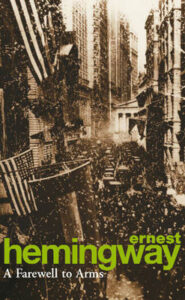
A Farewell to Arms is the unforgettable story of an American ambulance driver on the Italian front and his passion for a beautiful English nurse. Set against the looming horrors of the battlefield - the weary, demoralized men marching in the rain during the German attack on Caporetto; the profound struggle between loyalty and desertion—this gripping, semiautobiographical work captures the harsh realities of war and the pain of lovers caught in its inexorable sweep. Ernest Hemingway famously said that he rewrote his ending to A Farewell to Arms thirty-nine times to get the words right.
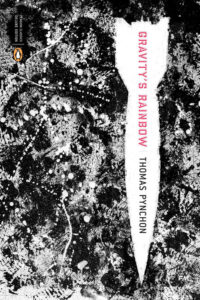
Winner of the 1973 National Book Award, Gravity's Rainbow is a postmodern epic, a work as exhaustively significant to the second half of the 20th century as Joyce's Ulysses was to the first. Its sprawling, encyclopedic narrative, and penetrating analysis of the impact of technology on society make it an intellectual tour de force.
The most nostalgic and reflective of Evelyn Waugh's novels, Brideshead Revisited looks back to the golden age before the Second World War. It tells the story of Charles Ryder's infatuation with the Marchmains and the rapidly-disappearing world of privilege they inhabit. Enchanted first by Sebastian at Oxford, then by his doomed Catholic family, in particular his remote sister, Julia, Charles comes finally to recognize only his spiritual and social distance from them.
All the King's Men is a 1946 novel by Robert Penn Warren. Its title is drawn from the nursery rhyme "Humpty Dumpty". The novel tells the story of charismatic populist governor Willie Stark and his political machinations in the Depression-era Deep South. It is commonly thought to have been loosely inspired by the real-life story of U.S. Senator Huey P. Long, who was assassinated in 1935. Warren won the Pulitzer Prize for All the King's Men in 1947. The novel has received critical acclaim and remained perennially popular since its first publication. It was rated the 36th greatest novel of the 20th century by Modern Library, and it was chosen as one of Time magazine's 100 best novels since 1923. All the King's Men portrays the dramatic and theatrical political rise and governorship of Willie Stark, a cynical populist in the 1930s American South.
Welcome Back!
Track your reading progress and sync your library.