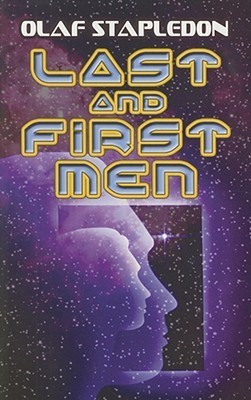
“No book before or since has ever had such an impact upon my imagination,” declared Arthur C. Clarke of Last and First Men. This masterpiece of science fiction by British philosopher and writer Olaf Stapledon (1886–1950) is an imaginative, ambitious history of humanity’s future that spans billions of years. Together with its follow-up, Star Maker, it is regarded as the standard by which all earlier and later future histories are measured.
The protagonist of this compelling novel is humanity itself, stripped down to sheer intelligence. It evolves through the ages: rising to pinnacles of civilization, teetering on the brink of extinction, surviving onslaughts from other planets and a decline in solar energy, and constantly developing new forms, new senses, and new intellectual abilities. From the present to five billion years into the future, this romance of humanity abounds in profound and imaginative thought.
One moment a man sits on a suburban hill, gazing curiously at the stars. The next, he is whirling through the firmament, and perhaps the most remarkable of all science fiction journeys has begun.
Even Stapledon's other great work, LAST AND FIRST MEN, pales in ambition next to STAR MAKER, which presents nothing less than an entire imagined history of life in the universe, encompassing billions of years.
In 1941, Astounding Science Fiction magazine published a short story by a little-known writer named Isaac Asimov. The story was called "Nightfall", and many years later it has long been recognized as a classic, its author a legend. Now, the Grand Master of Science Fiction teams with Robert Silverberg, one of the field's top award-winning authors, to explore and expand an apocalyptic tale that is more spellbinding today than ever before -- Nightfall: The Novel.
Imagine living on a planet with six suns that never experiences darkness. Imagine never having seen the stars. Then, one by one the suns start to set, gradually leading into darkness for the first time ever. Kalgash is a world on the edge of chaos, torn between the madness of religious fanaticism and the unyielding rationalism of scientists. Lurking beneath it all is a collective, instinctual fear of the Darkness. For Kalgash knows only the perpetual light of day; to its inhabitants, a gathering twilight portends unspeakable horror. And only a handful of people on the planet are prepared to face the truth, their six suns are setting all at once for the first time in over two thousand years, signaling the end of civilization as it explodes in the awesome splendor of Nightfall.
Encompassing the psychology of disaster, the tenacity of the human spirit, and, ultimately, the regenerative power of hope, Nightfall is a tale rich in character and suspense that only the unique collaboration of Isaac Asimov and Robert Silverberg could create.
Fraa Erasmas is a young avout living in the Concent of Saunt Edhar, a sanctuary for mathematicians, scientists, and philosophers, protected from the corrupting influences of the outside "saecular" world by ancient stone, honored traditions, and complex rituals. Over the centuries, cities and governments have risen and fallen beyond the concent's walls. Three times during history's darkest epochs violence born of superstition and ignorance has invaded and devastated the cloistered mathic community. Yet the avout have always managed to adapt in the wake of catastrophe, becoming out of necessity even more austere and less dependent on technology and material things. And Erasmas has no fear of the outside—the Extramuros—for the last of the terrible times was long, long ago.
Now, in celebration of the week-long, once-in-a-decade rite of Apert, the fraas and suurs prepare to venture beyond the concent's gates—at the same time opening them wide to welcome the curious "extras" in. During his first Apert as a fraa, Erasmas eagerly anticipates reconnecting with the landmarks and family he hasn't seen since he was "collected." But before the week is out, both the existence he abandoned and the one he embraced will stand poised on the brink of cataclysmic change.
Powerful unforeseen forces jeopardize the peaceful stability of mathic life and the established ennui of the Extramuros—a threat that only an unsteady alliance of saecular and avout can oppose—as, one by one, Erasmas and his colleagues, teachers, and friends are summoned forth from the safety of the concent in hopes of warding off global disaster. Suddenly burdened with a staggering responsibility, Erasmas finds himself a major player in a drama that will determine the future of his world—as he sets out on an extraordinary odyssey that will carry him to the most dangerous, inhospitable corners of the planet . . . and beyond.
Librarian's Note: Alternate cover edition available here.
Simak's City is a series of connected stories, a series of legends, myths, and campfire stories told by Dogs about the end of human civilization, centering on the Webster family, who, among their other accomplishments, designed the ships that took Men to the stars and gave Dogs the gift of speech and robots to be their hands.
The Shadow of the Torturer is the tale of young Severian, an apprentice in the Guild of Torturers on the world called Urth, exiled for committing the ultimate sin of his profession -- showing mercy toward his victim.
The Claw of the Conciliator continues the saga of Severian, banished from his home, as he undertakes a mythic quest to discover the awesome power of an ancient relic, and learn the truth about his hidden destiny.
The Book of the New Sun is unanimously acclaimed as Gene Wolfe's most remarkable work, hailed as "a masterpiece of science fantasy comparable in importance to the major works of Tolkien and Lewis" by Publishers Weekly, and "one of the most ambitious works of speculative fiction in the twentieth century" by The Magazine of Fantasy and Science Fiction. Shadow & Claw brings together the first two books of the tetralogy in one volume.
The award-winning masterpiece by one of today’s most honored writers! The Word for World is ForestWhen the inhabitants of a peaceful world are conquered by the bloodthirsty yumens, their existence is irrevocably altered. Forced into servitude, the Athsheans find themselves at the mercy of their brutal masters. Desperation causes the Athsheans, led by Selver, to retaliate against their captors, abandoning their strictures against violence. But in defending their lives, they have endangered the very foundations of their society. For every blow against the invaders is a blow to the humanity of the Athsheans. And once the killing starts, there is no turning back. At the publisher's request, this title is being sold without Digital Rights Management software (DRM) applied.
Ursula K. Le Guin's Always Coming Home is a major work of the imagination from one of America's most respected writers. More than five years in creation, it is a novel unlike any other.
A rich and complex interweaving of story and fable, poem, artwork, and music, it totally immerses the reader in the culture of the Kesh, a peaceful people of the far future who inhabit a place called the Valley on the Northern Pacific Coast. The author makes the inhabitants of the valley as familiar, as immediate, as wholly human as our own friends or family.
Spiraling outward from the dramatic life story of a woman called Stone Telling, Le Guin's Always Coming Home interweaves wry wit, deep insight and extraordinary compassion into a compelling unity of vision.
Philip K. Dick was a master of science fiction, but he was also a writer whose work transcended genre to examine the nature of reality and what it means to be human. A writer of great complexity and subtle humor, his work belongs on the shelf of great twentieth-century literature, next to Kafka and Vonnegut. Collected here are twenty-one of Dick's most dazzling and resonant stories, which span his entire career and show a world-class writer working at the peak of his powers.
In "The Days of Perky Pat," people spend their time playing with dolls who manage to live an idyllic life no longer available to the Earth's real inhabitants. "Adjustment Team" looks at the fate of a man who by mistake has stepped out of his own time. In "Autofac," one community must battle benign machines to take back control of their lives. And in "I Hope I Shall Arrive Soon," we follow the story of one man whose very reality may be nothing more than a nightmare. The collection also includes such classic stories as "The Minority Report," the basis for the Steven Spielberg movie, and "We Can Remember It for You Wholesale," the basis for the film Total Recall. Selected Stories of Philip K. Dick is a magnificent distillation of one of American literature's most searching imaginations.
» Introduction by Jonathan Lethem 1. Beyond Lies the Wub (wikipedia) 2. Roog (wikipedia) 3. Paycheck (wikipedia, imdb) 4. Second Variety (wikipedia, imdb) 5. Imposter (wikipedia) 6. The King of the Elves (wikipedia, imdb) 7. Adjustment Team (wikipedia, imdb) 8. Foster, You're Dead! (wikipedia) 9. Upon the Dull Earth (wikipedia) 10. Autofac (wikipedia) 11. The Minority Report (wikipedia, imdb) 12. The Days of Perky Pat (wikipedia) 13. Precious Artifact 14. A Game of Unchance 15. We Can Remember It for You Wholesale (wikipedia, imdb) 16. Faith of Our Fathers (wikipedia) 17. The Electric Ant (wikipedia) 18. A Little Something for Us Tempunauts (wikipedia) 19. The Exit Door Leads In (wikipedia) 20. Rautavaara's Case (wikipedia) 21. I Hope I Shall Arrive Soon (wikipedia)
Welcome Back!
Track your reading progress and sync your library.