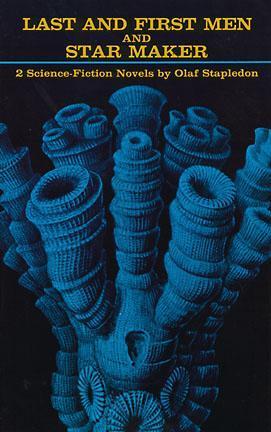
The greatest future histories in science fiction. In Last and First Men the protagonist is “mankind” in an ultimate definition — intelligence. Star Maker , in a sense its sequel, is concerned with the history of intelligence in the entire cosmos.
The Shadow of the Torturer is the tale of young Severian, an apprentice in the Guild of Torturers on the world called Urth, exiled for committing the ultimate sin of his profession -- showing mercy toward his victim.
The Claw of the Conciliator continues the saga of Severian, banished from his home, as he undertakes a mythic quest to discover the awesome power of an ancient relic, and learn the truth about his hidden destiny.
The Book of the New Sun is unanimously acclaimed as Gene Wolfe's most remarkable work, hailed as "a masterpiece of science fantasy comparable in importance to the major works of Tolkien and Lewis" by Publishers Weekly, and "one of the most ambitious works of speculative fiction in the twentieth century" by The Magazine of Fantasy and Science Fiction. Shadow & Claw brings together the first two books of the tetralogy in one volume.
In the overcrowded world and cramped space colonies of the late 21st century, tedium can be endured through the drug Can-D, which enables users to inhabit a shared illusory world. When industrialist Palmer Eldritch returns from an interstellar trip, he brings with him a new drug, Chew-Z. It is far more potent than Can-D, but threatens to plunge the world into a permanent state of drugged illusion controlled by the mysterious Eldritch.
On the arid colony of Mars the only thing more precious than water may be a ten-year-old schizophrenic boy named Manfred Steiner. For although the UN has slated 'anomalous' children for deportation and destruction, other people—especially Supreme Goodmember Arnie Kott of the Water Workers' union—suspect that Manfred's disorder may be a window into the future.
But what sort of future? And what happens to those unfortunates whom Manfred ushers into it? In Martian Time-Slip Philip K. Dick uses power politics and extraterrestrial real estate scams, adultery, and murder to penetrate the mysteries of being and time.
Nebula Award Reality has come unglued and a mad civilization takes root in Bellona, in this science fiction classic.
A young half–Native American known as the Kid has hitchhiked from Mexico to the midwestern city Bellona—only something is wrong there . . . In Bellona, the shattered city, a nameless cataclysm has left reality unhinged. Into this desperate metropolis steps the Kid, his fist wrapped in razor-sharp knives, to write, to love, to wound.
So begins Dhalgren , Samuel R. Delany’s masterwork, which in 1975 opened a new door for what science fiction could mean. A labyrinth of a novel, it raises questions about race, sexuality, identity, and art, but gives no easy answers, in a city that reshapes itself with each step you take . . .
This ebook features an illustrated biography of Samuel R. Delany including rare images from his early career.
Ragle Gumm is an ordinary man leading an ordinary life, except that he makes his living by entering a newspaper contest every day - and winning, every day.
But he gradually begins to suspect that his life - indeed his whole world - is an illusion, constructed around him for the express purpose of keeping him docile and happy. But if that is the case, what is his real world like, and what is he actually doing every day when he thinks he is guessing 'Where Will The Little Green Man Be Next?'
In this genre-bending novel—among the first to have launched sci-fi into the arena of literature—one of the great imaginers of the twentieth century tells a story as mind-blowing as any controlled substance and as affecting as a glimpse into a stranger's soul.
There's Lone, the simpleton who can hear other people's thoughts and make a man blow his brains out just by looking at him. There's Janie, who moves things without touching them, and there are the teleporting twins, who can travel ten feet or ten miles. There's Baby, who invented an antigravity engine while still in the cradle, and Gerry, who has everything it takes to run the world except for a conscience. Separately, they are talented freaks. Together, they compose a single organism that may represent the next step in evolution, and the final chapter in the history of the human race.
As the protagonists of More Than Human struggle to find out who they are and whether they are meant to help humanity or destroy it, Theodore Sturgeon explores questions of power and morality, individuality and belonging, with suspense, pathos, and a lyricism rarely seen in science fiction.
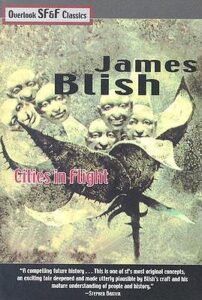
Originally published in four volumes nearly fifty years ago, Cities in Flight brings together the famed "Okie novels" of science fiction master James Blish. Named after the migrant workers of America's Dust Bowl, these novels convey Blish's "history of the future," a brilliant and bleak look at a world where cities roam the Galaxy looking for work and a sustainable way of life.
In the first novel, They Shall Have Stars, man has thoroughly explored the Solar System, yet the dream of going even further seems to have died in all but one man. His battle to realize his dream results in two momentous discoveries anti-gravity and the secret of immortality. In A Life for the Stars, it is centuries later and anti-gravity generations have enabled whole cities to lift off the surface of the earth to become galactic wanderers. In Earthman, Come Home, the nomadic cities revert to barbarism and marauding rogue cities begin to pose a threat to all civilized worlds. In the final novel, The Triumph of Time, history repeats itself as the cities once again journey back in to space making a terrifying discovery which could destroy the entire Universe. A serious and haunting vision of our world and its limits, Cities in Flight marks the return to print of one of science fiction's most inimitable writers.
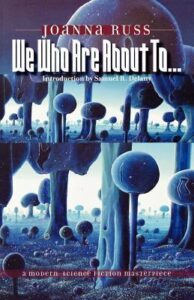
A multi-dimensional explosion hurls the starship's few passengers across the galaxies and onto an uncharted barren tundra. With no technical skills and scant supplies, the survivors face a bleak end in an alien world. One brave woman holds the daring answer, but it is the most desperate one possible.
Elegant and electric, We Who Are About To... brings us face to face with our basic assumptions about our will to live. While most of the stranded tourists decide to defy the odds and insist on colonizing the planet and creating life, the narrator decides to practice the art of dying. When she is threatened with compulsory reproduction, she defends herself with lethal force. Originally published in 1977, this is one of the most subtle, complex, and exciting science fiction novels ever written about the attempt to survive a hostile alien environment. It is characteristic of Russ's genius that such a readable novel is also one of her most intellectually intricate.
Welcome Back!
Track your reading progress and sync your library.