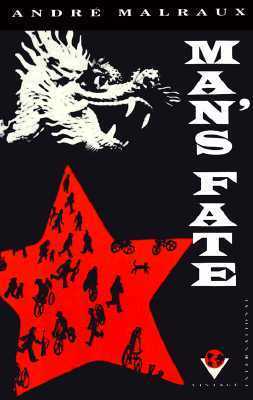
As explosive and immediate today as when it was first published in 1933, ‘Man’s Fate’ (‘La Condition Humaine’), an account of a crucial episode in the early days of the Chinese Revolution, foreshadows the contemporary world and brings to life the profound meaning of the revolutionary impulse for the individuals involved.
As a study of conspiracy and conspirators, of men caught in the desperate clash of ideologies, betrayal, expediency, and of free will, Andre Malraux’s novel remains unequaled.
Published in 1942 by French author Albert Camus, The Stranger has long been considered a classic of twentieth-century literature. Le Monde ranks it as number one on its "100 Books of the Century" list. Through this story of an ordinary man unwittingly drawn into a senseless murder on a sundrenched Algerian beach, Camus explores what he termed "the nakedness of man faced with the absurd."
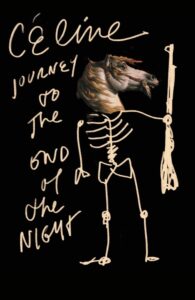
Louis-Ferdinand Celine's revulsion and anger at what he considered the idiocy and hypocrisy of society explodes from nearly every page of this novel. Filled with slang and obscenities and written in raw, colloquial language, Journey to the End of the Night is a literary symphony of violence, cruelty and obscene nihilism. This book shocked most critics when it was first published in France in 1932, but quickly became a success with the reading public in Europe, and later in America where it was first published by New Directions in 1952. The story of the improbable yet convincingly described travels of the petit-bourgeois (and largely autobiographical) antihero, Bardamu, from the trenches of World War I, to the African jungle, to New York and Detroit, and finally to life as a failed doctor in Paris, takes the readers by the scruff and hurtles them toward the novel's inevitable, sad conclusion.
Jean-Baptiste Clamence is a soul in turmoil. Over several drunken nights in an Amsterdam bar, he regales a chance acquaintance with his story. From this successful former lawyer and seemingly model citizen a compelling, self-loathing catalogue of guilt, hypocrisy and alienation pours forth.
The Fall (French: La Chute) is a philosophical novel by Albert Camus. First published in 1956, it is his last complete work of fiction. The Fall explores themes of innocence, imprisonment, non-existence, and truth. In a eulogy to Albert Camus, existentialist philosopher Jean-Paul Sartre described the novel as "perhaps the most beautiful and the least understood" of Camus' books.
The Plague is a novel by Albert Camus, published in 1947.
It tells the story from the point of view of a narrator of a plague sweeping the French Algerian city of Oran. The narrator remains unknown until the start of the last chapter, chapter 5 of part 5. The novel presents a snapshot of life in Oran as seen through the author's distinctive absurdist point of view.
The book tells a gripping tale of human unrelieved horror, of survival and resilience, and of the ways in which humankind confronts death, The Plague is at once a masterfully crafted novel, eloquently understated and epic in scope, and a parable of ageless moral resonance, profoundly relevant to our times. In Oran, a coastal town in North Africa, the plague begins as a series of portents, unheeded by the people. It gradually becomes an omnipresent reality, obliterating all traces of the past and driving its victims to almost unearthly extremes of suffering, madness, and compassion.
The Plague is considered an existentialist classic despite Camus' objection to the label. The novel stresses the powerlessness of the individual characters to affect their destinies. The narrative tone is similar to Kafka's, especially in The Trial, whose individual sentences potentially have multiple meanings; the material often pointedly resonating as stark allegory of phenomenal consciousness and the human condition.
Marcel Proust’s In Search of Lost Time is one of the most entertaining reading experiences in any language and arguably the finest novel of the twentieth century. But since its original prewar translation there has been no completely new version in English. Now, Penguin Classics brings Proust’s masterpiece to new audiences throughout the world, beginning with Lydia Davis’s internationally acclaimed translation of the first volume, Swann’s Way.
The elegant, haunting story of the forgotten people and places of Paris from the reigning Nobel Laureate.
Four narrators, a student from a café, a private detective hired by an aggrieved husband, the heroine herself and one of her lovers, construct a portrait of Jacqueline Delanque, otherwise known as Louki.
The daughter of a single mother who works in the Moulin Rouge, Louki grows up in poverty in Montmartre. Her one attempt to escape her background fails when she is rejected from the Lycée Jules-Ferry. She meanders on through life, into a cocaine habit, and begins frequenting the Café Condé, whose regulars call her "Louki". She drifts into marriage with a real estate agency director, but finds no satisfaction with him or his friends and so makes the simple decision not to return to him one evening. She turns instead to a young man almost as aimless and adrift as she, but who perhaps loves her all the same.
Ever-present through this story is the city of Paris, almost another character in her own right. This is the Paris of 'no-man's-lands', of lonely journeys on the last metro, or nocturnal walks along empty boulevards; of cafés where the lost youth wander in, searching for meaning, and the older generation sift through their memories of their own long-gone adolescence.
Handsome, ambitious Julien Sorel is determined to rise above his humble provincial origins. Soon realizing that success can only be achieved by adopting the subtle code of hypocrisy by which society operates, he begins to achieve advancement through deceit and self-interest. His triumphant career takes him into the heart of glamorous Parisian society, along the way conquering the gentle, married Madame de Rênal, and the haughty Mathilde. But then Julien commits an unexpected, devastating crime - and brings about his own downfall. The Red and the Black is a lively, satirical portrayal of French society after Waterloo, riddled with corruption, greed, and ennui, and Julien - the cold exploiter whose Machiavellian campaign is undercut by his own emotions - is one of the most intriguing characters in European literature.
Roger Gard's fine translation remains faithful to the natural, conversational tone of the original, while his introduction elucidates the complexities of Julien's character. This edition also contains a chronology, further reading and an appendix on Stendhal's use of epigraphs.
The Age of Reason is set in 1938 and tells of Mathieu, a French professor of philosophy who is obsessed with the idea of freedom. As the shadows of the Second World War draw closer -- even as his personal life is complicated by his mistress's pregnancy -- his search for a way to remain free becomes more and more intense.
Welcome Back!
Track your reading progress and sync your library.