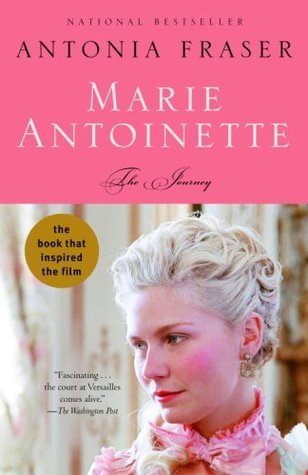
Marie Antoinette’s dramatic life-story continues to arouse mixed emotions. To many people, she is still ‘la reine méchante’, whose extravagance and frivolity helped to bring down the French monarchy; her indifference to popular suffering epitomised by the (apocryphal) words: ‘let them eat cake’. Others are equally passionate in her defence: to them, she is a victim of misogyny.
Antonia Fraser examines her influence over the king, Louis XVI, the accusations and sexual slurs made against her, her patronage of the arts which enhanced French cultural life, her imprisonment, the death threats made against her, rumours of lesbian affairs, her trial (during which her young son was forced to testify to sexual abuse by his mother) and her eventual execution by guillotine in 1793.
Jeannette Walls's memoir The Glass Castle was "nothing short of spectacular" (Entertainment Weekly). Now, in Half Broke Horses, she brings us the story of her grandmother, told in a first-person voice that is authentic, irresistible, and triumphant.
"Those old cows knew trouble was coming before we did." So begins the story of Lily Casey Smith, Jeannette Walls's no nonsense, resourceful, and spectacularly compelling grandmother. By age six, Lily was helping her father break horses. At fifteen, she left home to teach in a frontier town -- riding five hundred miles on her pony, alone, to get to her job. She learned to drive a car ("I loved cars even more than I loved horses. They didn't need to be fed if they weren't working, and they didn't leave big piles of manure all over the place") and fly a plane. And, with her husband Jim, she ran a vast ranch in Arizona. She raised two children, one of whom is Jeannette's memorable mother, Rosemary Smith Walls, unforgettably portrayed in The Glass Castle.
Lily survived tornadoes, droughts, floods, the Great Depression, and the most heartbreaking personal tragedy. She bristled at prejudice of all kinds -- against women, Native Americans, and anyone else who didn't fit the mold. Rosemary Smith Walls always told Jeannette that she was like her grandmother, and in this true-life novel, Jeannette Walls channels that kindred spirit. Half Broke Horses is Laura Ingalls Wilder for adults, as riveting and dramatic as Isak Dinesen's Out of Africa or Beryl Markham's West with the Night. Destined to become a classic, it will transfix audiences everywhere.
In her lifetime it was widely said that there were three political powers in Europe—Britain, Russia, and Madame de Stäel. Byron described her as "the first female writer of this, perhaps of any age," Germaine de Stäel was certainly the most remarkable woman of her time and she remains unique—both for the scope of her artistic and intellectual achievements, and the force of her political influence which helped to bring down Napoleon. Born in Paris in 1766, the daughter of Jacques Necker, Louis XVI's influential and reforming finance minister, Germaine de Stäel was brought up in her mother's salon, amidst the philosophers of the French Enlightenment. A prodigious and disciplined intellect, a need for love and a love of liberty, together with remarkable courage in both public and private life, de Stäel was driven to disregard dangers and conventions alike, often at great cost.
Discovered in the attic where she spent the final years of her life, Anne Frank’s Diary has become a timeless classic; a powerful reminder of the horrors of war and a moving testament to the resilience of the human spirit.
In 1942, as the Nazis occupied Holland, thirteen-year-old Anne Frank and her Jewish family fled their home in Amsterdam and went into hiding. For the next two years, until they were betrayed to the Gestapo, the Franks and another family lived in the cramped “Secret Annexe” of an old office building. Cut off from the outside world, they endured hunger, boredom, the strain of close quarters, and the constant fear of discovery and death.
Through it all, Anne documented her experiences in a diary filled with vivid observations. At times thoughtful, poignant, and even unexpectedly funny, her writing offers a remarkable window into the strength and vulnerability of the human spirit. It’s both a compelling self-portrait of a bright, spirited young woman and a heartbreaking glimpse of a life that should have been far longer.
On the occasion of the twenty-fifth anniversary of its first publication, here is the definitive edition of the book acclaimed as “the most affecting and successful narrative ever done about the Holocaust” (Wall Street Journal) and “the first masterpiece in comic book history” (The New Yorker).
The Pulitzer Prize-winning Maus tells the story of Vladek Spiegelman, a Jewish survivor of Hitler’s Europe, and his son, a cartoonist coming to terms with his father’s story. Maus approaches the unspeakable through the diminutive. Its form, the cartoon (the Nazis are cats, the Jews mice), shocks us out of any lingering sense of familiarity and succeeds in “drawing us closer to the bleak heart of the Holocaust” (The New York Times).
Maus is a haunting tale within a tale. Vladek’s harrowing story of survival is woven into the author’s account of his tortured relationship with his aging father. Against the backdrop of guilt brought by survival, they stage a normal life of small arguments and unhappy visits. This astonishing retelling of our century’s grisliest news is a story of survival, not only of Vladek but of the children who survive even the survivors. Maus studies the bloody pawprints of history and tracks its meaning for all of us.
At first glance, Bill Bryson seems an odd choice to write this addition to the Eminent Lives series.
The author of 'The Life and Times of the Thunderbolt Kid' isn't, after all, a Shakespeare scholar, a playwright, or even a biographer.
Reading 'Shakespeare The World As Stage', however, one gets the sense that this eclectic Iowan is exactly the type of person the Bard himself would have selected for the task.
The man who gave us 'The Mother Tongue' and 'A Walk in the Woods' approaches Shakespeare with the same freedom of spirit and curiosity that made those books such reader favorites. A refreshing take on an elusive literary master.
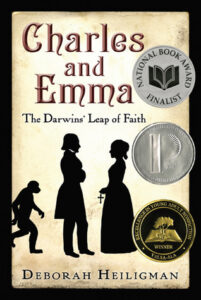
Charles Darwin published The Origin of Species, his revolutionary tract on evolution and the fundamental ideas involved, in 1859. Nearly 150 years later, the theory of evolution continues to create tension between the scientific and religious communities. Challenges about teaching the theory of evolution in schools occur annually all over the country. This same debate raged within Darwin himself, and played an important part in his marriage: his wife, Emma, was quite religious, and her faith gave Charles a lot to think about as he worked on a theory that continues to spark intense debates.
Deborah Heiligman's new biography of Charles Darwin is a thought-provoking account of the man behind evolutionary theory: how his personal life affected his work and vice versa. The end result is an engaging exploration of history, science, and religion for young readers.
Charles and Emma is a 2009 National Book Award Finalist for Young People's Literature.
Pulitzer Prize winner Massie offers the tale of a princess who went to Russia at 14 and became one of the most powerful women in history. Born into minor German nobility, she transformed herself into an empress by sheer determination. Possessing a brilliant, curious mind, she devoured the works of Enlightenment philosophers, and reaching the throne, tried using their principles to rule the vast, backward empire. She knew or corresponded with notable figures of her time: Voltaire, Diderot, Frederick the Great, Maria Theresa of Austria, Marie Antoinette & John Paul Jones. Wanting to be the “benevolent despot” Montesquieu idealized, she contended with the deeply ingrained realities of Russian life, including serfdom. She persevered, and for 34 years the government, foreign policy, cultural development and welfare of the Russian people were in her hands. She dealt with domestic rebellion, wars & the tides of political change and violence inspired by the French Revolution. Her reputation depended on the perspective of the speaker. She was praised by Voltaire as like the classical philosophers. She was condemned by enemies, mostly foreign, as “the Messalina of the north.” Her family, friends, ministers, generals, lovers and enemies are vividly described. These included her ambitious, scheming mother; her weak, bullying husband, Peter (who left her sexually untouched for nine years after their marriage); her unhappy son & heir, Paul; her beloved grandchildren; and her favorites—the young men from whom she sought companionship and the recapture of youth as well as sex. Here, too, is Gregory Potemkin, her most significant lover & possible husband, with whom she shared a correspondence of love & separation, followed by 17 years of unparalleled mutual achievement. All the qualities that Massie brought to Nicholas & Alexandra and Peter the Great are present: historical accuracy, deep understanding, felicity of style, mastery of detail, ability to shatter myth & a genius for finding and expressing a human drama.
On a May afternoon in 1943, an Army Air Forces bomber crashed into the Pacific Ocean and disappeared, leaving only a spray of debris and a slick of oil, gasoline, and blood. Then, on the ocean surface, a face appeared. It was that of a young lieutenant, the plane's bombardier, who was struggling to a life raft and pulling himself aboard. So began one of the most extraordinary odysseys of the Second World War.
The lieutenant’s name was Louis Zamperini. In boyhood, he'd been a cunning and incorrigible delinquent, breaking into houses, brawling, and fleeing his home to ride the rails. As a teenager, he had channeled his defiance into running, discovering a prodigious talent that had carried him to the Berlin Olympics and within sight of the four-minute mile. But when war had come, the athlete had become an airman, embarking on a journey that led to his doomed flight, a tiny raft, and a drift into the unknown.
Ahead of Zamperini lay thousands of miles of open ocean, leaping sharks, a foundering raft, thirst and starvation, enemy aircraft, and, beyond, a trial even greater. Driven to the limits of endurance, Zamperini would answer desperation with ingenuity; suffering with hope, resolve, and humor; brutality with rebellion. His fate, whether triumph or tragedy, would be suspended on the fraying wire of his will.
Welcome Back!
Track your reading progress and sync your library.