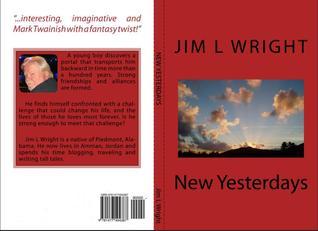
A young boy stumbles into a portal that transports him back in time more than a hundred years. The longer he stays, the stronger the bonds of friendship grow. Soon, he finds himself faced with a challenge that could change his life, and the lives of the ones he loves most forever. Will he be able to meet this challenge? This story presents a unique view of the life of the Cherokee Indians in the years leading up to the Great Removal and the Trail of Tears. Factual historical information and characters are used to make the story more real and entertaining.
The St. Louis World’s Fair, 1904: A miniature city of palaces and pavilions that becomes a backdrop for romance, betrayal—and murder. Cousins Grace and Lillie have been best friends since birth, despite Grace’s vastly inferior social status ever since her mother married for love instead of wealth. When Lillie invites Grace to the biggest event of the century—the legendary World’s Fair, also known as “The Ivory City”—Grace hopes her fortunes might be about to change. But when a member of their party is brutally killed at the fair, and suspicion falls on Lillie’s brother Oliver, Grace must prove Oliver’s innocence before her beloved cousins’ family is ruined forever. Along the way, she'll discover that the city’s wealthy elite—including Oliver’s handsome but irritable friend Theodore—aren’t quite who they appear to be. And amidst the glitz, glamor, and magic of the Ivory City lurks a danger that just may claim her life.
Orphaned at an early age, Philip Ashley is raised by his benevolent older cousin, Ambrose. Resolutely single, Ambrose delights in Philip as his heir, a man who will love his grand home as much as he does himself. But the cosy world the two construct is shattered when Ambrose sets off on a trip to Florence. There he falls in love and marries - and there he dies suddenly. Jealous of his marriage, racked by suspicion at the hints in Ambrose's letters, and grief-stricken by his death, Philip prepares to meet his cousin's widow with hatred in his heart. Despite himself, Philip is drawn to this beautiful, sophisticated, mysterious Rachel like a moth to the flame. And yet... might she have had a hand in Ambrose's death?
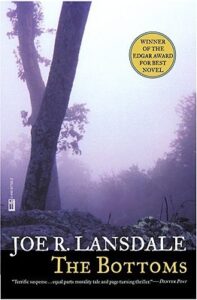
The narrator of The Bottoms is Harry Collins, an old man obsessively reflecting on certain key experiences of his childhood. In 1933, the year that forms the centerpiece of the narrative, Harry is 11 years old and living with his mother, father, and younger sister on a farm outside of Marvel Creek, Texas, near the Sabine River bottoms. Harry's world changes forever when he discovers the corpse of a young black woman tied to a tree in the forest near his home. The woman, who is eventually identified as a local prostitute, has been murdered, molested, and sexually mutilated. She is also, as Harry will soon discover, the first in a series of similar corpses, all of them the victims of a new, unprecedented sort of monster: a traveling serial killer.
From his privileged position as the son of constable (and farmer and part-time barber) Jacob Collins, Harry watches as the distinctly amateur investigation unfolds. As more bodies -- not all of them "colored" -- surface, the mood of the local residents darkens. Racial tensions -- never far from the surface, even in the best of times -- gradually kindle. When circumstantial evidence implicates an ancient, innocent black man named Mose, the Ku Klux Klan mobilizes, initiating a chilling, graphically described lynching that will occupy a permanent place in Harry Collins's memories. With Mose dead and the threat to local white women presumably put to rest, the residents of Marvel Creek resume their normal lives, only to find that the actual killer remains at large and continues to threaten the safety and stability of the town.
Lansdale uses this protracted murder investigation to open up a window on an insular, poverty-stricken, racially divided community. With humor, precision, and great narrative economy, he evokes the society of Marvel Creek in all its alternating tawdriness and nobility, offering us a varied, absolutely convincing portrait of a world that has receded into history. At the same time, he offers us a richly detailed re-creation of the vibrant, dangerous physical landscapes that were part of that world and have since been buried under the concrete and cement of the industrialized juggernaut of the late 20th century. In Lansdale's hands, the gritty realities of Depression-era Texas are as authentic -- and memorable -- as anything in recent American fiction.
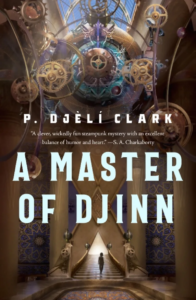
Nebula, Locus, and Alex Award-winner P. Djèlí Clark returns to his popular alternate Cairo universe for his fantasy novel debut, A Master of Djinn
Cairo, 1912: Though Fatma el-Sha’arawi is the youngest woman working for the Ministry of Alchemy, Enchantments and Supernatural Entities, she’s certainly not a rookie, especially after preventing the destruction of the universe last summer.
So when someone murders a secret brotherhood dedicated to one of the most famous men in history, al-Jahiz, Agent Fatma is called onto the case. Al-Jahiz transformed the world 50 years ago when he opened up the veil between the magical and mundane realms, before vanishing into the unknown. This murderer claims to be al-Jahiz, returned to condemn the modern age for its social oppressions. His dangerous magical abilities instigate unrest in the streets of Cairo that threaten to spill over onto the global stage.
Alongside her Ministry colleagues and her clever girlfriend Siti, Agent Fatma must unravel the mystery behind this imposter to restore peace to the city -or face the possibility he could be exactly who he seems…
It's 1843, and Grace Marks has been convicted for her involvement in the vicious murders of her employer and his housekeeper and mistress. Some believe Grace is innocent; others think her evil or insane. Now serving a life sentence, Grace claims to have no memory of the murders.
An up-and-coming expert in the burgeoning field of mental illness is engaged by a group of reformers and spiritualists who seek a pardon for Grace. He listens to her story while bringing her closer and closer to the day she cannot remember. What will he find in attempting to unlock her memories?
Captivating and disturbing, Alias Grace showcases best-selling, Booker Prize-winning author Margaret Atwood at the peak of her powers.
A foundling, an old book of dark fairy tales, a secret garden, an aristocratic family, a love denied, and a mystery. The Forgotten Garden is a captivating, atmospheric and compulsively readable story of the past, secrets, family and memory from the international best-selling author Kate Morton.
Cassandra is lost, alone and grieving. Her much loved grandmother, Nell, has just died and Cassandra, her life already shaken by a tragic accident ten years ago, feels like she has lost everything dear to her. But an unexpected and mysterious bequest from Nell turns Cassandra’s life upside down and ends up challenging everything she thought she knew about herself and her family.
Inheriting a book of dark and intriguing fairytales written by Eliza Makepeace—the Victorian authoress who disappeared mysteriously in the early twentieth century—Cassandra takes her courage in both hands to follow in the footsteps of Nell on a quest to find out the truth about their history, their family and their past; little knowing that in the process, she will also discover a new life for herself.
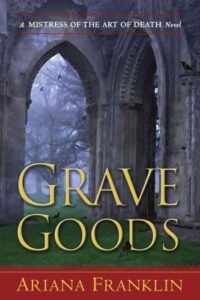
Combining the best of modern forensic thrillers with the drama of medieval fiction, New York Times' bestselling author Ariana Franklin returns with the third title in the Mistress of the Art of Death series.
England, 1176. Beautiful, tranquil Glastonbury Abbey—one of England's holiest sites, and believed by some to be King Arthur's sacred Isle of Avalon—has been burned almost to the ground. The arsonist remains at large, but the fire has uncovered something even more shocking: two hidden skeletons, a man and a woman. The skeletons' height and age send rumors flying- are the remains those of Arthur and Guinevere?
King Henry II hopes so. Struggling to put down a rebellion in Wales, where the legend of Celtic savior Arthur is particularly strong, Henry wants definitive proof that the bones are Arthur's. If the rebels are sure that the Once and Future King will not be coming to their aid, Henry can stamp out the insurgence for good. He calls on Adelia Aguilar, Mistress of the Art of Death, to examine the bones.
Henry's summons comes not a moment too soon, for Adelia has worn out her welcome in Cambridge. As word of her healing powers has spread, so have rumors of witchcraft. So Adelia and her household ride to Glastonbury, where the investigation into the abbey fire will be overseen by the Church authorities—in this case, the Bishop of St. Albans, who happens also to be the father of Adelia's daughter.
1975 is a time of change in America. The Vietnam War is ending. Mohammed Ali is fighting Joe Frazier. And in the small town of Monta Clare, Missouri, girls are disappearing.
When the daughter of a wealthy family is targeted, the most unlikely hero emerges—Patch, a local boy with one eye, who saves the girl, and, in doing so, leaves heartache in his wake.
Patch and those who love him soon discover that the line between triumph and tragedy has never been finer. And that their search for answers will lead them to truths that could mean losing one another.
A missing person mystery, a serial killer thriller, a love story, a unique twist on each, Chris Whitaker has written a novel about what lurks in the shadows of obsession, and the blinding light of hope.
Welcome Back!
Track your reading progress and sync your library.