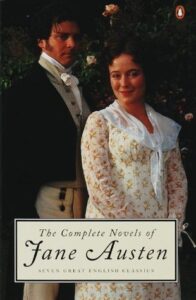
Since its immediate success in 1813, Pride and Prejudice has remained one of the most popular novels in the English language. Jane Austen called this brilliant work “her own darling child” and its vivacious heroine, Elizabeth Bennet, “as delightful a creature as ever appeared in print.” The romantic clash between the opinionated Elizabeth and her proud beau, Mr. Darcy, is a splendid performance of civilized sparring. And Jane Austen’s radiant wit sparkles as her characters dance a delicate quadrille of flirtation and intrigue, making this book the most superb comedy of manners of Regency England.
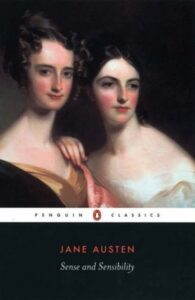
'The more I know of the world, the more am I convinced that I shall never see a man whom I can really love. I require so much!'
Marianne Dashwood wears her heart on her sleeve, and when she falls in love with the dashing but unsuitable John Willoughby she ignores her sister Elinor's warning that her impulsive behaviour leaves her open to gossip and innuendo. Meanwhile Elinor, always sensitive to social convention, is struggling to conceal her own romantic disappointment, even from those closest to her. Through their parallel experience of love—and its threatened loss—the sisters learn that sense must mix with sensibility if they are to find personal happiness in a society where status and money govern the rules of love.
This edition includes explanatory notes, textual variants between the first and second editions, and Tony Tanner's introduction to the original Penguin Classic edition.
The newest edition is here. Another alternate cover can be found here.
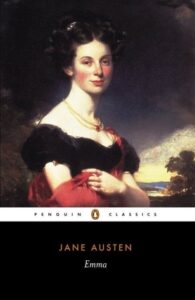
Emma Woodhouse is one of Austen's most captivating and vivid characters. Beautiful, spoilt, vain and irrepressibly witty, Emma organizes the lives of the inhabitants of her sleepy little village and plays matchmaker with devastating effect.
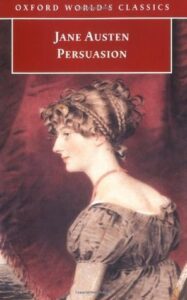
Persuasion is Jane Austen's last completed novel. She began it soon after she had finished Emma, completing it in August 1816. She died, aged 41, in 1817; Persuasion was published in December that year (but dated 1818). Persuasion is linked to Northanger Abbey not only by the fact that the two books were originally bound up in one volume and published together, but also because both stories are set partly in Bath, a fashionable city with which Austen was well acquainted, having lived there from 1801 to 1805. Besides the theme of persuasion, the novel evokes other topics, such as the Royal Navy, in which two of Jane Austen's brothers ultimately rose to the rank of admiral. As in Northanger Abbey, the superficial social life of Bath-well known to Austen, who spent several relatively unhappy and unproductive years there-is portrayed extensively and serves as a setting for the second half of the book. In many respects Persuasion marks a break with Austen's previous works, both in the more biting, even irritable satire directed at some of the novel's characters and in the regretful, resigned outlook of its otherwise admirable heroine, Anne Elliot, in the first part of the story. Against this is set the energy and appeal of the Royal Navy, which symbolises for Anne and the reader the possibility of a more outgoing, engaged, and fulfilling life, and it is this worldview which triumphs for the most part at the end of the novel.
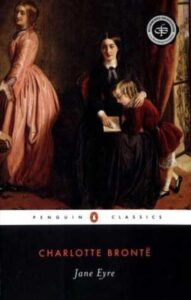
A gothic masterpiece of tempestuous passions and dark secrets, Charlotte Brontë's Jane Eyre is edited with an introduction and notes by Stevie Davis in Penguin Classics.
Charlotte Brontë tells the story of orphaned Jane Eyre, who grows up in the home of her heartless aunt, enduring loneliness and cruelty. This troubled childhood strengthens Jane's natural independence and spirit - which prove necessary when she finds employment as a governess to the young ward of Byronic, brooding Mr Rochester. As her feelings for Rochester develop, Jane gradually uncovers Thornfield Hall's terrible secret, forcing her to make a choice. Should she stay with Rochester and live with the consequences, or follow her convictions - even if it means leaving the man she loves? A novel of intense power and intrigue, Jane Eyre dazzled readers with its passionate depiction of a woman's search for equality and freedom.
Scarlett O'Hara, the beautiful, spoiled daughter of a well-to-do Georgia plantation owner, must use every means at her disposal to claw her way out of the poverty she finds herself in after Sherman's March to the Sea.
Few novelists have conveyed the subtleties and nuances of their own social milieu with the wit and insight of Jane Austen. Through her vivacious and spirited heroines and their circle, she paints vivid portraits of English middle-class life as the eighteenth century came to a close. Each of the novels is a love story and a story about marriage — marriage for love, for financial security, for social status. But they are not mere romances; ironic, comic and wise, they are masterly studies of the society Jane Austen observed. The seven novels in this volume contain some of the most brilliant, dazzling prose in the English language. --back cover
Emma / Lady Susan / Mansfield Park / Northanger Abbey / Persuasion / Pride and Prejudice / Sense and Sensibility
Taken from the poverty of her parents' home in Portsmouth, Fanny Price is brought up with her rich cousins at Mansfield Park, acutely aware of her humble rank and with her cousin Edmund as her sole ally. During her uncle's absence in Antigua, the Crawford's arrive in the neighbourhood bringing with them the glamour of London life and a reckless taste for flirtation. Mansfield Park is considered Jane Austen's first mature work and, with its quiet heroine and subtle examination of social position and moral integrity, one of her most profound.
You can find the redesigned cover of this edition HERE.
At the centre of this novel is the passionate love between Catherine Earnshaw and Heathcliff - recounted with such emotional intensity that a plain tale of the Yorkshire moors acquires the depth and simplicity of ancient tragedy.
This best-selling Norton Critical Edition is based on the 1847 first edition of the novel. For the Fourth Edition, the editor has collated the 1847 text with several modern editions and has corrected a number of variants, including accidentals. The text is accompanied by entirely new explanatory annotations.
New to the fourth Edition are twelve of Emily Bronte's letters regarding the publication of the 1847 edition of Wuthering Heights as well as the evolution of the 1850 edition, prose and poetry selections by the author, four reviews of the novel, and poetry selections by the author, four reviews of the novel, and Edward Chitham's insightful and informative chronology of the creative process behind the beloved work.
Five major critical interpretations of Wuthering Heights are included, three of them new to the Fourth Edition. A Stuart Daley considers the importance of chronology in the novel. J. Hillis Miller examines Wuthering Heights's problems of genre and critical reputation. Sandra M. Gilbert assesses the role of Victorian Christianity plays in the novel, while Martha Nussbaum traces the novel's romanticism. Finally, Lin Haire-Sargeant scrutinizes the role of Heathcliff in film adaptations of Wuthering Heights.
A Chronology and updated Selected Bibliography are also included.
Welcome Back!
Track your reading progress and sync your library.