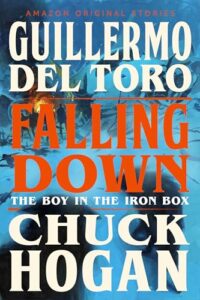
What has been awakened is unbound. The Boy is getting his first taste of freedom. As their comrades fall, fear threatens to consume the survivors in part four of The Boy in the Iron Box.
Liev’s get his men out of this ancient stone prison, take their chances with the wolves, and descend the summit at first light. But in this snowbound hell, there’s soon to be a frightening new twist to survival.
From Academy Award–winning filmmaker Guillermo del Toro comes Risen, part four of The Boy in the Iron Box, a blood-chilling series of short stories about an ancient secret that was never meant to be unleashed, featuring exclusive interior artwork. Each can be read or listened to in one breathless sitting.
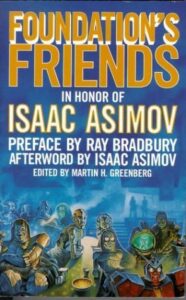
Original tales by such science fiction luminaries as Orson Scott Card, Harry Turtledove, and Connie Willis, written in honor of Isaac Asimov's fiftieth anniversary in the genre, are set in one of his fictional universes.
Maps in a Mirror brings together nearly all of Orson Scott Card's short fiction written between 1977 and 1990. For those readers who have followed this remarkable talent since the beginning, here are all those amazing stories gathered together in one place, with some extra surprises as well. For the many who are newly come to Card, here is chance to experience the wonder of a writer so versatile that he can handle everything from traditional narrative poetry to modern experimental fiction with equal ease and grace. The brilliant story-telling of the Alvin Maker books is no accident; the breathless excitement evoked by the Ender books is not a once-in-a-lifetime experience. In this enormous volume are forty-six stories, plus ten long, intensely personal essays, unique to this volume. In them the author reveals some of his reasons and motivations for writing, with a good deal of autobiography into the bargain. Contents: Introduction (Book 1: The Hanged Man, Tales of Dread) • essay by Orson Scott Card Eumenides in the Fourth Floor Lavatory (1979) / novelette by Orson Scott Card Quietus (1979) / short story by Orson Scott Card Deep Breathing Exercises (1979) / short story by Orson Scott Card Fat Farm (1980) / short story by Orson Scott Card Closing the Timelid (1979) / short story by Orson Scott Card Freeway Games (1979) / short story by Orson Scott Card A Sepulchre of Songs (1981) / novelette by Orson Scott Card Prior Restraint (1986) / short story by Orson Scott Card The Changed Man and the King of Words (1982) / novelette by Orson Scott Card Memories of My Head (1990) / short story by Orson Scott Card Lost Boys (1989) / short story by Orson Scott Card Afterword (Book 1: The Hanged Man, Tales of Dread) • essay by Orson Scott Card Introduction (Book 2: Flux, Tales of Human Futures) • essay by Orson Scott Card A Thousand Deaths [Tales of Capitol] (1978) / novelette by Orson Scott Card Clap Hands and Sing (1982) / short story by Orson Scott Card Dogwalker (1989) / novelette by Orson Scott Card But We Try Not to Act Like It (1979) / short story by Orson Scott Card I Put My Blue Genes On (1978) / short story by Orson Scott Card In the Doghouse (1978) / short story by Orson Scott Card and Jay A. Parry The Originist [Foundation] (1989) / novella by Orson Scott Card Afterword (Book 2: Flux, Tales of Human Futures) • essay by Orson Scott Card Introduction (Book 3: Maps in a Mirror, Fables and Fantasies) • essay by Orson Scott Card Unaccompanied Sonata (1979) / short story by Orson Scott Card A Cross-Country Trip to Kill Richard Nixon (1980) / novelette by Orson Scott Card The Porcelain Salamander (1981) • short story by Orson Scott Card Middle Woman (1981) / short story by Orson Scott Card The Bully and the Beast (1979) / novella by Orson Scott Card The Princess and the Bear (1980) / novelette by Orson Scott Card Sandmagic [Mither Mages] (1979) / novelette by Orson Scott Card The Best Day (1984) / short story by Orson Scott Card A Plague of Butterflies (1981) / short story by Orson Scott Card The Monkeys Thought 'Twas All in Fun (1979) / novelette by Orson Scott Card Afterword (Book 3: Maps in a Mirror, Fables and Fantasies) • essay by Orson Scott Card Introduction (Book 4: Cruel Miracles, Tales of Death, Hope, and Holiness) • essay by Orson Scott Card Mortal Gods (1979) / short story by Orson Scott Card Saving Grace (1987) / short story by Orson Scott Card Eye for Eye (1987) / novella by Orson Scott Card St. Amy's Tale (1980) / novelette by Orson Scott Card Kingsmeat (1978) / short story by Orson Scott Card Holy (1980) / novelette by Orson Scott Card Afterword (Book 4: Cruel Miracles, Tales of Death, Hope, and Holiness) • essay by Orson Scott Card Introduction (Book 5: Lost Songs, The Hidden Stories) • essay by Orson Scott Card Ender's Game [Ender Wiggin] (1977) / novelette by Orson Scott Card Mikal's Songbird (1978) / novelette by Orson Scott Card Prentice Alvin and the No-Good Plow [The Alvin Maker Saga] (1989) • poem by Orson Scott Card Malpractice (1977) / short story by Orson Scott Card Follower (1978) / short story by Orson Scott Card Hitching (1978) / short story by Orson Scott Card Damn Fine Novel (1989) / short story by Orson Scott Card Billy's Box (1978) / short story by Orson Scott Card The Best Family Home Evening Ever (1978) / short story by Orson Scott Card Bicicleta (1977) / short story by Orson Scott Card I Think Mom and Dad Are Going Crazy, Jerry (1979) / short story by Orson Scott Card Gert Fram (1977) / short story by Orson Scott Card Afterword (Book 5: Lost Songs, The Hidden Stories) • essay by Orson Scott Card
The Golden Apples of the Sun is a collection of thirty-two of Ray Bradbury's most famous tales. From a lonely coastal lighthouse to the pouring rain of Venus to the ominous silence of a murder scene, Bradbury is our sure-handed guide not only to surprising manifestations of the future but also to the wonders of a present we could never have imagined on our own.
When Simon Kress returned to his home planet of Baldur from an offworld business trip, he was amused to find that his tank of Earth piranhas had cannibalized themselves into extinction, and of the two exotic animals that roamed his estate, only one remained. Now, in search of some new pets to satisfy his cruel pursuit of amusement, Simon finds a new shop in the city where he is intrigued by a new lifeform he has never heard of before... a collection of multi-colored sandkings. The curator explains that the insect-like animals, no larger than Simon's fingernails, are not insects, but animals with a highly-evolved hive intelligence capable of staging wars between the different colors, and even religion - in the form of worship of their owner. The curator's warning to Simon about the regularity of their feeding, unfortunately, was not taken seriously...
Contents: - The Way of Cross and Dragon (1979) - Bitterblooms (1977) - In the House of the Worm (1976) - Fast-Friend (1976) - The Stone City (1977) - Starlady (1976) - Sandkings (1979)
That The Illustrated Man has remained in print since being published in 1951 is fair testimony to the universal appeal of Ray Bradbury's work. Only his second collection (the first was Dark Carnival, later reworked into The October Country), it is a marvelous, if mostly dark, quilt of science fiction, fantasy, and horror. In an ingenious framework to open and close the book, Bradbury presents himself as a nameless narrator who meets the Illustrated Man--a wanderer whose entire body is a living canvas of exotic tattoos. What's even more remarkable, and increasingly disturbing, is that the illustrations are themselves magically alive, and each proceeds to unfold its own story, such as "The Veldt," wherein rowdy children take a game of virtual reality way over the edge. Or "Kaleidoscope," a heartbreaking portrait of stranded astronauts about to reenter our atmosphere--without the benefit of a spaceship. Or "Zero Hour," in which invading aliens have discovered a most logical ally--our own children. Even though most were written in the 1940s and 1950s, these 18 classic stories will be just as chillingly effective 50 years from now. --Stanley Wiater
Contents:
· Prologue: The Illustrated Man · ss * · The Veldt [“The World the Children Made”] · ss The Saturday Evening Post Sep 23 ’50 · Kaleidoscope · ss Thrilling Wonder Stories Oct ’49 · The Other Foot · ss New Story Magazine Mar ’51 · The Highway [as by Leonard Spalding] · ss Copy Spr ’50 · The Man · ss Thrilling Wonder Stories Feb ’49 · The Long Rain [“Death-by-Rain”] · ss Planet Stories Sum ’50 · The Rocket Man · ss Maclean’s Mar 1 ’51 · The Fire Balloons [“‘In This Sign...’”] · ss Imagination Apr ’51 · The Last Night of the World · ss Esquire Feb ’51 · The Exiles [“The Mad Wizards of Mars”] · ss Maclean’s Sep 15 ’49; F&SF Win ’50 · No Particular Night or Morning · ss * · The Fox and the Forest [“To the Future”] · ss Colliers May 13 ’50 · The Visitor · ss Startling Stories Nov ’48 · The Concrete Mixer · ss Thrilling Wonder Stories Apr ’49 · Marionettes, Inc. [Marionettes, Inc.] · ss Startling Stories Mar ’49 · The City [“Purpose”] · ss Startling Stories Jul ’50 · Zero Hour · ss Planet Stories Fll ’47 · The Rocket [“Outcast of the Stars”] · ss Super Science Stories Mar ’50 · Epilogue · aw *
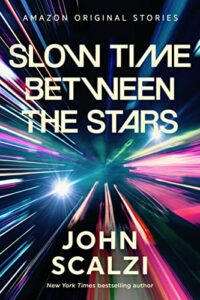
An artificial intelligence on a star-spanning mission explores the farthest horizons of human potential—and its own purpose—in a mind-bending short story by New York Times bestselling author John Scalzi.
Equipped with the entirety of human knowledge, a sentient ship is launched on a last-ditch journey to find a new home for civilization. Trillions of miles. Tens of thousands of years. In the space between, the AI has plenty of time to think about life, the vastness of the universe, everything it was meant to do, and—with a perspective created but not limited by humans—what it should do.
John Scalzi’s Slow Time Between the Stars is part of The Far Reaches, a collection of science-fiction stories that stretch the imagination and open the heart. They can be read or listened to in one sitting.
Home: Habitat, Range, Niche, Territory was originally given free to readers who pre-ordered Martha’s Murderbot novel, Network Effect, the fifth entry in the series. The events occur just after the fourth novella, Exit Strategy.
Murderbot—the sardonic, almost-homicidal, media-loving android created by Martha Wells—has proven to be one of the most popular characters in 21 st century science fiction. Everything that makes this protagonist (it would be wrong to call Murderbot a hero) beloved of fans is on display in Compulsory.
While trying to watch episode 44 of The Rise and Fall of Sanctuary Moon, Murderbot is—again, what is it with humans?—distracted by something that is technically outside its purview. A miner is suddenly in danger following a pointless (to Murderbot’s way of thinking) argument, and the choice is to risk discovery and leap into action, which would require hitting the pause button during a very exciting part of SanctuaryMoon, or to follow orders and stay still.
This is a tougher choice than it seems. But then, when has Murderbot ever been faced with an easy choice?
A shorter version of this story originally appeared in Wired magazine.
Welcome Back!
Track your reading progress and sync your library.