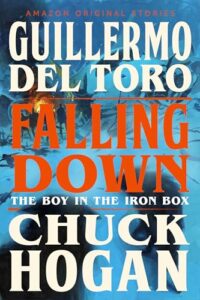
What has been awakened is unbound. The Boy is getting his first taste of freedom. As their comrades fall, fear threatens to consume the survivors in part four of The Boy in the Iron Box.
Liev’s get his men out of this ancient stone prison, take their chances with the wolves, and descend the summit at first light. But in this snowbound hell, there’s soon to be a frightening new twist to survival.
From Academy Award–winning filmmaker Guillermo del Toro comes Risen, part four of The Boy in the Iron Box, a blood-chilling series of short stories about an ancient secret that was never meant to be unleashed, featuring exclusive interior artwork. Each can be read or listened to in one breathless sitting.
Murderbot—the sardonic, almost-homicidal, media-loving android created by Martha Wells—has proven to be one of the most popular characters in 21 st century science fiction. Everything that makes this protagonist (it would be wrong to call Murderbot a hero) beloved of fans is on display in Compulsory.
While trying to watch episode 44 of The Rise and Fall of Sanctuary Moon, Murderbot is—again, what is it with humans?—distracted by something that is technically outside its purview. A miner is suddenly in danger following a pointless (to Murderbot’s way of thinking) argument, and the choice is to risk discovery and leap into action, which would require hitting the pause button during a very exciting part of SanctuaryMoon, or to follow orders and stay still.
This is a tougher choice than it seems. But then, when has Murderbot ever been faced with an easy choice?
A shorter version of this story originally appeared in Wired magazine.
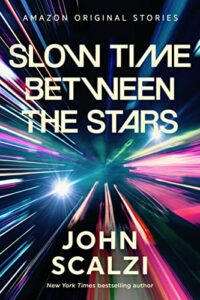
An artificial intelligence on a star-spanning mission explores the farthest horizons of human potential—and its own purpose—in a mind-bending short story by New York Times bestselling author John Scalzi.
Equipped with the entirety of human knowledge, a sentient ship is launched on a last-ditch journey to find a new home for civilization. Trillions of miles. Tens of thousands of years. In the space between, the AI has plenty of time to think about life, the vastness of the universe, everything it was meant to do, and—with a perspective created but not limited by humans—what it should do.
John Scalzi’s Slow Time Between the Stars is part of The Far Reaches, a collection of science-fiction stories that stretch the imagination and open the heart. They can be read or listened to in one sitting.
- Stability - Roog - The Little Movement - Beyond Lies the Wub - The Gun - The Skull - The Defenders - Mr. Spaceship - Piper in the Woods - The Infinites - The Preserving Machine - Expendable - The Variable Man - The Indefatigable Frog - The Crystal Crypt - The Short Happy Life of the Brown Oxford - The Builder - Meddler - Paycheck - The Great C - Out in the Garden - The King of the Elves - Colony - Prize Ship - Nanny
Other editions of this volume have the same list of stories, and were published under these titles: - The Short Happy Life of the Brown Oxford, - Paycheck and Other Classic Stories, - The King of the Elves (+1 extra story).
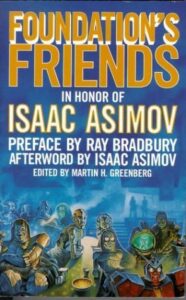
Original tales by such science fiction luminaries as Orson Scott Card, Harry Turtledove, and Connie Willis, written in honor of Isaac Asimov's fiftieth anniversary in the genre, are set in one of his fictional universes.
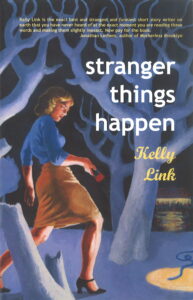
This first collection by award-winning author Kelly Link takes fairy tales and cautionary tales, dictators and extraterrestrials, amnesiacs and honeymooners, revenants and readers alike, on a voyage into new, strange, and wonderful territory. The girl detective must go to the underworld to solve the case of the tap-dancing bank robbers. A librarian falls in love with a girl whose father collects artificial noses. A dead man posts letters home to his estranged wife. Two women named Louise begin a series of consecutive love affairs with a string of cellists. A newly married couple become participants in an apocalyptic beauty pageant. Sexy blond aliens invade New York City. A young girl learns how to make herself disappear.
These eleven extraordinary stories are quirky, spooky, and smart. They all have happy endings. Every story contains a secret prize. Each story was written especially for you.
Stories from Stranger Things Happen have won the Nebula, Tiptree, and World Fantasy Award. Stranger Things Happen was a Salon Book of the Year, one of the Village Voice's 25 Favorite Books of 2001, and was nominated for the Firecracker Alternative Book Award.
Contents: - Carnation, Lily, Lily, Rose (1998) - Water Off a Black Dog's Back (1995) - The Specialist's Hat (1998) - Flying Lessons (1995) - Travels with the Snow Queen (1996/1997) - Vanishing Act (1996) - Survivor's Ball, or, The Donner Party (1998) - Shoe and Marriage (2000) - Most of My Friends Are Two-Thirds Water (2001) - Louise's Ghost (2001) - The Girl Detective (1999)
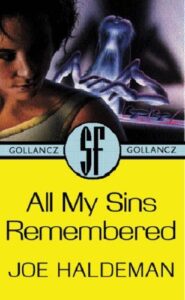
Otto McGavin is peaceful and idealistic by nature, an Anglo-Buddhist, who seeks employment with the Confederacion because he believes in it and its mission to protect the rights of humans and nonhumans. The only problem is that the Confederacion needs him as a Prime Operator for its secret service, the TBII, and the TBII wants Otto as a spy, a thief and an assassin. It's not, of course, a problem for the Confederacion, which simply uses immersion therapy and hypnosis for Otto's training, and then sends him out in deep cover on a variety of dangerous missions on a number of bizarre worlds. But for Otto, it's a different what he has to witness and what he is forced to do take a terrible toll on him ...
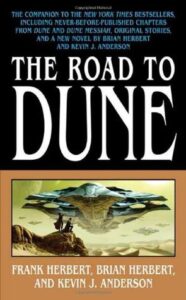
Frank Herbert's Dune is widely known as the science fiction equivalent of The Lord of the Rings. Now The Road to Dune is a companion work comparable to The Silmarillion, shedding light on and following the remarkable development of the bestselling science fiction novel of all time.
In this fascinating volume, the world's millions of Dune fans can read--at long last--the unpublished chapters and scenes from Dune and Dune Messiah. The Road to Dune also includes some of the original correspondence between Frank Herbert and famed editor John W. Campbell, Jr., along with other correspondence during Herbert's years-long struggle to get his innovative work published, and the article "They Stopped the Moving Sands," Herbert's original inspiration for Dune.
The Road to Dune also features newly discovered papers and manuscripts of Frank Herbert, and Spice Planet, an original novel by Brian Herbert and Kevin J. Anderson, based on a detailed outline left by Frank Herbert.
The Road to Dune is a treasure trove of essays, articles, and fiction that every reader of Dune will want to add to their shelf.
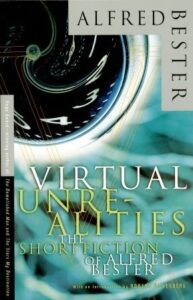
Alfred Bester took science fiction into hyperdrive, endowing it with a wit, speed, and narrative inventiveness that have inspired two generations of writers. And nowhere is Bester funnier, speedier, or more audacious than in these seventeen short stories—two of them previously unpublished—that have now been brought together in a single volume for the first time.
Read about the sweet-natured young man whose phenomenal good luck turns out to be disastrous for the rest of humanity. Find out why tourists are flocking to a hellish little town in a post-nuclear Kansas. Meet a warlock who practices on Park Avenue and whose potions comply with the Pure Food and Drug Act. Make a deal with the Devil—but not without calling your agent. Dazzling, effervescent, sexy, and sardonic, Virtual Unrealities is a historic collection from one of science fiction's true pathbreakers.
CONTENTS: Disappearing Act Oddy and Id Star Light, Star Bright (1953) 5,271,009 (1954) Fondly Fahrenheit (1954) Hobson's Choice (1952) Of Time and Third Avenue (1952) Time is the Traitor (1953) The Men Who Murdered Mohammed (1958) The Pi Man (1959) They Don't Make Life Like They Used To (1963) Will You Wait? (1959) The Flowered Thundermug (1964) Adam and No Eve (1941) And 3 1/2 to Go Galatea Galante (1979) The Devil Without Glasses
Welcome Back!
Track your reading progress and sync your library.