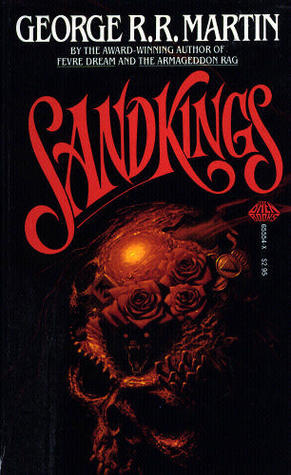
When Simon Kress returned to his home planet of Baldur from an offworld business trip, he was amused to find that his tank of Earth piranhas had cannibalized themselves into extinction, and of the two exotic animals that roamed his estate, only one remained. Now, in search of some new pets to satisfy his cruel pursuit of amusement, Simon finds a new shop in the city where he is intrigued by a new lifeform he has never heard of before… a collection of multi-colored sandkings. The curator explains that the insect-like animals, no larger than Simon’s fingernails, are not insects, but animals with a highly-evolved hive intelligence capable of staging wars between the different colors, and even religion – in the form of worship of their owner. The curator’s warning to Simon about the regularity of their feeding, unfortunately, was not taken seriously…
Contents: – The Way of Cross and Dragon (1979) – Bitterblooms (1977) – In the House of the Worm (1976) – Fast-Friend (1976) – The Stone City (1977) – Starlady (1976) – Sandkings (1979)
Maps in a Mirror brings together nearly all of Orson Scott Card's short fiction written between 1977 and 1990. For those readers who have followed this remarkable talent since the beginning, here are all those amazing stories gathered together in one place, with some extra surprises as well. For the many who are newly come to Card, here is chance to experience the wonder of a writer so versatile that he can handle everything from traditional narrative poetry to modern experimental fiction with equal ease and grace. The brilliant story-telling of the Alvin Maker books is no accident; the breathless excitement evoked by the Ender books is not a once-in-a-lifetime experience. In this enormous volume are forty-six stories, plus ten long, intensely personal essays, unique to this volume. In them the author reveals some of his reasons and motivations for writing, with a good deal of autobiography into the bargain. Contents: Introduction (Book 1: The Hanged Man, Tales of Dread) • essay by Orson Scott Card Eumenides in the Fourth Floor Lavatory (1979) / novelette by Orson Scott Card Quietus (1979) / short story by Orson Scott Card Deep Breathing Exercises (1979) / short story by Orson Scott Card Fat Farm (1980) / short story by Orson Scott Card Closing the Timelid (1979) / short story by Orson Scott Card Freeway Games (1979) / short story by Orson Scott Card A Sepulchre of Songs (1981) / novelette by Orson Scott Card Prior Restraint (1986) / short story by Orson Scott Card The Changed Man and the King of Words (1982) / novelette by Orson Scott Card Memories of My Head (1990) / short story by Orson Scott Card Lost Boys (1989) / short story by Orson Scott Card Afterword (Book 1: The Hanged Man, Tales of Dread) • essay by Orson Scott Card Introduction (Book 2: Flux, Tales of Human Futures) • essay by Orson Scott Card A Thousand Deaths [Tales of Capitol] (1978) / novelette by Orson Scott Card Clap Hands and Sing (1982) / short story by Orson Scott Card Dogwalker (1989) / novelette by Orson Scott Card But We Try Not to Act Like It (1979) / short story by Orson Scott Card I Put My Blue Genes On (1978) / short story by Orson Scott Card In the Doghouse (1978) / short story by Orson Scott Card and Jay A. Parry The Originist [Foundation] (1989) / novella by Orson Scott Card Afterword (Book 2: Flux, Tales of Human Futures) • essay by Orson Scott Card Introduction (Book 3: Maps in a Mirror, Fables and Fantasies) • essay by Orson Scott Card Unaccompanied Sonata (1979) / short story by Orson Scott Card A Cross-Country Trip to Kill Richard Nixon (1980) / novelette by Orson Scott Card The Porcelain Salamander (1981) • short story by Orson Scott Card Middle Woman (1981) / short story by Orson Scott Card The Bully and the Beast (1979) / novella by Orson Scott Card The Princess and the Bear (1980) / novelette by Orson Scott Card Sandmagic [Mither Mages] (1979) / novelette by Orson Scott Card The Best Day (1984) / short story by Orson Scott Card A Plague of Butterflies (1981) / short story by Orson Scott Card The Monkeys Thought 'Twas All in Fun (1979) / novelette by Orson Scott Card Afterword (Book 3: Maps in a Mirror, Fables and Fantasies) • essay by Orson Scott Card Introduction (Book 4: Cruel Miracles, Tales of Death, Hope, and Holiness) • essay by Orson Scott Card Mortal Gods (1979) / short story by Orson Scott Card Saving Grace (1987) / short story by Orson Scott Card Eye for Eye (1987) / novella by Orson Scott Card St. Amy's Tale (1980) / novelette by Orson Scott Card Kingsmeat (1978) / short story by Orson Scott Card Holy (1980) / novelette by Orson Scott Card Afterword (Book 4: Cruel Miracles, Tales of Death, Hope, and Holiness) • essay by Orson Scott Card Introduction (Book 5: Lost Songs, The Hidden Stories) • essay by Orson Scott Card Ender's Game [Ender Wiggin] (1977) / novelette by Orson Scott Card Mikal's Songbird (1978) / novelette by Orson Scott Card Prentice Alvin and the No-Good Plow [The Alvin Maker Saga] (1989) • poem by Orson Scott Card Malpractice (1977) / short story by Orson Scott Card Follower (1978) / short story by Orson Scott Card Hitching (1978) / short story by Orson Scott Card Damn Fine Novel (1989) / short story by Orson Scott Card Billy's Box (1978) / short story by Orson Scott Card The Best Family Home Evening Ever (1978) / short story by Orson Scott Card Bicicleta (1977) / short story by Orson Scott Card I Think Mom and Dad Are Going Crazy, Jerry (1979) / short story by Orson Scott Card Gert Fram (1977) / short story by Orson Scott Card Afterword (Book 5: Lost Songs, The Hidden Stories) • essay by Orson Scott Card
Harlan Ellison is probably best known as a script writer for sci-fi and fantasy movies and TV series such as the original Outer Limits, The Hunger, Logan's Run, and Babylon Five. But his range is much broader than that, encompassing stories, novels, essays, reviews, reminiscences, plays, even fake autobiographies. The Essential Ellison, a special limited edition personally signed and numbered by Ellison, contains 74 unabridged works, including such classics as "A Boy and His Dog," "Xenogenesis," and "Mefisto in Onyx."
Here are strange, beautiful stories covering the full spectrum of the late Roger Zelazny's remarkable talents. In Doors of His Face, The Lamps of His Mouth, Zelazny's rare ability to mix the dream-like, disturbing imagery of fantasy with the real-life hardware of science fiction is on full display. His vivid imagination and fine prose made him one of the most highly acclaimed writers in his field. Contents: · The Doors of His Face, the Lamps of His Mouth · nv F&SF Mar ’65 · The Keys to December · nv New Worlds Aug ’66 · Devil Car [Sam Nurdock] · ss Galaxy Jun ’65 · A Rose for Ecclesiastes · nv F&SF Nov ’63 · The Monster and the Maiden · vi Galaxy Dec ’64 · Collector’s Fever · vi Galaxy Jun ’64 · This Mortal Mountain · nv If Mar ’67 · This Moment of the Storm · nv F&SF Jun ’66 · The Great Slow Kings · ss Worlds of Tomorrow Dec ’63 · A Museum Piece · ss Fantastic Jun ’63 · Divine Madness · ss Magazine of Horror Sum ’66 · Corrida · ss Anubis v1 #3 ’68 · Love Is an Imaginary Number · ss New Worlds Jan ’66 · The Man Who Loved the Faioli · ss Galaxy Jun ’67 · Lucifer · ss Worlds of Tomorrow Jun ’64
The recipient of numerous literary prizes, including the National Book Award, the Kafka Award, and the Pushcart Prize, Ursula K. Le Guin is renowned for her lyrical writing, rich characters, and diverse worlds. The Wind's Twelve Quarters collects seventeen powerful stories, each with an introduction by the author, ranging from fantasy to intriguing scientific concepts, from medieval settings to the future.
Including an insightful foreword by Le Guin, describing her experience, her inspirations, and her approach to writing, this stunning collection explores human values, relationships, and survival, and showcases the myriad talents of one of the most provocative writers of our time.
Wizardry, transforming its master into a cloud of fine mist...cloning, duplicating the ideal man ten times over...Utopia, in a city where almost everyone is perfectly happy...
Ursula Le Guin, author of The Earthsea Trilogy, has a special way of blending stirring adventure with fantasy that has made comparison with such masters as C.S. Lewis and J.R.R. Tolkien inevitable.
Now, in The Wind's Twelve Quarters, seventeen of her favorite stories reaffirm Ursula Le Guin as one of America's outstanding writers.
CONTENTS:
Foreword Semley's Necklace April in Paris The Masters Darkness Box The Word of Unbinding The Rule of Names Winter's King The Good Trip Nine Lives Things A Trip to the Head Vaster than Empires and More Slow The Stars Below The Field of Vision Direction of the Road The Ones Who Walk Away from Omelas The Day Before the Revolution
That The Illustrated Man has remained in print since being published in 1951 is fair testimony to the universal appeal of Ray Bradbury's work. Only his second collection (the first was Dark Carnival, later reworked into The October Country), it is a marvelous, if mostly dark, quilt of science fiction, fantasy, and horror. In an ingenious framework to open and close the book, Bradbury presents himself as a nameless narrator who meets the Illustrated Man--a wanderer whose entire body is a living canvas of exotic tattoos. What's even more remarkable, and increasingly disturbing, is that the illustrations are themselves magically alive, and each proceeds to unfold its own story, such as "The Veldt," wherein rowdy children take a game of virtual reality way over the edge. Or "Kaleidoscope," a heartbreaking portrait of stranded astronauts about to reenter our atmosphere--without the benefit of a spaceship. Or "Zero Hour," in which invading aliens have discovered a most logical ally--our own children. Even though most were written in the 1940s and 1950s, these 18 classic stories will be just as chillingly effective 50 years from now. --Stanley Wiater
Contents:
· Prologue: The Illustrated Man · ss * · The Veldt [“The World the Children Made”] · ss The Saturday Evening Post Sep 23 ’50 · Kaleidoscope · ss Thrilling Wonder Stories Oct ’49 · The Other Foot · ss New Story Magazine Mar ’51 · The Highway [as by Leonard Spalding] · ss Copy Spr ’50 · The Man · ss Thrilling Wonder Stories Feb ’49 · The Long Rain [“Death-by-Rain”] · ss Planet Stories Sum ’50 · The Rocket Man · ss Maclean’s Mar 1 ’51 · The Fire Balloons [“‘In This Sign...’”] · ss Imagination Apr ’51 · The Last Night of the World · ss Esquire Feb ’51 · The Exiles [“The Mad Wizards of Mars”] · ss Maclean’s Sep 15 ’49; F&SF Win ’50 · No Particular Night or Morning · ss * · The Fox and the Forest [“To the Future”] · ss Colliers May 13 ’50 · The Visitor · ss Startling Stories Nov ’48 · The Concrete Mixer · ss Thrilling Wonder Stories Apr ’49 · Marionettes, Inc. [Marionettes, Inc.] · ss Startling Stories Mar ’49 · The City [“Purpose”] · ss Startling Stories Jul ’50 · Zero Hour · ss Planet Stories Fll ’47 · The Rocket [“Outcast of the Stars”] · ss Super Science Stories Mar ’50 · Epilogue · aw *
Introduction · Algis Budrys · in The Phantom of Kansas · nv Galaxy Feb ’76 Air Raid [as by Herb Boehm] · ss IASFM Spr ’77 Retrograde Summer · nv F&SF Feb ’75 The Black Hole Passes · nv F&SF Jun ’75 In the Hall of the Martian Kings · na F&SF Feb ’77 In the Bowl · nv F&SF Dec ’75 Gotta Sing, Gotta Dance · nv Galaxy Jul ’76 Overdrawn at the Memory Bank · nv Galaxy May ’76 The Persistence of Vision · na F&SF Mar ’78
The mind of Ray Bradbury is a wonder-filled carnival of delight and terror that stretches from the verdant Irish countryside to the coldest reaches of outer space. Yet all his work is united by one common thread: a vivid and profound understanding of the vast set of emotions that bring strength and mythic resonance to our frail species. Ray Bradbury characters may find themselves anywhere and anywhen. A horrified mother may give birth to a strange blue pyramid. A man may take Abraham Lincoln out of the grave—and meet another who puts him back. An amazing Electrical Grandmother may come to live with a grieving family. An old parrot may have learned over long evenings to imitate the voice of Ernest Hemingway, and became the last link to the great man. A priest on Mars may confront his fondest dream: to meet the Messiah. Each of these magnificent creations has something to tell us about our humanity—and all of their fates await you in this new trade edition of twenty-eight classic Bradbury stories and one luscious poem. Travel on an unpredictable and unforgettable literary journey—safe in the hands of one of the century's great men of imagination.
Welcome Back!
Track your reading progress and sync your library.