Somer’s life is everything she imagined it would be — she’s newly married and has started her career as a physician in San Francisco — until she makes the devastating discovery she never will be able to have children.
The same year in India, a poor mother makes the heartbreaking choice to save her newborn daughter’s life by giving her away. It is a decision that will haunt Kavita for the rest of her life, and cause a ripple effect that travels across the world and back again.
Asha, adopted out of a Mumbai orphanage, is the child that binds the destinies of these two women. We follow both families, invisibly connected until Asha’s journey of self-discovery leads her back to India.
Compulsively readable and deeply touching, SECRET DAUGHTER is a story of the unforeseen ways in which our choices and families affect our lives, and the indelible power of love in all its many forms.
In 1982, the oil rig Ocean Ranger sank off the coast of Newfoundland during a Valentine's night storm. In the early hours of the next morning, all 84 men aboard died. Helen O'Mara is one of those left behind when her husband, Cal, drowns. Her story starts years after the Ranger disaster, but she is compelled to travel back to the 'February' that persists in her mind, and to that moment in 1982 when, expecting a fourth child, she received the call informing her that Cal was lost at sea. A quarter of a century on, late one winter's night, Helen is woken by another phone call. It is her wayward son John, in another time zone, on his way home. He has made a girl pregnant and he needs his mother to decide what he should do. As John grapples with what it might mean to be a father, Helen realises that she must shake off her decades of mourning in order to help. With grace and precision, and a shocking ability to render the precise details of her characters' physical and emotional worlds, Lisa
Librarian's note: An alternate cover edition can be found here
Navigating between the Indian traditions they've inherited and the baffling new world, the characters in Jhumpa Lahiri's elegant, touching stories seek love beyond the barriers of culture and generations. In "A Temporary Matter," published in The New Yorker, a young Indian-American couple faces the heartbreak of a stillborn birth while their Boston neighborhood copes with a nightly blackout. In the title story, an interpreter guides an American family through the India of their ancestors and hears an astonishing confession. Lahiri writes with deft cultural insight reminiscent of Anita Desai and a nuanced depth that recalls Mavis Gallant.
Jhumpa Lahiri's Interpreter of Maladies established this young writer as one the most brilliant of her generation. Her stories are one of the very few debut works -- and only a handful of collections -- to have won the Pulitzer Prize for fiction. Among the many other awards and honors it received were the New Yorker Debut of the Year award, the PEN/Hemingway Award, and the highest critical praise for its grace, acuity, and compassion in detailing lives transported from India to America.
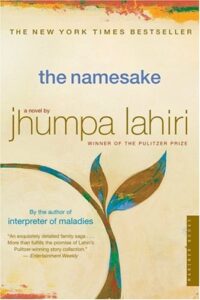
In The Namesake, Lahiri enriches the themes that made her collection an international bestseller: the immigrant experience, the clash of cultures, the conflicts of assimilation, and, most poignantly, the tangled ties between generations. Here again Lahiri displays her deft touch for the perfect detail — the fleeting moment, the turn of phrase — that opens whole worlds of emotion.
The Namesake takes the Ganguli family from their tradition-bound life in Calcutta through their fraught transformation into Americans. On the heels of their arranged wedding, Ashoke and Ashima Ganguli settle together in Cambridge, Massachusetts. An engineer by training, Ashoke adapts far less warily than his wife, who resists all things American and pines for her family. When their son is born, the task of naming him betrays the vexed results of bringing old ways to the new world. Named for a Russian writer by his Indian parents in memory of a catastrophe years before, Gogol Ganguli knows only that he suffers the burden of his heritage as well as his odd, antic name.
Lahiri brings great empathy to Gogol as he stumbles along the first-generation path, strewn with conflicting loyalties, comic detours, and wrenching love affairs. With penetrating insight, she reveals not only the defining power of the names and expectations bestowed upon us by our parents, but also the means by which we slowly, sometimes painfully, come to define ourselves.
Rohinton Mistry’s enthralling novel is at once a domestic drama and an intently observed portrait of present-day Bombay in all its vitality and corruption. At the age of seventy-nine, Nariman Vakeel, already suffering from Parkinson’s disease, breaks an ankle and finds himself wholly dependent on his family. His step-children, Coomy and Jal, have a spacious apartment (in the inaptly named Chateau Felicity), but are too squeamish and resentful to tend to his physical needs.
Nariman must now turn to his younger daughter, Roxana, her husband, Yezad, and their two sons, who share a small, crowded home. Their decision will test not only their material resources but, in surprising ways, all their tolerance, compassion, integrity, and faith. Sweeping and intimate, tragic and mirthful, Family Matters is a work of enormous emotional power.
A haunting novel about identity, love, and loss by the author of Three Day Road
Will Bird is a legendary Cree bush pilot, now lying in a coma in a hospital in his hometown of Moose Factory, Ontario. His niece Annie Bird, beautiful and self-reliant, has returned from her own perilous journey to sit beside his bed. Broken in different ways, the two take silent communion in their unspoken kinship, and the story that unfolds is rife with heartbreak, fierce love, ancient blood feuds, mysterious disappearances, fires, plane crashes, murders, and the bonds that hold a family, and a people, together. As Will and Annie reveal their secrets-the tragic betrayal that cost Will his family, Annie's desperate search for her missing sister, the famous model Suzanne-a remarkable saga of resilience and destiny takes shape. From the dangerous bush country of upper Canada to the drug-fueled glamour of the Manhattan club scene, Joseph Boyden tracks his characters with a keen eye for the telling detail and a rare empathy for the empty places concealed within the heart. Sure to appeal to readers of Louise Erdrich and Jim Harrison, Through Black Spruce establishes Boyden as a writer of startling originality and uncommon power.
From the internationally best-selling, Pulitzer Prize–winning author, a superbly crafted new work of fiction: eight stories—longer and more emotionally complex than any she has yet written—that take us from Cambridge and Seattle to India and Thailand as they enter the lives of sisters and brothers, fathers and mothers, daughters and sons, friends and lovers.
In the stunning title story, Ruma, a young mother in a new city, is visited by her father, who carefully tends the earth of her garden, where he and his grandson form a special bond. But he’s harboring a secret from his daughter, a love affair he’s keeping all to himself. In “A Choice of Accommodations,” a husband’s attempt to turn an old friend’s wedding into a romantic getaway weekend with his wife takes a dark, revealing turn as the party lasts deep into the night. In “Only Goodness,” a sister eager to give her younger brother the perfect childhood she never had is overwhelmed by guilt, anguish, and anger when his alcoholism threatens her family. And in “Hema and Kaushik,” a trio of linked stories—a luminous, intensely compelling elegy of life, death, love, and fate—we follow the lives of a girl and boy who, one winter, share a house in Massachusetts. They travel from innocence to experience on separate, sometimes painful paths, until destiny brings them together again years later in Rome.
Unaccustomed Earth is rich with Jhumpa Lahiri’s signature gifts: exquisite prose, emotional wisdom, and subtle renderings of the most intricate workings of the heart and mind. It is a masterful, dazzling work of a writer at the peak of her powers.
A gritty, heart-wrenching novel about bruised innocence on the city's feral streets—the remarkable debut of a stunning literary talent
Heather O'Neill dazzles with a first novel of extraordinary prescience and power, a subtly understated yet searingly effective story of a young life on the streets—and the strength, wits, and luck necessary for survival.
At thirteen, Baby vacillates between childhood comforts and adult temptation: still young enough to drag her dolls around in a vinyl suitcase yet old enough to know more than she should about urban cruelties. Motherless, she lives with her father, Jules, who takes better care of his heroin habit than he does of his daughter. Baby's gift is a genius for spinning stories and for cherishing the small crumbs of happiness that fall into her lap. But her blossoming beauty has captured the attention of a charismatic and dangerous local pimp who runs an army of sad, slavishly devoted girls—a volatile situation even the normally oblivious Jules cannot ignore. And when an escape disguised as betrayal threatens to crush Baby's spirit, she will ultimately realize that the power of salvation rests in her hands alone.
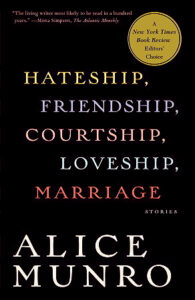
In the her tenth collection (the title story of which is the basis for the new film Hateship Loveship), Alice Munro achieves new heights, creating narratives that loop and swerve like memory, and conjuring up characters as thorny and contradictory as people we know ourselves.
A tough-minded housekeeper jettisons the habits of a lifetime because of a teenager’s practical joke. A college student visiting her brassy, unconventional aunt stumbles on an astonishing secret and its meaning in her own life. An incorrigible philanderer responds with unexpected grace to his wife’s nursing-home romance.
Hateship, Friendship, Courtship, Loveship, Marriage is Munro at her best, tirelessly observant, serenely free of illusion, deeply and gloriously humane.
Welcome Back!
Track your reading progress and sync your library.