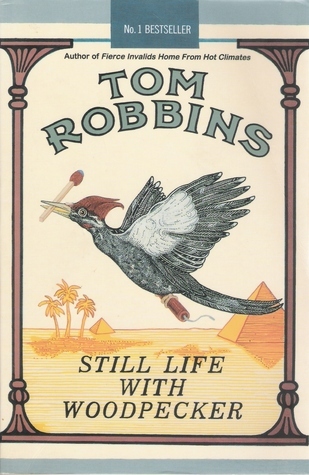
Still Life with Woodpecker is a sort of a love story that takes place inside a pack of Camel cigarettes. It reveals the purpose of the moon, explains the difference between criminals andoutlaws, examines the conflict between social activism and romantic individualism, and paints a portrait of contemporary society that includes powerful Arabs, exiled royalty, and pregnant cheerleaders. It also deals withthe problem of redheads. “From the Trade Paperback edition.”
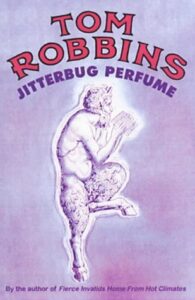
Jitterbug Perfume is an epic, which is to say, it begins in the forests of ancient Bohemia and doesn't conclude until nine o'clock tonight [Paris time]. It is a saga, as well. A saga must have a hero, and the hero of this one is a janitor with a missing bottle. The bottle is blue, very, very old, and embossed with the image of a goat-horned god. If the liquid in the bottle is actually is the secret essence of the universe, as some folks seem to think, it had better be discovered soon because it is leaking and there is only a drop or two left.
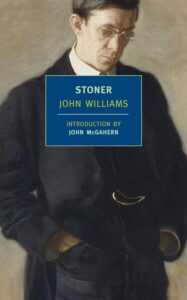
William Stoner is born at the end of the nineteenth century into a dirt-poor Missouri farming family. Sent to the state university to study agronomy, he instead falls in love with English literature and embraces a scholar’s life, so different from the hardscrabble existence he has known. And yet as the years pass, Stoner encounters a succession of disappointments: marriage into a “proper” family estranges him from his parents; his career is stymied; his wife and daughter turn coldly away from him; a transforming experience of new love ends under threat of scandal. Driven ever deeper within himself, Stoner rediscovers the stoic silence of his forebears and confronts an essential solitude.
John Williams’s luminous and deeply moving novel is a work of quiet perfection. William Stoner emerges from it not only as an archetypal American, but as an unlikely existential hero, standing, like a figure in a painting by Edward Hopper, in stark relief against an unforgiving world.
A gargantuan, mind-altering tragi-comedy about the Pursuit of Happiness in America.
Set in an addicts' halfway house and a tennis academy, and featuring the most endearingly screwed-up family to come along in recent fiction, Infinite Jest explores essential questions about what entertainment is and why it has come to so dominate our lives; about how our desire for entertainment affects our need to connect with other people; and about what the pleasures we choose say about who we are.
Equal parts philosophical quest and screwball comedy, Infinite Jest bends every rule of fiction without sacrificing for a moment its own entertainment value. It is an exuberant, uniquely American exploration of the passions that make us human—and one of those rare books that renew the idea of what a novel can do.
Horacio Oliveira is an Argentinian writer who lives in Paris with his mistress, La Maga, surrounded by a loose-knit circle of bohemian friends who call themselves "the Club." A child's death and La Maga's disappearance put an end to his life of empty pleasures and intellectual acrobatics, and prompt Oliveira to return to Buenos Aires, where he works by turns as a salesman, a keeper of a circus cat which can truly count, and an attendant in an insane asylum. Hopscotch is the dazzling, freewheeling account of Oliveira's astonishing adventures.
The book is highly influenced by Henry Miller’s reckless and relentless search for truth in post-decadent Paris and Daisetz Teitaro Suzuki’s modal teachings on Zen Buddhism.
Cortázar's employment of interior monologue, punning, slang, and his use of different languages is reminiscent of Modernist writers like Joyce, although his main influences were Surrealism and the French New Novel, as well as the "riffing" aesthetic of jazz and New Wave Cinema.
In 1966, Gregory Rabassa won the first National Book Award to recognize the work of a translator, for his English-language edition of Hopscotch. Julio Cortázar was so pleased with Rabassa's translation of Hopscotch that he recommended the translator to Gabriel García Márquez when García Márquez was looking for someone to translate his novel One Hundred Years of Solitude into English. "Rabassa's One Hundred Years of Solitude improved the original," according to García Márquez.
Cannery Row is a book without much of a plot. Rather, it is an attempt to capture the feeling and people of a place, the cannery district of Monterey, California, which is populated by a mix of those down on their luck and those who choose for other reasons not to live "up the hill" in the more respectable area of town. The flow of the main plot is frequently interrupted by short vignettes that introduce us to various denizens of the Row, most of whom are not directly connected with the central story. These vignettes are often characterized by direct or indirect reference to extreme violence: suicides, corpses, and the cruelty of the natural world.
The "story" of Cannery Row follows the adventures of Mack and the boys, a group of unemployed yet resourceful men who inhabit a converted fish-meal shack on the edge of a vacant lot down on the Row.
Giants in the Earth (Norwegian: Verdens Grøde) is a novel by Norwegian-American author Ole Edvart Rølvaag. First published in Norway as two books in 1924 and 1925, the author collaborated with Minnesotan Lincoln Colcord on the English translation.
The novel follows a Norwegian family's struggles as they try to make a new life as pioneers in the Dakota territory. Rølvaag is interested in psychology and the human cost of empire building, at a time when other writers focused on the glamor and romance of the West. The book reflects his personal experiences as a settler as well as the immigrant homesteader experience of his wife’s family. Both the grim realities of pioneering and the gloomy fatalism of the Norse mind are captured in depictions of snow storms, locusts, poverty, hunger, loneliness, homesickness, the difficulty of fitting into a new culture, and the estrangement of immigrant children who grow up in a new land. It is a novel at once palpably European and distinctly American.
Giants in the Earth was turned into an opera by Douglas Moore and Arnold Sundgaard; it won the Pulitzer Prize for Music in 1951.
Amidst disillusioned saints hiding in wrestling rings, mothers burnt by glowing halos, and a Baby Nostradamus who sees only blackness, a gang of flower pickers heads off to war, led by a lonely man who cannot help but wet his bed in sadness. Part memoir, part lies, this is a book about the wounds inflicted by first love and sharp objects.
An omnibus edition of three counterculture classics by Richard Brautigan that embody the spirit of the 1960s. Trout Fishing in America is by turns a hilarious, playful, and melancholy novel that wanders from San Francisco through America's rural waterways; In Watermelon Sugar expresses the mood of a new generation, revealing death as a place where people travel the length of their dreams, rejecting violence and hate; and The Pill Versus the Springhill Mine Disaster is a collection of nearly 100 poems, first published in 1968.
Welcome Back!
Track your reading progress and sync your library.