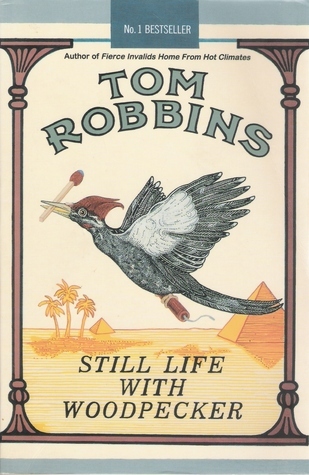
Still Life with Woodpecker is a sort of a love story that takes place inside a pack of Camel cigarettes. It reveals the purpose of the moon, explains the difference between criminals andoutlaws, examines the conflict between social activism and romantic individualism, and paints a portrait of contemporary society that includes powerful Arabs, exiled royalty, and pregnant cheerleaders. It also deals withthe problem of redheads. “From the Trade Paperback edition.”
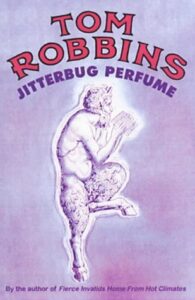
Jitterbug Perfume is an epic, which is to say, it begins in the forests of ancient Bohemia and doesn't conclude until nine o'clock tonight [Paris time]. It is a saga, as well. A saga must have a hero, and the hero of this one is a janitor with a missing bottle. The bottle is blue, very, very old, and embossed with the image of a goat-horned god. If the liquid in the bottle is actually is the secret essence of the universe, as some folks seem to think, it had better be discovered soon because it is leaking and there is only a drop or two left.
Amidst disillusioned saints hiding in wrestling rings, mothers burnt by glowing halos, and a Baby Nostradamus who sees only blackness, a gang of flower pickers heads off to war, led by a lonely man who cannot help but wet his bed in sadness. Part memoir, part lies, this is a book about the wounds inflicted by first love and sharp objects.
Horacio Oliveira is an Argentinian writer who lives in Paris with his mistress, La Maga, surrounded by a loose-knit circle of bohemian friends who call themselves "the Club." A child's death and La Maga's disappearance put an end to his life of empty pleasures and intellectual acrobatics, and prompt Oliveira to return to Buenos Aires, where he works by turns as a salesman, a keeper of a circus cat which can truly count, and an attendant in an insane asylum. Hopscotch is the dazzling, freewheeling account of Oliveira's astonishing adventures.
The book is highly influenced by Henry Miller’s reckless and relentless search for truth in post-decadent Paris and Daisetz Teitaro Suzuki’s modal teachings on Zen Buddhism.
Cortázar's employment of interior monologue, punning, slang, and his use of different languages is reminiscent of Modernist writers like Joyce, although his main influences were Surrealism and the French New Novel, as well as the "riffing" aesthetic of jazz and New Wave Cinema.
In 1966, Gregory Rabassa won the first National Book Award to recognize the work of a translator, for his English-language edition of Hopscotch. Julio Cortázar was so pleased with Rabassa's translation of Hopscotch that he recommended the translator to Gabriel García Márquez when García Márquez was looking for someone to translate his novel One Hundred Years of Solitude into English. "Rabassa's One Hundred Years of Solitude improved the original," according to García Márquez.
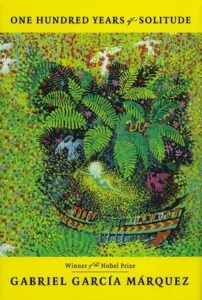
Probably García Márquez finest and most famous work. One Hundred Years of Solitude tells the story of the rise and fall, birth and death of a mythical town of Macondo through the history of the Buendia family. Inventive, amusing, magnetic, sad, alive with unforgettable men and women, and with a truth and understanding that strike the soul. One Hundred Years of Solitude is a masterpiece of the art of fiction.
A classic of Mexican modern literature about a haunted village.
As one enters Juan Rulfo's legendary novel, one follows a dusty road to a town of death. Time shifts from one consciousness to another in a hypnotic flow of dreams, desires, and memories, a world of ghosts dominated by the figure of Pedro Páramo - lover, overlord, murderer.
Rulfo's extraordinary mix of sensory images, violent passions, and unfathomable mysteries has been a profound influence on a whole generation of Latin American writers, including Carlos Fuentes, Mario Vargas Llosa, and Gabriel García Márquez. To read Pedro Páramo today is as overwhelming an experience as when it was first published in Mexico back in 1955.
Milkman Dead was born shortly after a neighborhood eccentric hurled himself off a rooftop in a vain attempt at flight. For the rest of his life he, too, will be trying to fly. With this brilliantly imagined novel, Toni Morrison transfigures the coming-of-age story as audaciously as Saul Bellow or Gabriel García Márquez. As she follows Milkman from his rustbelt city to the place of his family’s origins, Morrison introduces an entire cast of strivers and seeresses, liars and assassins, the inhabitants of a fully realized black world.
If on a Winter's Night a Traveler is a marvel of ingenuity, an experimental text that looks longingly back to the great age of narration—"when time no longer seemed stopped and did not yet seem to have exploded." Italo Calvino's novel is in one sense a comedy in which the two protagonists, the Reader and the Other Reader, ultimately end up married, having almost finished If on a Winter's Night a Traveler. In another, it is a tragedy, a reflection on the difficulties of writing and the solitary nature of reading. The Reader buys a fashionable new book, which opens with an exhortation: "Relax. Concentrate. Dispel every other thought. Let the world around you fade." Alas, after 30 or so pages, he discovers that his copy is corrupted, and consists of nothing but the first section, over and over. Returning to the bookshop, he discovers the volume, which he thought was by Calvino, is actually by the Polish writer Bazakbal. Given the choice between the two, he goes for the Pole, as does the Other Reader, Ludmilla. But this copy turns out to be by yet another writer, as does the next, and the next.
The real Calvino intersperses 10 different pastiches—stories of menace, spies, mystery, premonition—with explorations of how and why we choose to read, make meanings, and get our bearings or fail to. Meanwhile the Reader and Ludmilla try to reach, and read, each other. If on a Winter's Night is dazzling, vertiginous, and deeply romantic. "What makes lovemaking and reading resemble each other most is that within both of them times and spaces open, different from measurable time and space."
An Arab and a Jew open a restaurant together across the street from the United Nations... It sounds like the beginning of an ethnic joke, but it's the axis around which spins this gutsy, fun-loving and alarmingly provocative novel, widely acclaimed as among Robbins's very best. As a dessert spoon mystifies, a waitress takes
Welcome Back!
Track your reading progress and sync your library.