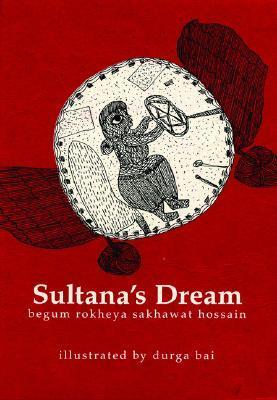
The female narrator of Sultana’s Dream wanders into a dream city that shuns war and violence. In this utopian world, women rule and men are content with their places in the kitchen. The queen of this kingdom explains how women won and kept their peace against men and their war-like ways.
This edition of a feminist utopian classic is a conversation across time; Durga Bai, a contemporary tribal woman artist from Central India, brings her own vision to bear on a Muslim gentlewoman’s radical tale.
In 1941, Astounding Science Fiction magazine published a short story by a little-known writer named Isaac Asimov. The story was called "Nightfall", and many years later it has long been recognized as a classic, its author a legend. Now, the Grand Master of Science Fiction teams with Robert Silverberg, one of the field's top award-winning authors, to explore and expand an apocalyptic tale that is more spellbinding today than ever before -- Nightfall: The Novel.
Imagine living on a planet with six suns that never experiences darkness. Imagine never having seen the stars. Then, one by one the suns start to set, gradually leading into darkness for the first time ever. Kalgash is a world on the edge of chaos, torn between the madness of religious fanaticism and the unyielding rationalism of scientists. Lurking beneath it all is a collective, instinctual fear of the Darkness. For Kalgash knows only the perpetual light of day; to its inhabitants, a gathering twilight portends unspeakable horror. And only a handful of people on the planet are prepared to face the truth, their six suns are setting all at once for the first time in over two thousand years, signaling the end of civilization as it explodes in the awesome splendor of Nightfall.
Encompassing the psychology of disaster, the tenacity of the human spirit, and, ultimately, the regenerative power of hope, Nightfall is a tale rich in character and suspense that only the unique collaboration of Isaac Asimov and Robert Silverberg could create.
“H. P. Lovecraft has yet to be surpassed as the 20th century’s greatest practitioner of the classic horror tale.”―Stephen King The most important tales of the godfather of the modern horror genre―a master who influenced the works of a generation of writers including Stephen King and Anne Rice―are gathered in one volume by National Book Award-winning author Joyce Carol Oates. Combining the 19th-century gothic sensibility of Edgar Allan Poe with a daring internal vision, Lovecraft’s tales foretold a psychically troubled world to come. Set in a meticulously wrought, historically grounded New England landscape, his harrowing stories explore the collapse of sanity beneath the weight of chaotic events. Lovecraft’s universe is a frightening shadow world were reality and nightmare intertwine, and redemption can come only from below. For aficionados and a new generation of 21st-century readers , Tales of H. P. Lovecraft is a classic not to be missed.
Librarian's Note: Alternate cover edition available here.
Simak's City is a series of connected stories, a series of legends, myths, and campfire stories told by Dogs about the end of human civilization, centering on the Webster family, who, among their other accomplishments, designed the ships that took Men to the stars and gave Dogs the gift of speech and robots to be their hands.
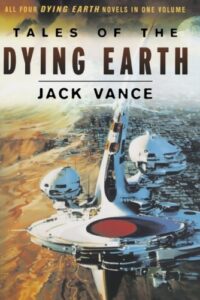
Jack Vance is one of the most remarkable talents to ever grace the world of science fiction. His unique, stylish voice has been beloved by generations of readers. One of his enduring classics is his 1964 novel, The Dying Earth, and its sequels--a fascinating, baroque tale set on a far-future Earth, under a giant red sun that is soon to go out forever.
This omnibus volume comprised all four books in the series The Dying Earth The Eyes of the Overworld Cugel's Saga Rialto the Marvellous
The mind of Ray Bradbury is a wonder-filled carnival of delight and terror that stretches from the verdant Irish countryside to the coldest reaches of outer space. Yet all his work is united by one common thread: a vivid and profound understanding of the vast set of emotions that bring strength and mythic resonance to our frail species. Ray Bradbury characters may find themselves anywhere and anywhen. A horrified mother may give birth to a strange blue pyramid. A man may take Abraham Lincoln out of the grave—and meet another who puts him back. An amazing Electrical Grandmother may come to live with a grieving family. An old parrot may have learned over long evenings to imitate the voice of Ernest Hemingway, and became the last link to the great man. A priest on Mars may confront his fondest dream: to meet the Messiah. Each of these magnificent creations has something to tell us about our humanity—and all of their fates await you in this new trade edition of twenty-eight classic Bradbury stories and one luscious poem. Travel on an unpredictable and unforgettable literary journey—safe in the hands of one of the century's great men of imagination.
In a thirtieth anniversary edition of the classic, the Harlequin, a rebel, inhabits a world where conformity and punctuality are top priorities, and the Ticktockman cannot accept the Harlequin's presence in his perfectly ordered world. 25,000 first printing. IP.
That The Illustrated Man has remained in print since being published in 1951 is fair testimony to the universal appeal of Ray Bradbury's work. Only his second collection (the first was Dark Carnival, later reworked into The October Country), it is a marvelous, if mostly dark, quilt of science fiction, fantasy, and horror. In an ingenious framework to open and close the book, Bradbury presents himself as a nameless narrator who meets the Illustrated Man--a wanderer whose entire body is a living canvas of exotic tattoos. What's even more remarkable, and increasingly disturbing, is that the illustrations are themselves magically alive, and each proceeds to unfold its own story, such as "The Veldt," wherein rowdy children take a game of virtual reality way over the edge. Or "Kaleidoscope," a heartbreaking portrait of stranded astronauts about to reenter our atmosphere--without the benefit of a spaceship. Or "Zero Hour," in which invading aliens have discovered a most logical ally--our own children. Even though most were written in the 1940s and 1950s, these 18 classic stories will be just as chillingly effective 50 years from now. --Stanley Wiater
Contents:
· Prologue: The Illustrated Man · ss * · The Veldt [“The World the Children Made”] · ss The Saturday Evening Post Sep 23 ’50 · Kaleidoscope · ss Thrilling Wonder Stories Oct ’49 · The Other Foot · ss New Story Magazine Mar ’51 · The Highway [as by Leonard Spalding] · ss Copy Spr ’50 · The Man · ss Thrilling Wonder Stories Feb ’49 · The Long Rain [“Death-by-Rain”] · ss Planet Stories Sum ’50 · The Rocket Man · ss Maclean’s Mar 1 ’51 · The Fire Balloons [“‘In This Sign...’”] · ss Imagination Apr ’51 · The Last Night of the World · ss Esquire Feb ’51 · The Exiles [“The Mad Wizards of Mars”] · ss Maclean’s Sep 15 ’49; F&SF Win ’50 · No Particular Night or Morning · ss * · The Fox and the Forest [“To the Future”] · ss Colliers May 13 ’50 · The Visitor · ss Startling Stories Nov ’48 · The Concrete Mixer · ss Thrilling Wonder Stories Apr ’49 · Marionettes, Inc. [Marionettes, Inc.] · ss Startling Stories Mar ’49 · The City [“Purpose”] · ss Startling Stories Jul ’50 · Zero Hour · ss Planet Stories Fll ’47 · The Rocket [“Outcast of the Stars”] · ss Super Science Stories Mar ’50 · Epilogue · aw *
Welcome Back!
Track your reading progress and sync your library.