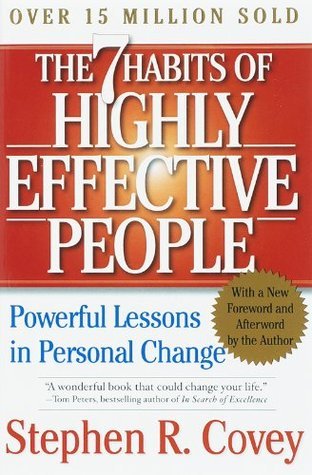
The 7 Habits of Highly Effective People: Powerful Lessons in Personal Change
7 zakonet e njerëzve të suksesshëm
No matter your goals, Atomic Habits offers a proven framework for improving—every day. James Clear, one of the world's leading experts on habit formation, reveals practical strategies that will teach you exactly how to form good habits, break bad ones, and master the tiny behaviors that lead to remarkable results.
If you're having trouble changing your habits, the problem isn't you. The problem is your system. Bad habits repeat themselves again and again not because you don't want to change, but because you have the wrong system for change. You do not rise to the level of your goals. You fall to the level of your systems. Here, you'll get a proven system that can take you to new heights.
Clear is known for his ability to distill complex topics into simple behaviors that can be easily applied to daily life and work. Here, he draws on the most proven ideas from biology, psychology, and neuroscience to create an easy-to-understand guide for making good habits inevitable and bad habits impossible. Along the way, readers will be inspired and entertained with true stories from Olympic gold medalists, award-winning artists, business leaders, life-saving physicians, and star comedians who have used the science of small habits to master their craft and vault to the top of their field.
Learn how to:
- Make time for new habits (even when life gets crazy);
- Overcome a lack of motivation and willpower;
- Design your environment to make success easier;
- Get back on track when you fall off course;
...and much more.
Atomic Habits will reshape the way you think about progress and success, and give you the tools and strategies you need to transform your habits--whether you are a team looking to win a championship, an organization hoping to redefine an industry, or simply an individual who wishes to quit smoking, lose weight, reduce stress, or achieve any other goal.

You can go after the job you want...and get it! You can take the job you have...and improve it! You can take any situation you're in...and make it work for you!
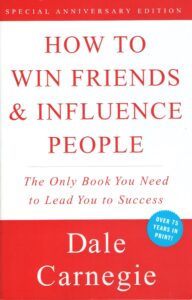
Since its release in 1936, How to Win Friends and Influence People has sold more than 30 million copies. Dale Carnegie's first book is a timeless bestseller, packed with rock-solid advice that has carried thousands of now famous people up the ladder of success in their business and personal lives.
As relevant as ever before, Dale Carnegie's principles endure, and will help you achieve your maximum potential in the complex and competitive modern age.
Learn the six ways to make people like you, the twelve ways to win people to your way of thinking, and the nine ways to change people without arousing resentment.
Avoid terrible advice, cognitive biases, and poor decisions.
Want to avoid business disasters, whether minor mishaps, such as excessive team conflict, or major calamities like those that threaten bankruptcy or doom a promising career? Fortunately, behavioral economics studies show that such disasters stem from poor decisions due to our faulty mental patterns—what scholars call “cognitive biases”—and are preventable.
Unfortunately, the typical advice for business leaders to “go with their guts” plays into these cognitive biases and leads to disastrous decisions that devastate the bottom line. By combining practical case studies with cutting-edge research, Never Go With Your Gut will help you make the best decisions and prevent these business disasters.
The leading expert on avoiding business disasters, Dr. Gleb Tsipursky, draws on over 20 years of extensive consulting, coaching, and speaking experience to show how pioneering leaders and organizations—many of them his clients—avoid business disasters. Reading this book will enable you to:
Discover how pioneering leaders and organizations address cognitive biases to avoid disastrous decisions.
Adapt best practices on avoiding business disasters from these leaders and organizations to your own context.
Develop processes that empower everyone in your organization to avoid business disasters.
"Who Moved My Cheese?" is a simple parable that reveals profound truths. It is an amusing and enlightening story of four characters who live in a "Maze" and look for "Cheese" to nourish them and make them happy.
Two are mice named Sniff and Scurry. And two are "Littlepeople" — beings the size of mice who look and act a lot like people. Their names are Hem and Haw.
"Cheese" is a metaphor for what you want to have in life — whether it's a good job, a loving relationship, money, a possession, health, or spiritual peace of mind.
And the "Maze" is where you look for what you want — the organisation you work in or the family or community you live in.
In the story, the characters are faced with unexpected change. Eventually, one of them deals with it successfully, and writes what he has learned from his experience on the Maze walls.
When you come to see "The Handwriting on the Wall," you can discover for yourself how to deal with change, so that you can enjoy less stress and more success (however you define it) in your work and in your life.
Written for all ages, the story takes less than an hour to read, but its unique insights can last for a lifetime.
In the highly anticipated Thinking, Fast and Slow, Kahneman takes us on a groundbreaking tour of the mind and explains the two systems that drive the way we think. System 1 is fast, intuitive, and emotional; System 2 is slower, more deliberative, and more logical. Kahneman exposes the extraordinary capabilities—and also the faults and biases—of fast thinking, and reveals the pervasive influence of intuitive impressions on our thoughts and behavior. The impact of loss aversion and overconfidence on corporate strategies, the difficulties of predicting what will make us happy in the future, the challenges of properly framing risks at work and at home, the profound effect of cognitive biases on everything from playing the stock market to planning the next vacation—each of these can be understood only by knowing how the two systems work together to shape our judgments and decisions.
Engaging the reader in a lively conversation about how we think, Kahneman reveals where we can and cannot trust our intuitions and how we can tap into the benefits of slow thinking. He offers practical and enlightening insights into how choices are made in both our business and our personal lives—and how we can use different techniques to guard against the mental glitches that often get us into trouble. Thinking, Fast and Slow will transform the way you think about thinking.
The book that started the Quiet Revolution
At least one-third of the people we know are introverts. They are the ones who prefer listening to speaking; who innovate and create but dislike self-promotion; who favor working on their own over working in teams. It is to introverts—Rosa Parks, Chopin, Dr. Seuss, Steve Wozniak—that we owe many of the great contributions to society.
In Quiet, Susan Cain argues that we dramatically undervalue introverts and shows how much we lose in doing so. She charts the rise of the Extrovert Ideal throughout the twentieth century and explores how deeply it has come to permeate our culture. She also introduces us to successful introverts—from a witty, high-octane public speaker who recharges in solitude after his talks, to a record-breaking salesman who quietly taps into the power of questions. Passionately argued, superbly researched, and filled with indelible stories of real people, Quiet has the power to permanently change how we see introverts and, equally important, how they see themselves.
Now with Extra Libris material, including a reader’s guide and bonus content.
A straightforward look at the history and the art of maintaining courteous communication in an increasingly divided world.
Have you ever been in a conversation that, after volleying back and forth, ended with the words, “I’m just saying . . .”? Usually, this signals frustration, that the discussion has reached a dead end, that you haven’t made your point, and may even leave you feeling that your relationship with the other person has changed for the worse. Digital interactions, devoid of nuance and understanding, further complicate discussion. We may believe that we are superior because our opinions are the “right” ones, and in the future avoid conversations with those whose opinions differ from ours, sending us into a never-ending echo chamber.
In I’m Just Saying, author Milan Kordestani shows us that although challenging conversations can be unpleasant, they can also help us grow. Sometimes, people inspire us to change how we speak, making us better communicators in the process as we search to find common ground with those with whom we disagree. Kordestani uses contemporary case studies and personal experience to teach readers how to have constructive conversations by engaging in civil discourse—the idea that good-faith actors can reach consensus on any opinion-based disagreement. He discusses influential leaders and reflects on his successes and failures in creating The Doe, an online publication focused on civil discourse. He addresses the challenges that digital media consumption presents when seeking common ground—especially when people are only digitally connected.
Civil discourse, an essential part of democracy, is becoming rare in today's digital age. I’m Just Saying examines discourse's successes and the ways to rebuild it. Drawing from history, popular culture, and personal anecdotes, the book promotes effective civil discourse by providing practical advice and strategies for respect. Through story, I’m Just Saying offers insight and tools for politeness in a divided world.
Think and Grow Rich is a guide to success by Napoleon Hill, which was first published in 1937 following the Great Depression. It was immediately welcomed as an antidote to hard times and remained a bestseller for decades. Many people still find its philosophy of positive thinking and its specific steps for achieving wealth both relevant and life-changing. Hill contends that our thoughts become our reality, and offers a plan and principles for transforming thoughts into riches, including visualization, affirmation, creating a Master Mind group, defining a goal, and planning.