The Aeneid – thrilling, terrifying and poignant in equal measure – has inspired centuries of artists, writers and musicians.
Virgil’s epic tale tells the story of Aeneas, a Trojan hero, who flees his city after its fall, with his father Anchises and his young son Ascanius – for Aeneas is destined to found Rome and father the Roman race. As Aeneas journeys closer to his goal, he must first prove his worth and attain the maturity necessary for such an illustrious task. He battles raging storms in the Mediterranean, encounters the fearsome Cyclopes, falls in love with Dido, Queen of Carthage, travels into the Underworld and wages war in Italy.
Composed toward the end of the first millennium, Beowulf is the elegiac narrative of the adventures of Beowulf, a Scandinavian hero who saves the Danes from the seemingly invincible monster Grendel and, later, from Grendel's mother. He then returns to his own country and dies in old age in a vivid fight against a dragon. The poem is about encountering the monstrous, defeating it, and then having to live on in the exhausted aftermath. In the contours of this story, at once remote and uncannily familiar at the beginning of the twenty-first century, Nobel laureate Seamus Heaney finds a resonance that summons power to the poetry from deep beneath its surface. Drawn to what he has called the "four-squareness of the utterance" in Beowulf and its immense emotional credibility, Heaney gives these epic qualities new and convincing reality for the contemporary reader.
Sing to me of the man, Muse, the man of twists and turns driven time and again off course, once he had plundered the hallowed heights of Troy.
So begins Robert Fagles' magnificent translation of the Odyssey.
If the Iliad is the world's greatest war epic, then the Odyssey is literature's grandest evocation of everyman's journey though life. Odysseus' reliance on his wit and wiliness for survival in his encounters with divine and natural forces, during his ten-year voyage home to Ithaca after the Trojan War, is at once a timeless human story and an individual test of moral endurance.
In the myths and legends that are retold here, Fagles has captured the energy and poetry of Homer's original in a bold, contemporary idiom, and given us an Odyssey to read aloud, to savor, and to treasure for its sheer lyrical mastery.
Renowned classicist Bernard Knox's superb Introduction and textual commentary provide new insights and background information for the general reader and scholar alike, intensifying the strength of Fagles' translation.
This is an Odyssey to delight both the classicist and the public at large, and to captivate a new generation of Homer's students.
--
Robert Fagles, winner of the PEN/Ralph Manheim Medal for Translation and a 1996 Academy Award in Literature from the American Academy of Arts and Letters, presents us with Homer's best-loved and most accessible poem in a stunning new modern-verse translation.
Miraculously preserved on clay tablets dating back as much as four thousand years, the poem of Gilgamesh, king of Uruk, is the world’s oldest epic, predating Homer by many centuries. The story tells of Gilgamesh’s adventures with the wild man Enkidu, and of his arduous journey to the ends of the earth in quest of the Babylonian Noah and the secret of immortality. Alongside its themes of family, friendship and the duties of kings, the Epic of Gilgamesh is, above all, about mankind’s eternal struggle with the fear of death.
The Babylonian version has been known for over a century, but linguists are still deciphering new fragments in Akkadian and Sumerian.
The first and most terrifying monster in English literature, from the great early epic Beowulf, tells his side of the story in a book William Gass called "one of the finest of our contemporary fictions."
Ovid’s sensuous and witty poem, in an accessible translation by David Raeburn
In Metamophoses, Ovid brings together a dazzling array of mythological tales, ingeniously linked by the idea of transformation—often as a result of love or lust—where men and women find themselves magically changed into new and sometimes extraordinary beings. Beginning with the creation of the world and ending with the deification of Augustus, Ovid interweaves many of the best-known myths and legends of ancient Greece and Rome, including Daedalus and Icarus, Pyramus and Thisbe, Pygmalion, Perseus and Andromeda, and the fall of Troy. Erudite but light-hearted, dramatic and yet playful, Metamorphoses has influenced writers and artists throughout the centuries from Shakespeare and Titian to Picasso and Ted Hughes.
For more than seventy years, Penguin has been the leading publisher of classic literature in the English-speaking world. With more than 1,700 titles, Penguin Classics represents a global bookshelf of the best works throughout history and across genres and disciplines. Readers trust the series to provide authoritative texts enhanced by introductions and notes by distinguished scholars and contemporary authors, as well as up-to-date translations by award-winning translators.
Gripping listeners and readers for more than 2,700 years, 'The Iliad' is the story of the Trojan War and the rage of Achilles. Combining the skills of a poet and scholar, Robert Fagles brings the energy of contemporary language to this enduring heroic epic.
If 'The Iliad' is the world's greatest war story, then 'The Odyssey' is literature's greatest evocation of every man's journey through life. Here again, Fagles has performed the translator's task magnificently, giving us an Odyssey to read aloud, to savor, and to treasure for its sheer lyrical mastery.
Each volume contains a superb introduction with textual and critical commentary by renowned classicist Bernard Knox.
"Day after day, day after day, We stuck, nor breath nor motion; As idle as a painted ship Upon a painted ocean.
The Rime of the Ancient Mariner (originally "The Rime of the Ancyent Marinere") is the longest major poem by the English poet Samuel Taylor Coleridge, written circa 1797 and published in 1798 in the first edition of Lyrical Ballads. Modern editions use a later revised version printed in 1817 and featuring a gloss. Along with other poems in Lyrical Ballads, it was a signal shift to modern poetry and the beginning of British Romantic literature.
It relates the events experienced by a mariner who has returned from a long sea voyage. The Mariner stops a man on his way to a wedding ceremony and begins to narrate a story. The Wedding-Guest's reaction turns from bemusement to impatience, fear, and fascination as the Mariner's story progresses, as can be seen in the language style: for example, the use of narrative techniques such as personification and repetition to create a sense of danger, or the supernatural, or serenity, depending on the mood each different part of the poem.
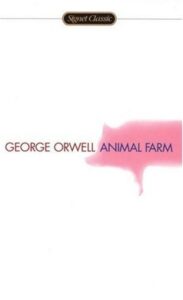
After years of exploitation, neglect, and despair, the animals of Manor Farm revolt. They drive owner Mr. Jones off the land and rechristen the property Animal Farm, a utopia of equality and mutual support. But Napoleon, a young boar who assumes command after the rebellion, is hungry for power. And as the pigs consolidate control, all the good intentions of Animal Farm are crushed by a new and inevitable tyranny.
George Orwell’s Animal Farm, the chilling allegorical satire about the working class and the gripping rhetoric of despots, illustrates just how easy the slide into oppression and totalitarianism can be.
Revised Previously published as Animal Farm , this edition of Animal Farm (AmazonClassics Edition) includes editorial revisions.
Welcome Back!
Track your reading progress and sync your library.