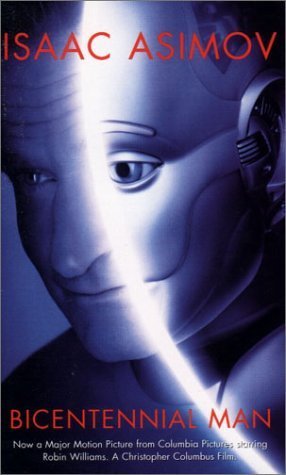
Andrew was one of Earth’s first house robot domestic servants—smoothly designed and functional. But when Andrew started to develop special talents which exceeded the confines of his allotted positronic pathways, he abandoned his domestic duties in favour of more intellectual pursuits. As time passed, Andrew acquired knowledge, feelings and ambitions way beyond anything ever experienced by any other mechanical men. And he found himself launched on to a career which would bring him fame fortune — and danger. For a robot who wants to be human must also be prepared to die…
In the Bicentennial Man, Isaac Asimov returns to his first and most enduring love — robotics. The result is a brilliant book of first-class entertainment and mind-spinning ideas which confirm Asimov’s supreme status as Grand Master of science fiction.
Content
“Feminine Intuition” (1969) “Waterclap” (1970) “That Thou Art Mindful of Him” (1974) “Stranger in Paradise” (1974) “The Life and Times of Multivac” (1975) “The Winnowing” (1976) “The Bicentennial Man” (1976) “Marching In” (1976) “Old-Fashioned” (1976) “The Tercentenary Incident” (1976) “Birth of a Notion” (1976)
Cover Illustration: Don Dixon
Books similar to The Bicentennial Man and Other Stories
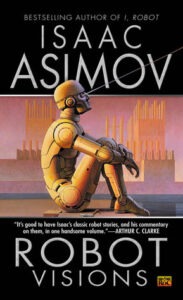
From Isaac Asimov, the Hugo Award-winning Grand Master of Science Fiction whose name is synonymous with the science of robotics, comes five decades of robot visions: thirty-four landmark stories and essays—including three rare tales—gathered together in one volume.
Meet all of Asimov’s most famous creations including: Robbie, the very first robot that his imagination brought to life; Susan Calvin, the original robot psychologist; Stephen Byerley, the humanoid robot; and the famous human/robot detective team of Lije Bailey and R. Daneel Olivaw, who have appeared in such bestselling novels as The Robots of Dawn and Robots and Empire.
Let the master himself guide you through the key moments in the fictional history of robot-human relations—from the most primitive computers and mobile machines to the first robot to become a man. (back cover)
Contents:
Robot Visions • cover and interior artwork by Ralph McQuarrie Introduction: The Robot Chronicles • essay by Isaac Asimov Robot Visions / short story by Isaac Asimov Too Bad! (1989) / short story by Isaac Asimov Robbie (1940) / short story by Isaac Asimov (variant of Strange Playfellow) Reason [Mike Donovan] (1941) / short story by Isaac Asimov Liar! [Susan Calvin] (1941) / short story by Isaac Asimov Runaround [Mike Donovan] (1942) / novelette by Isaac Asimov Evidence [Susan Calvin] (1946) / novelette by Isaac Asimov Little Lost Robot [Susan Calvin] (1947) / novelette by Isaac Asimov The Evitable Conflict [Susan Calvin] (1950) / novelette by Isaac Asimov Feminine Intuition [Susan Calvin] (1969) / novelette by Isaac Asimov The Bicentennial Man (1976) / novelette by Isaac Asimov Someday (1956) / short story by Isaac Asimov Think! (1977) / short story by Isaac Asimov Segregationist (1967) / short story by Isaac Asimov Mirror Image [Elijah Bailey/R. Daneel Olivaw] (1972) / short story by Isaac Asimov Lenny [Susan Calvin] (1958) / short story by Isaac Asimov Galley Slave [Susan Calvin] (1957) / novelette by Isaac Asimov Christmas Without Rodney (1988) / short story by Isaac Asimov Essays by Isaac Asimov: Robots I Have Known (1954); The New Teachers (1976); Whatever You Wish (1977); The Friends We Make (1977); Our Intelligent Tools (1977); The Laws of Robotics (1979); Future Fantastic (1989); The Machine and the Robot (1978); The New Profession (1979); The Robot As Enemy? (1979); Intelligences Together (1979); My Robots (1987); The Laws of Humanics (1987); Cybernetic Organism (1987); The Sense of Humor (1988); Robots in Combination (1988).
The volume features many black-and-white illustrations by Ralph McQuarrie.
A millennium into the future two advancements have altered the course of human history: the colonization of the galaxy and the creation of the positronic brain. Isaac Asimov's Robot novels chronicle the unlikely partnership between a New York City detective and a humanoid robot who must learn to work together. Like most people left behind on an over-populated Earth, New York City police detective Elijah Baley had little love for either the arrogant Spacers or their robotic companions. But when a prominent Spacer is murdered under mysterious circumstances, Baley is ordered to the Outer Worlds to help track down the killer. The relationship between Life and his Spacer superiors, who distrusted all Earthmen, was strained from the start. Then he learned that they had assigned him a partner: R. Daneel Olivaw. Worst of all was that the "R" stood for robot--and his positronic partner was made in the image and likeness of the murder victim!
Isaac Asimov's I, Robot launches readers on an adventure into a not-so-distant future where man and machine , struggle to redefinelife, love, and consciousness—and where the stakes are nothing less than survival. Filled with unforgettable characters, mind-bending speculation, and nonstop action, I, Robot is a powerful reading experience from one of the master storytellers of our time.
I, ROBOT
They mustn't harm a human being, they must obey human orders, and they must protect their own existence...but only so long as that doesn't violate rules one and two. With these Three Laws of Robotics, humanity embarked on perhaps its greatest adventure: the invention of the first positronic man. It was a bold new era of evolution that would open up enormous possibilities—and unforeseen risks. For the scientists who invented the earliest robots weren't content that their creations should ' remain programmed helpers, companions, and semisentient worker-machines. And soon the robots themselves; aware of their own intelligence, power, and humanity, aren't either.
As humans and robots struggle to survive together—and sometimes against each other—on earth and in space, the future of both hangs in the balance. Human men and women confront robots gone mad, telepathic robots, robot politicians, and vast robotic intelligences that may already secretly control the world. And both are asking the same questions: What is human? And is humanity obsolete?
In l, Robot Isaac Asimov changes forever our perception of robots, and human beings and updates the timeless myth of man's dream to play god. with all its rewards—and terrors. --front flap
This volume is the definitive collection of the best science fiction novellas between 1929 to 1964 and contains eleven great classics. There is no better anthology that captures the birth of science fiction as a literary field.
Published in 1973 to honor stories that had come before the institution of the Nebula Awards, The Science Fiction Hall of Fame introduced tens of thousands of young readers to the wonders of science fiction and was a favorite of libraries across the country.
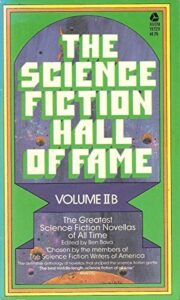
Eleven more classic novellas by the most honored authors of science fiction. Companion to Volume IIA.
Introduction · Ben Bova The Martian Way · Isaac Asimov · na Galaxy Nov ’52 Earthman, Come Home [Okie] · James Blish · nv Astounding Nov ’53 Rogue Moon · Algis Budrys · na F&SF Dec ’60 The Specter General · Theodore R. Cogswell · na Astounding Jun ’52 The Machine Stops · E. M. Forster · nv Oxford and Cambridge Review Nov ’09 The Midas Plague · Frederik Pohl · na Galaxy Apr ’54 The Witches of Karres · James H. Schmitz · nv Astounding Dec ’49 E for Effort · T. L. Sherred · nv Astounding May ’47 In Hiding · Wilmar H. Shiras · nv Astounding Nov ’48 The Big Front Yard · Clifford D. Simak · na Astounding Oct ’58 The Moon Moth · Jack Vance · na Galaxy Aug ’61
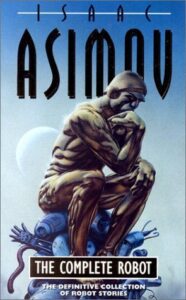
THE COMPLETE ROBOT is the definitive anthology of Asimov's stunning visions of a robotic future…
In these stories, Isaac Asimov creates the Three Laws of Robotics and ushers in the Robot Age: when Earth is ruled by master-machines and when robots are more human than mankind. Contents
9 • Introduction (The Complete Robot) • (1982) • essay by Isaac Asimov 15 • A Boy's Best Friend • (1975) • short story by Isaac Asimov 19 • Sally • (1953) • short story by Isaac Asimov 41 • Someday • (1956) • short story by Isaac Asimov 55 • Point of View • [Multivac] • (1975) • short story by Isaac Asimov 59 • Think! • (1977) • short story by Isaac Asimov 70 • True Love • (1977) • short story by Isaac Asimov 77 • Robot AL-76 Goes Astray • (1942) • short story by Isaac Asimov 93 • Victory Unintentional • (1942) • short story by Isaac Asimov 117 • Stranger in Paradise • (1974) • novelette by Isaac Asimov 151 • Light Verse • (1973) • short story by Isaac Asimov 157 • Segregationist • (1967) • short story by Isaac Asimov 164 • Robbie • (1940) • short story by Isaac Asimov (variant of Strange Playfellow) 191 • Let's Get Together • (1957) • short story by Isaac Asimov 211 • Mirror Image • [Elijah Bailey / R. Daneel Olivaw] • (1972) • short story by Isaac Asimov 231 • The Tercentenary Incident • (1976) • short story by Isaac Asimov 253 • First Law • [Mike Donovan] • (1956) • short story by Isaac Asimov 257 • Runaround • [Mike Donovan] • (1942) • novelette by Isaac Asimov 280 • Reason • [Mike Donovan] • (1941) • short story by Isaac Asimov 302 • Catch That Rabbit • [Mike Donovan] • (1944) • short story by Isaac Asimov 329 • Liar! • [Susan Calvin] • (1941) • short story by Isaac Asimov 350 • Satisfaction Guaranteed • [Susan Calvin] • (1951) • short story by Isaac Asimov 368 • Lenny • [Susan Calvin] • (1958) • short story by Isaac Asimov 385 • Galley Slave • [Susan Calvin] • (1957) • novelette by Isaac Asimov 427 • Little Lost Robot • [Susan Calvin] • (1947) • novelette by Isaac Asimov 459 • Risk • [Susan Calvin] • (1955) • novelette by Isaac Asimov 490 • Escape! • [Susan Calvin] • (1945) • short story by Isaac Asimov 518 • Evidence • [Susan Calvin] • (1946) • novelette by Isaac Asimov 546 • The Evitable Conflict • [Susan Calvin] • (1950) • novelette by Isaac Asimov 575 • Feminine Intuition • [Susan Calvin] • (1969) • novelette by Isaac Asimov 605 • ... That Thou Art Mindful of Him • (1974) • novelette by Isaac Asimov (variant of —That Thou Art Mindful of Him!) 635 • The Bicentennial Man • (1976) • novelette by Isaac Asimov 683 • A Last Word • (1982) • essay by Isaac Asimov
THE COMPLETE ROBOT is the ultimate collection of timeless, amazing and amusing robot stories from the greatest science fiction writer of all time, offering golden insights into robot thought processes. Asimov's Three Laws of Robotics were programmed into real computers thirty years ago at the Massachusetts Institute of Technology - with surprising results. Readers of today still have many surprises in store...
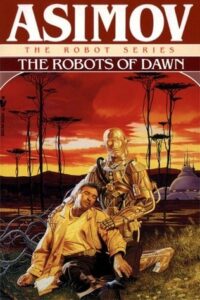
A millennium into the future two advances have altered the course of human history: the colonization of the Galaxy and the creation of the positronic brain. Isaac Asimov's Robot novels chronicle the unlikely partnership between a New York City detective and a humanoid robot who must learn to work together.
Detective Elijah Baley is called to the Spacer world Aurora to solve a bizarre case of roboticide. The prime suspect is a gifted roboticist who had the means, the motive, and the opportunity to commit the crime. There's only one catch: Baley and his positronic partner, R. Daneel Olivaw, must prove the man innocent. For in a case of political intrigue and love between woman and robot gone tragically wrong, there's more at stake than simple justice. This time Baley's career, his life, and Earth's right to pioneer the Galaxy lie in the delicate balance.
This is an alternative cover edition for ISBN 9780586010167
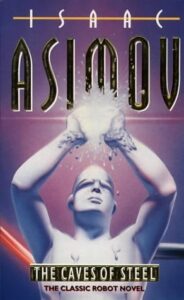
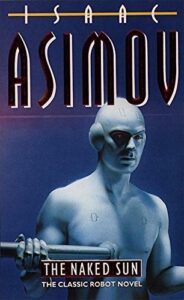
Like all Earthmen, detective Elijah Baley has a terror of open landscape., of the naked sun.
Reacting in fear of the technological superiority of the Outer Worlds, the people of Earth have hidden themselves in vast underground cities, nursing a hatred for Spacers. The fifty Outer Worlds of the Spacers together are home to fewer people than planet Earth. And home to many, many more robots. Earthmen hate Spacer robots, too...
But Baley doesn't. He once had a robot partner, R. Daneel – and when the authorities of the planet Solaria request terrestrial assistance in investigating a murder, Baley is once again teamed with Daneel. He is the first Earthmen in a millennium to travel to the Outer Worlds... and he must endure the glare of a sun far more deadly than Earth's.
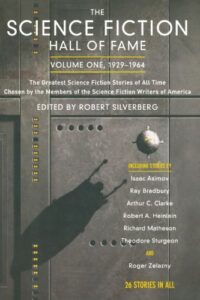
The definitive collection of the best in science fiction stories between 1929 and 1964
This book contains twenty-six of the greatest science fiction stories ever written. They represent the considered verdict of the Science Fiction Writers of America, those who have shaped the genre and who know, more intimately than anyone else, what the criteria for excellence in the field should be. The authors chosen for the Science Fiction Hall Fame are the men and women who have shaped the body and heart of modern science fiction; their brilliantly imaginative creations continue to inspire and astound new generations of writers and fans.
Robert Heinlein in "The Roads Must Roll" describes an industrial civilization of the future caught up in the deadly flaws of its own complexity. "Country of the Kind," by Damon Knight, is a frightening portrayal of biological mutation. "Nightfall," by Isaac Asimov, one of the greatest stories in the science fiction field, is the story of a planet where the sun sets only once every millennium and is a chilling study in mass psychology.
Originally published in 1970 to honor those writers and their stories that had come before the institution of the Nebula Awards, The Science Fiction Hall Of Fame, Vol. 1, was the book that introduced tens of thousands of young readers to the wonders of science fiction. Too long unavailable, this new edition will treasured by all science fiction fans everywhere.
Contents: · Introduction · Robert Silverberg · in · A Martian Odyssey [Tweel] · Stanley G. Weinbaum · nv Wonder Stories Jul ’34 · Twilight [as by Don A. Stuart; Dying Earth] · John W. Campbell, Jr. · ss Astounding Nov ’34 · Helen O’Loy · Lester del Rey · ss Astounding Dec ’38 · The Roads Must Roll · Robert A. Heinlein · nv Astounding Jun ’40 · Microcosmic God · Theodore Sturgeon · nv Astounding Apr ’41 · Nightfall · Isaac Asimov · nv Astounding Sep ’41 · The Weapon Shop [Isher] · A. E. van Vogt · nv Astounding Dec ’42 · Mimsy Were the Borogoves · Lewis Padgett · nv Astounding Feb ’43 · Huddling Place [City (Websters)] · Clifford D. Simak · ss Astounding Jul ’44 · Arena · Fredric Brown · nv Astounding Jun ’44 · First Contact · Murray Leinster · nv Astounding May ’45 · That Only a Mother · Judith Merril · ss Astounding Jun ’48 · Scanners Live in Vain · Cordwainer Smith · nv Fantasy Book #6 ’50 · Mars Is Heaven! · Ray Bradbury · ss Planet Stories Fll ’48 · The Little Black Bag · C. M. Kornbluth · nv Astounding Jul ’50 · Born of Man and Woman · Richard Matheson · vi F&SF Sum ’50 · Coming Attraction · Fritz Leiber · ss Galaxy Nov ’50 · The Quest for Saint Aquin · Anthony Boucher · ss New Tales of Space and Time, ed. Raymond J. Healy, Holt, 1951; F&SF Jan ’59 · Surface Tension [Lavon] · James Blish · nv Galaxy Aug ’52 · The Nine Billion Names of God · Arthur C. Clarke · ss Star Science Fiction Stories #1, ed. Frederik Pohl, Ballantine, 1953 · It’s a Good Life · Jerome Bixby · ss Star Science Fiction Stories #2, ed. Frederik Pohl, Ballantine, 1953 · The Cold Equations · Tom Godwin · nv Astounding Aug ’54 · Fondly Fahrenheit · Alfred Bester · nv F&SF Aug ’54 · The Country of the Kind · Damon Knight · ss F&SF Feb ’56 · Flowers for Algernon · Daniel Keyes · nv F&SF Apr ’59 · A Rose for Ecclesiastes · Roger Zelazny · nv F&SF Nov ’63
Welcome Back!
Track your reading progress and sync your library.