Homicide is always an abomination, but there is something exceptionally disturbing about the victim discovered in a high lonely place, a corpse with a mouth full of sand, abandoned at a crime scene seemingly devoid of tracks or useful clues. Though it goes against his better judgment, Navajo Tribal Police Lieutenant Joe Leaphorn cannot help but suspect the hand of a supernatural killer. There is palpable evil in the air, and Leaphorn’s pursuit of a Wolf-Witch is leading him where even the bravest men fear, on a chilling trail that winds perilously between mysticism and murder.

Two Native-American boys have vanished into thin air, leaving a pool of blood behind them. Lieutenant Joe Leaphorn of the Navajo Tribal Police has no choice but to suspect the very worst, since the blood that stains the parched New Mexican ground once flowed through the veins of one of the missing, a young Zuñi. But his investigation into a terrible crime is being complicated by an important archaeological dig . . . and a steel hypodermic needle. And the unique laws and sacred religious rites of the Zuñi people are throwing impassable roadblocks in Leaphorn's already twisted path, enabling a craven murderer to elude justice or, worse still, to kill again.
Joe Pickett's old friend Nate Romanowski is off the grid, lying low while the FBI search for him. But they're not the only ones looking. Nate finds himself confronted by agents who need his help assessing a potential terror threat in Wyoming's Red Desert – in return they'll make Nate's criminal record disappear. Nate knows they can't be trusted – but with his liberty at stake, he has to comply... for now.
Meanwhile, Joe's heading south, under orders from State Governor Rulon to investigate a rash of crimes and an uptick in secretive federal activity along Interstate 80...
As they pursue their quarries, both men will be drawn deep into the Red Desert, 9,000 square miles of bleak, punishing terrain, home to a secret that could take them both down.
Walt Longmire, sheriff of Wyoming's Absaroka County, knows he's got trouble when Cody Pritchard is found dead. Two years earlier, Cody and three accomplices had been given suspended sentences for raping a Northern Cheyenne girl. Is someone seeking vengeance? Longmire faces one of the more volatile and challenging cases in his twenty-four years as sheriff and means to see that revenge, a dish that is best served cold, is never served at all.
Texas attorney and former Texas Ranger Billy Bob Holland has many secrets in his dark past. Among them is Vernon Smothers' son Lucas, a teenaged boy about whom only Vernon and Billy Bob know the truth. Lucas is really Billy Bob's illegitimate son, and when Lucas is arrested for murder, Billy Bob knows that he has no choice but to confront the past and serve as the boy's criminal attorney. During Lucas's trial, Billy Bob realizes that he will have to bring injury upon Lucas as well as himself in order to save his son. And as a result, Billy Bob creates enemies that are far more dangerous than any he had faced as a Texas Ranger.
The Expose Millenium publisher Mikael Blomkvist has made his reputation exposing corrupt establishment figures. So when a young journalist approaches him with an investigation into sex trafficking, Blomkvist cannot resist waging war on the powerful figures who control this lucrative industry.
The Murder When a young couple is found dead in their Stockholm apartment, it's a straightforward job for Inspector Bublanski and his team. The killer left the weapon at the scene - and the fingerprints on the gun point in only one direction.
The Girl Who Played with Fire Ex-security analyst Lisbeth Salander is wanted for murder. Her history of unpredictable and vengeful behaviour makes her an official danger to society - but no-one can find her. The only way Salander can be reached is by computer. But she can break into almost any network she chooses...
Pretty and popular high school senior Andie Bell was murdered by her boyfriend, Sal Singh, who then killed himself. It was all anyone could talk about. And five years later, Pip sees how the tragedy still haunts her town.
But she can't shake the feeling that there was more to what happened that day. She knew Sal when she was a child, and he was always so kind to her. How could he possibly have been a killer?
Now a senior herself, Pip decides to reexamine the closed case for her final project, at first just to cast doubt on the original investigation. But soon she discovers a trail of dark secrets that might actually prove Sal innocent . . . and the line between past and present begins to blur. Someone in Fairview doesn't want Pip digging around for answers, and now her own life might be in danger.
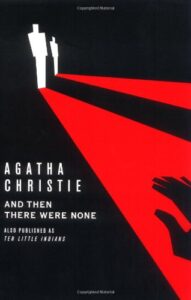
First, there were ten—a curious assortment of strangers summoned as weekend guests to a little private island off the coast of Devon. Their host, an eccentric millionaire unknown to all of them, is nowhere to be found. All that the guests have in common is a wicked past they're unwilling to reveal—and a secret that will seal their fate. For each has been marked for murder. A famous nursery rhyme is framed and hung in every room of the mansion:
"Ten little boys went out to dine; One choked his little self and then there were nine. Nine little boys sat up very late; One overslept himself and then there were eight. Eight little boys traveling in Devon; One said he'd stay there then there were seven. Seven little boys chopping up sticks; One chopped himself in half and then there were six. Six little boys playing with a hive; A bumblebee stung one and then there were five. Five little boys going in for law; One got in Chancery and then there were four. Four little boys going out to sea; A red herring swallowed one and then there were three. Three little boys walking in the zoo; A big bear hugged one and then there were two. Two little boys sitting in the sun; One got frizzled up and then there was one. One little boy left all alone; He went out and hanged himself and then there were none."
When they realize that murders are occurring as described in the rhyme, terror mounts. One by one they fall prey. Before the weekend is out, there will be none. Who has choreographed this dastardly scheme? And who will be left to tell the tale? Only the dead are above suspicion.
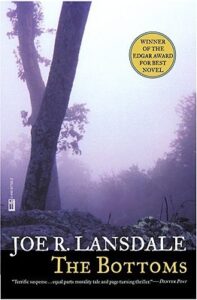
The narrator of The Bottoms is Harry Collins, an old man obsessively reflecting on certain key experiences of his childhood. In 1933, the year that forms the centerpiece of the narrative, Harry is 11 years old and living with his mother, father, and younger sister on a farm outside of Marvel Creek, Texas, near the Sabine River bottoms. Harry's world changes forever when he discovers the corpse of a young black woman tied to a tree in the forest near his home. The woman, who is eventually identified as a local prostitute, has been murdered, molested, and sexually mutilated. She is also, as Harry will soon discover, the first in a series of similar corpses, all of them the victims of a new, unprecedented sort of monster: a traveling serial killer.
From his privileged position as the son of constable (and farmer and part-time barber) Jacob Collins, Harry watches as the distinctly amateur investigation unfolds. As more bodies -- not all of them "colored" -- surface, the mood of the local residents darkens. Racial tensions -- never far from the surface, even in the best of times -- gradually kindle. When circumstantial evidence implicates an ancient, innocent black man named Mose, the Ku Klux Klan mobilizes, initiating a chilling, graphically described lynching that will occupy a permanent place in Harry Collins's memories. With Mose dead and the threat to local white women presumably put to rest, the residents of Marvel Creek resume their normal lives, only to find that the actual killer remains at large and continues to threaten the safety and stability of the town.
Lansdale uses this protracted murder investigation to open up a window on an insular, poverty-stricken, racially divided community. With humor, precision, and great narrative economy, he evokes the society of Marvel Creek in all its alternating tawdriness and nobility, offering us a varied, absolutely convincing portrait of a world that has receded into history. At the same time, he offers us a richly detailed re-creation of the vibrant, dangerous physical landscapes that were part of that world and have since been buried under the concrete and cement of the industrialized juggernaut of the late 20th century. In Lansdale's hands, the gritty realities of Depression-era Texas are as authentic -- and memorable -- as anything in recent American fiction.
Welcome Back!
Track your reading progress and sync your library.