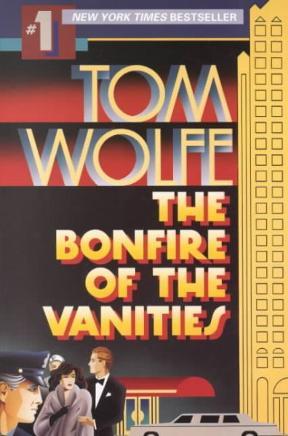
The Bonfire of the Vanities is a 1987 satirical novel by Tom Wolfe. The story is a drama about ambition, racism, social class, politics, and greed in 1980s New York City, and centers on three main characters: WASP bond trader Sherman McCoy, Jewish assistant district attorney Larry Kramer, and British expatriate journalist Peter Fallow.
The novel was originally conceived as a serial in the style of Charles Dickens’ writings: It ran in 27 installments in Rolling Stone starting in 1984. Wolfe heavily revised it before it was published in book form. The novel was a bestseller and a phenomenal success, even in comparison with Wolfe’s other books. It has often been called the quintessential novel of the 1980s.
It is a stunningly eventful day in the life of Eric Packer, a multi-billionaire who has recently married the heiress of a vast European fortune. A violent protest is being staged by anti-globalist groups and Eric fears that he may be a target. He is very much the target - but not by the protestors.
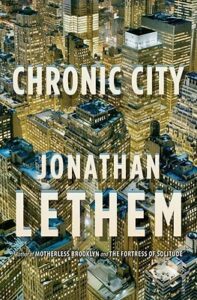
The acclaimed author of Motherless Brooklyn and The Fortress of Solitude returns with a roar with this gorgeous, searing portrayal of Manhattanites wrapped in their own delusions, desires, and lies.
Chase Insteadman, a handsome, inoffensive fixture on Manhattan's social scene, lives off residuals earned as a child star on a beloved sitcom called Martyr & Pesty. Chase owes his current social cachet to an ongoing tragedy much covered in the tabloids: His teenage sweetheart and fiancée, Janice Trumbull, is trapped by a layer of low-orbit mines on the International Space Station, from which she sends him rapturous and heartbreaking love letters. Like Janice, Chase is adrift, she in Earth's stratosphere, he in a vague routine punctuated by Upper East Side dinner parties.
Into Chase's cloistered city enters Perkus Tooth, a wall-eyed free-range pop critic whose soaring conspiratorial riffs are fueled by high-grade marijuana, mammoth cheeseburgers, and a desperate ache for meaning. Perkus's countercultural savvy and voracious paranoia draw Chase into another Manhattan, where questions of what is real, what is fake, and who is complicit take on a life-shattering urgency. Along with Oona Laszlo, a self-loathing ghostwriter, and Richard Abneg, a hero of the Tompkins Square Park riot now working as a fixer for the billionaire mayor, Chase and Perkus attempt to unearth the answers to several mysteries that seem to offer that rarest of artifacts on an island where everything can be bought: Truth.
Like Manhattan itself, Jonathan Lethem's masterpiece is beautiful and tawdry, tragic and forgiving, devastating and antic, a stand-in for the whole world and a place utterly unique.
From the prize-winning author of Motherless Brooklyn, a daring, riotous, sweeping novel that spins the tale of two friends and their adventures in late 20th-century America.
This is the story of two boys, Dylan Ebdus and Mingus Rude. They live in Brooklyn and are friends and neighbours; but since Dylan is white and Mingus is black, their friendship is not simple.
This is the story of 1970s America, a time when the simplest decisions—what music you listen to, whether to speak to the kid in the seat next to you, whether to give up your lunch money—are laden with potential political, social and racial disaster. This is also the story of 1990s America, when nobody cared anymore.
This is the story of what would happen if two teenaged boys obsessed with comic book heroes actually had superpowers: they would screw up their lives.
In the dawning light of a late-summer morning, the people of lower Manhattan stand hushed, staring up in disbelief at the Twin Towers. It is August 1974, and a mysterious tightrope walker is running, dancing, leaping between the towers, suspended a quarter mile above the ground. In the streets below, a slew of ordinary lives become extraordinary in bestselling novelist Colum McCann’s stunningly intricate portrait of a city and its people. Let the Great World Spin is the critically acclaimed author’s most ambitious novel yet: a dazzlingly rich vision of the pain, loveliness, mystery, and promise of New York City in the 1970s.
Corrigan, a radical young Irish monk, struggles with his own demons as he lives among the prostitutes in the middle of the burning Bronx. A group of mothers gather in a Park Avenue apartment to mourn their sons who died in Vietnam, only to discover just how much divides them even in grief. A young artist finds herself at the scene of a hit-and-run that sends her own life careening sideways. Tillie, a thirty-eight-year-old grandmother, turns tricks alongside her teenage daughter, determined not only to take care of her family but to prove her own worth.
Elegantly weaving together these and other seemingly disparate lives, McCann’s powerful allegory comes alive in the unforgettable voices of the city’s people, unexpectedly drawn together by hope, beauty, and the “artistic crime of the century.” A sweeping and radical social novel, Let the Great World Spin captures the spirit of America in a time of transition, extraordinary promise, and, in hindsight, heartbreaking innocence. Hailed as a “fiercely original talent” (San Francisco Chronicle), award-winning novelist McCann has delivered a triumphantly American masterpiece that awakens in us a sense of what the novel can achieve, confront, and even heal.
Few novels have caused as much debate as Hubert Selby Jr.'s notorious masterpiece, Last Exit to Brooklyn, and this Penguin Modern Classics edition includes an introduction by Irvine Welsh, author of Trainspotting.
Described by various reviewers as hellish and obscene, Last Exit to Brooklyn tells the stories of New Yorkers who at every turn confront the worst excesses in human nature. Yet there are moments of exquisite tenderness in these troubled lives. Georgette, the transvestite who falls in love with a callous hoodlum; Tralala, the conniving prostitute who plumbs the depths of sexual degradation; and Harry, the strike leader who hides his true desires behind a boorish masculinity, are unforgettable creations. Last Exit to Brooklyn was banned by British courts in 1967, a decision that was reversed the following year with the help of a number of writers and critics including Anthony Burgess and Frank Kermode.
Hubert Selby, Jr. (1928-2004) was born in Brooklyn, New York. At the age of 15, he dropped out of school and went to sea with the merchant marines. While at sea he was diagnosed with lung disease. With no other way to make a living, he decided to try writing: 'I knew the alphabet. Maybe I could be a writer.' In 1964 he completed his first book, Last Exit to Brooklyn, which has since become a cult classic. In 1966, it was the subject of an obscenity trial in the UK. His other books include The Room, The Demon, Requiem for a Dream, The Willow Tree and Waiting Period. In 2000, Requiem for a Dream was adapted into a film starring Jared Leto and Ellen Burstyn, and directed by Darren Aronofsky.
'Last Exit to Brooklyn will explode like a rusty hellish bombshell over America, and still be eagerly read in 100 years' Allen Ginsberg
A gargantuan, mind-altering tragi-comedy about the Pursuit of Happiness in America.
Set in an addicts' halfway house and a tennis academy, and featuring the most endearingly screwed-up family to come along in recent fiction, Infinite Jest explores essential questions about what entertainment is and why it has come to so dominate our lives; about how our desire for entertainment affects our need to connect with other people; and about what the pleasures we choose say about who we are.
Equal parts philosophical quest and screwball comedy, Infinite Jest bends every rule of fiction without sacrificing for a moment its own entertainment value. It is an exuberant, uniquely American exploration of the passions that make us human—and one of those rare books that renew the idea of what a novel can do.
Raised from birth in the orphanage at St. Cloud's, Maine, Homer Wells has become the protege of Dr. Wilbur Larch, its physician and director. There Dr. Larch cares for the troubled mothers who seek his help, either by delivering and taking in their unwanted babies or by performing illegal abortions. Meticulously trained by Dr. Larch, Homer assists in the former, but draws the line at the latter. Then a young man brings his beautiful fiancee to Dr. Larch for an abortion, and everything about the couple beckons Homer to the wide world outside the orphanage ...
This is the life and times of T. S. Garp, the bastard son of Jenny Fields—a feminist leader ahead of her times. This is the life and death of a famous mother and her almost-famous son; theirs is a world of sexual extremes—even of sexual assassinations. It is a novel rich with "lunacy and sorrow"; yet the dark, violent events of the story do not undermine a comedy both ribald and robust. In more than thirty languages, in more than forty countries—with more than ten million copies in print—this novel provides almost cheerful, even hilarious evidence of its famous last line: "In the world according to Garp, we are all terminal cases."
Welcome Back!
Track your reading progress and sync your library.