Fifteen years after their mother walked out on them and their father, twenty-seven-year-old Charlene, and her sister Stacy open a box that their father keeps his secrets hidden away in. What they learn changes everything, what really happened to their mother.
With two team members in the hospital and another traumatized by their last near-fatal case, Special Agent Emma Last and her partner are the only ones left standing—and the only ones available to tackle a gruesome murder in Boston.
If Emma can survive the drive through Salem.
Her increasing encounters with the Other and the terrifying dreams that haunt her are nothing compared to the disturbing pull of her childhood home. But making peace with the Other will have to wait.
The husband of a local politician has been found murdered, his naked body—minus a certain appendage—thrown from the rooftop of a high-class hotel, the Roman numeral one carved in his chest. The case seems cut and dried. The victim’s wife is running for mayor, and with all but one of her opponents suspiciously forced out of the race, his murder reeks of a warning message.
Until the prime suspect turns up dead.
With leads piling up as fast as the bodies, the countdown is on. Because if two follows one, then the killer has his sights on victim three. Unless Emma can stop him first.
Last Vote, the tenth book in the Emma Last series by bestselling author Mary Stone, gives new meaning to taking a pound of flesh.
In the small town of Hart's Ridge, a recent tragedy leaves the tight-knit community still reeling. In the highly anticipated ninth installment of the Hart's Ridge small-town mystery series, "Blackbird," Deputy Taylor Gray finds herself supporting a colleague through a painful journey of letting go.
Meanwhile, a young woman and her children must flee from her abusive ex-partner, seeking refuge and safety. Deputy Gray becomes entangled in their plight, blurring the lines between duty and personal conviction.
"Blackbird" masterfully intertwines these dual plot lines, exploring the complexities of small-town life and the resilience of its residents. Brace yourself for an exhilarating journey to the heart of Hart's Ridge—a ride that promises to captivate readers until the final, unforgettable page.
The finale to A Good Girl's Guide to Murder series. By the end of this mystery series, you'll never think of good girls the same way again...
Pip is about to head to college, but she is still haunted by the way her last investigation ended. She’s used to online death threats in the wake of her viral true-crime podcast, but she can’t help noticing an anonymous person who keeps asking her: Who will look for you when you’re the one who disappears?
Soon the threats escalate and Pip realizes that someone is following her in real life. When she starts to find connections between her stalker and a local serial killer caught six years ago, she wonders if maybe the wrong man is behind bars.
Police refuse to act, so Pip has only one choice: find the suspect herself—or be the next victim. As the deadly game plays out, Pip discovers that everything in her small town is coming full circle... and if she doesn’t find the answers, this time she will be the one who disappears...
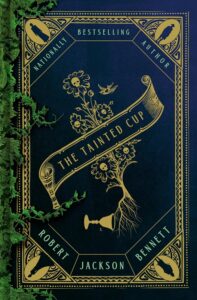
In Daretana’s most opulent mansion, a high Imperial officer lies dead—killed, to all appearances, when a tree spontaneously erupted from his body. Even in this canton at the borders of the Empire, where contagions abound and the blood of the Leviathans works strange magical changes, it’s a death at once terrifying and impossible.
Called in to investigate this mystery is Ana Dolabra, an investigator whose reputation for brilliance is matched only by her eccentricities.
At her side is her new assistant, Dinios Kol. Din is an engraver, magically altered to possess a perfect memory. His job is to observe and report, and act as his superior’s eyes and ears--quite literally, in this case, as among Ana’s quirks are her insistence on wearing a blindfold at all times, and her refusal to step outside the walls of her home.
Din is most perplexed by Ana’s ravenous appetite for information and her mind’s frenzied leaps—not to mention her cheerful disregard for propriety and the apparent joy she takes in scandalizing her young counterpart. Yet as the case unfolds and Ana makes one startling deduction after the next, he finds it hard to deny that she is, indeed, the Empire’s greatest detective.
As the two close in on a mastermind and uncover a scheme that threatens the safety of the Empire itself, Din realizes he’s barely begun to assemble the puzzle that is Ana Dolabra—and wonders how long he’ll be able to keep his own secrets safe from her piercing intellect.
Featuring an unforgettable Holmes-and-Watson style pairing, a gloriously labyrinthine plot, and a haunting and wholly original fantasy world, The Tainted Cup brilliantly reinvents the classic mystery tale.
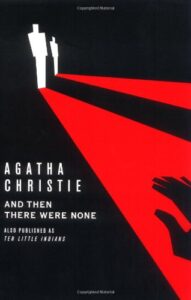
First, there were ten—a curious assortment of strangers summoned as weekend guests to a little private island off the coast of Devon. Their host, an eccentric millionaire unknown to all of them, is nowhere to be found. All that the guests have in common is a wicked past they're unwilling to reveal—and a secret that will seal their fate. For each has been marked for murder. A famous nursery rhyme is framed and hung in every room of the mansion:
"Ten little boys went out to dine; One choked his little self and then there were nine. Nine little boys sat up very late; One overslept himself and then there were eight. Eight little boys traveling in Devon; One said he'd stay there then there were seven. Seven little boys chopping up sticks; One chopped himself in half and then there were six. Six little boys playing with a hive; A bumblebee stung one and then there were five. Five little boys going in for law; One got in Chancery and then there were four. Four little boys going out to sea; A red herring swallowed one and then there were three. Three little boys walking in the zoo; A big bear hugged one and then there were two. Two little boys sitting in the sun; One got frizzled up and then there was one. One little boy left all alone; He went out and hanged himself and then there were none."
When they realize that murders are occurring as described in the rhyme, terror mounts. One by one they fall prey. Before the weekend is out, there will be none. Who has choreographed this dastardly scheme? And who will be left to tell the tale? Only the dead are above suspicion.
A breakneck race against time...and an implacable enemy. An anonymous young woman murdered in a run-down hotel, all identifying characteristics dissolved by acid. A father publicly beheaded in the blistering heat of a Saudi Arabian public square. A notorious Syrian biotech expert found eyeless in a Damascus junkyard. Smoldering human remains on a remote mountainside in Afghanistan. A flawless plot to commit an appalling crime against humanity. One path links them all, and only one man can make the journey. Pilgrim.'
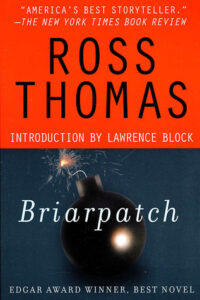
A long-distance call from a Texas city on his birthday gives Benjamin Dill the news that his sister—it's her birthday, too, they were born exactly ten years apart—has died in a car bomb explosion. It's the chief of police calling—Felicity Dill worked for him; she was a homicide detective. Dill is there that night, the beginning of his dogged search for her killer. What he finds is no surprise to him, because Benjamin Dill is never surprised at what awful things people will do—but it's a real surprise to the reader. As Newsday said when the novel was first published, "One sure thing about Ross Thomas's novels: A reader won't get bored waiting for the action to start."
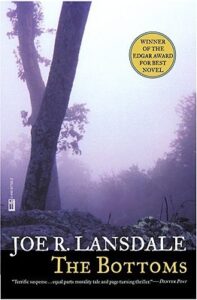
The narrator of The Bottoms is Harry Collins, an old man obsessively reflecting on certain key experiences of his childhood. In 1933, the year that forms the centerpiece of the narrative, Harry is 11 years old and living with his mother, father, and younger sister on a farm outside of Marvel Creek, Texas, near the Sabine River bottoms. Harry's world changes forever when he discovers the corpse of a young black woman tied to a tree in the forest near his home. The woman, who is eventually identified as a local prostitute, has been murdered, molested, and sexually mutilated. She is also, as Harry will soon discover, the first in a series of similar corpses, all of them the victims of a new, unprecedented sort of monster: a traveling serial killer.
From his privileged position as the son of constable (and farmer and part-time barber) Jacob Collins, Harry watches as the distinctly amateur investigation unfolds. As more bodies -- not all of them "colored" -- surface, the mood of the local residents darkens. Racial tensions -- never far from the surface, even in the best of times -- gradually kindle. When circumstantial evidence implicates an ancient, innocent black man named Mose, the Ku Klux Klan mobilizes, initiating a chilling, graphically described lynching that will occupy a permanent place in Harry Collins's memories. With Mose dead and the threat to local white women presumably put to rest, the residents of Marvel Creek resume their normal lives, only to find that the actual killer remains at large and continues to threaten the safety and stability of the town.
Lansdale uses this protracted murder investigation to open up a window on an insular, poverty-stricken, racially divided community. With humor, precision, and great narrative economy, he evokes the society of Marvel Creek in all its alternating tawdriness and nobility, offering us a varied, absolutely convincing portrait of a world that has receded into history. At the same time, he offers us a richly detailed re-creation of the vibrant, dangerous physical landscapes that were part of that world and have since been buried under the concrete and cement of the industrialized juggernaut of the late 20th century. In Lansdale's hands, the gritty realities of Depression-era Texas are as authentic -- and memorable -- as anything in recent American fiction.
Welcome Back!
Track your reading progress and sync your library.