Around a mysterious death is woven a glittering, fantastical, cunningly contrived trilogy of novels. Luring the reader down labyrinthine tunnels of myth, history, and magic, The Deptford Trilogy provides an exhilarating antidote to a world from where “the fear and dread and splendour of wonder have been banished.”
This daring literary thriller, rich with eroticism and suspense, is one of John Fowles's best-loved and bestselling novels and has contributed significantly to his international reputation as a writer of the first degree. At the center of The Magus is Nicholas Urfe, a young Englishman who accepts a teaching position on a remote Greek island, where he befriends a local millionaire. The friendship soon evolves into a deadly game, in which reality and fantasy are deliberately manipulated, and Nicholas finds that he must fight not only for his sanity but for his very survival.
G. K. Chesterton's surreal masterpiece is a psychological thriller that centers on seven anarchists in turn-of-the-century London who call themselves by the names of the days of the week. Chesterton explores the meanings of their disguised identities in what is a fascinating mystery and, ultimately, a spellbinding allegory.
As Jonathan Lethem remarks in his Introduction, The real characters are the ideas. Chesterton's nutty agenda is really quite simple: to expose moral relativism and parlor nihilism for the devils he believes them to be. This wouldn't be interesting at all, though, if he didn't also show such passion for giving the devil his due. He animates the forces of chaos and anarchy with every ounce of imaginative verve and rhetorical force in his body.
The Sirens of Titan is an outrageous romp through space, time, and morality. The richest, most depraved man on Earth, Malachi Constant, is offered a chance to take a space journey to distant worlds with a beautiful woman at his side. Of course there's a catch to the invitation—and a prophetic vision about the purpose of human life that only Vonnegut has the courage to tell.
Unique Elements Two of Wells’s best-loved science fiction novels
The Time Machine , H. G. Wells ’s first novel, was published in 1895. It is a tale of Darwinian evolution taken to its extreme. Its protagonist, a young scientist, travels 800,000 years into the future and discovers a dying earth inhabited by two bizarre humanoid the brutal Morlocks and the kind but nearly helpless Eloi.
The Invisible Man, first published in 1897 , tells the story of an adventurous scientist discovering the formula for invisibility—a secret that drives him mad. It combines chilling terror, suspense, and acute psychological insight.
Ramsay is a man twice born, a man who has returned from the hell of the battle-grave at Passchendaele in World War I decorated with the Victoria Cross and destined to be caught in a no man's land where memory, history, and myth collide. As Ramsay tells his story, it begins to seem that from boyhood, he has exerted a perhaps mystical, perhaps pernicious, influence on those around him. His apparently innocent involvement in such innocuous events as the throwing of a snowball or the teaching of card tricks to a small boy in the end prove neither innocent nor innocuous. Fifth Business stands alone as a remarkable story told by a rational man who discovers that the marvelous is only another aspect of the real.
A cuatro profesores de literatura, Pelletier, Morini, Espinoza y Norton, los une su fascinación por la obra de Beno von Archimboldi, un enigmático escritor alemán cuyo prestigio crece en todo el mundo. La complicidad se vuelve vodevil intelectual y desemboca en un peregrinaje a Santa Teresa (trasunto de Ciudad Juárez), donde hay quien dice que Archimboldi ha sido visto. Ya allí, Pelletier y Espinoza se enteran de que la ciudad es desde años atrás escenario de una larga cadena de crímenes: en los vertederos aparecen cadáveres de mujeres con señales de haber sido violadas y torturadas. Es el primer asomo de la novela a sus procelosos caudales, repletos de personajes memorables cuyas historias, a caballo entre la risa y el horror, abarcan dos continentes e incluyen un vertiginoso travelling por la historia europea del siglo XX. 2666 confirma el veredicto de Susan Sontag: "el más influyente y admirado novelista en lengua española de su generación. Su muerte, a los cincuenta años, es una gran pérdida para la literatura".
A doomed lord, an emergent hero, and a dazzling array of bizarre creatures inhabit the magical world of the Gormenghast novels which, along with Tolkien's Lord of the Rings, reign as one of the undisputed fantasy classics of all time. At the center of it all is the seventy-seventh Earl, Titus Groan, who stands to inherit the miles of rambling stone and mortar that form Gormenghast Castle and its kingdom, unless the conniving Steerpike, who is determined to rise above his menial position and control the House of Groan, has his way.
In these extraordinary novels, Peake has created a world where all is like a dream - lush, fantastical, and vivid. Accompanying the text are Peake's own drawings, illustrating the whole assembly of strange and marvelous creatures that inhabit Gormenghast.
Also featuring: Introductory essays by Anthony Burgess and Quentin Crisp Twelve critical essays, curated by Peake scholar Peter G. Winnington Fragment of the unpublished novel, Titus Awakes
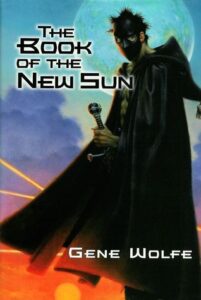
Recently voted the greatest fantasy of all time, after The Lord of the Rings and The Hobbit, Gene Wolfe's The Book of the New Sun is an extraordinary epic, set a million years in the future, on an Earth transformed in mysterious and wondrous ways, in a time when our present culture is no longer even a memory. Severian, the central character, is a torturer, exiled from his guild after falling in love with one of his victims, and journeying to the distant city of Thrax, armed with his ancient executioner's sword, Terminus Est. This edition contains the first four volumes of the series.
Welcome Back!
Track your reading progress and sync your library.