Around a mysterious death is woven a glittering, fantastical, cunningly contrived trilogy of novels. Luring the reader down labyrinthine tunnels of myth, history, and magic, The Deptford Trilogy provides an exhilarating antidote to a world from where “the fear and dread and splendour of wonder have been banished.”
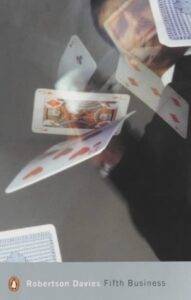
Ramsay is a man twice born, a man who has returned from the hell of the battle-grave at Passchendaele in World War I decorated with the Victoria Cross and destined to be caught in a no man's land where memory, history, and myth collide. As Ramsay tells his story, it begins to seem that from boyhood, he has exerted a perhaps mystical, perhaps pernicious, influence on those around him. His apparently innocent involvement in such innocuous events as the throwing of a snowball or the teaching of card tricks to a small boy in the end prove neither innocent nor innocuous. Fifth Business stands alone as a remarkable story told by a rational man who discovers that the marvelous is only another aspect of the real.
Andy, Dag and Claire have been handed a society priced beyond their means. Twentysomethings, brought up with divorce, Watergate and Three Mile Island, and scarred by the 80s fall-out of yuppies, recession, crack and Ronald Reagan, they represent the new generation — Generation X. Fiercely suspicious of being lumped together as an advertiser's target market, they have quit dreary careers and cut themselves adrift in the California desert. Unsure of their futures, they immerse themselves in a regime of heavy drinking and working at no-future McJobs in the service industry. Underemployed, overeducated, intensely private and unpredictable, they have nowhere to direct their anger, no one to assuage their fears, and no culture to replace their anomie. So they tell stories; disturbingly funny tales that reveal their barricaded inner world. A world populated with dead TV shows, 'Elvis moments' and semi-disposable Swedish furniture...
Margaret Atwood takes the art of storytelling to new heights in a dazzling novel that unfolds layer by astonishing layer and concludes in a brilliant and wonderfully satisfying twist. Told in a style that magnificently captures the colloquialisms and clichés of the 1930s and 1940s, The Blind Assassin is a richly layered and uniquely rewarding experience.
It opens with these simple, resonant words: "Ten days after the war ended, my sister drove a car off the bridge." They are spoken by Iris, whose terse account of her sister Laura's death in 1945 is followed by an inquest report proclaiming the death accidental. But just as the reader expects to settle into Laura's story, Atwood introduces a novel-within-a-novel. Entitled The Blind Assassin, it is a science fiction story told by two unnamed lovers who meet in dingy backstreet rooms. When we return to Iris, it is through a 1947 newspaper article announcing the discovery of a sailboat carrying the dead body of her husband, a distinguished industrialist.
For the past twenty-five years, Margaret Atwood has written works of striking originality and imagination. In The Blind Assassin, she stretches the limits of her accomplishments as never before, creating a novel that is entertaining and profoundly serious. The Blind Assassin proves once again that Atwood is one of the most talented, daring, and exciting writers of our time. Like The Handmaid's Tale, it is destined to become a classic.
This daring literary thriller, rich with eroticism and suspense, is one of John Fowles's best-loved and bestselling novels and has contributed significantly to his international reputation as a writer of the first degree. At the center of The Magus is Nicholas Urfe, a young Englishman who accepts a teaching position on a remote Greek island, where he befriends a local millionaire. The friendship soon evolves into a deadly game, in which reality and fantasy are deliberately manipulated, and Nicholas finds that he must fight not only for his sanity but for his very survival.
G. K. Chesterton's surreal masterpiece is a psychological thriller that centers on seven anarchists in turn-of-the-century London who call themselves by the names of the days of the week. Chesterton explores the meanings of their disguised identities in what is a fascinating mystery and, ultimately, a spellbinding allegory.
As Jonathan Lethem remarks in his Introduction, The real characters are the ideas. Chesterton's nutty agenda is really quite simple: to expose moral relativism and parlor nihilism for the devils he believes them to be. This wouldn't be interesting at all, though, if he didn't also show such passion for giving the devil his due. He animates the forces of chaos and anarchy with every ounce of imaginative verve and rhetorical force in his body.
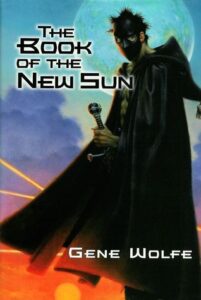
Recently voted the greatest fantasy of all time, after The Lord of the Rings and The Hobbit, Gene Wolfe's The Book of the New Sun is an extraordinary epic, set a million years in the future, on an Earth transformed in mysterious and wondrous ways, in a time when our present culture is no longer even a memory. Severian, the central character, is a torturer, exiled from his guild after falling in love with one of his victims, and journeying to the distant city of Thrax, armed with his ancient executioner's sword, Terminus Est. This edition contains the first four volumes of the series.
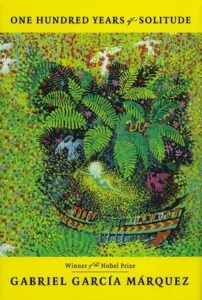
Probably García Márquez finest and most famous work. One Hundred Years of Solitude tells the story of the rise and fall, birth and death of a mythical town of Macondo through the history of the Buendia family. Inventive, amusing, magnetic, sad, alive with unforgettable men and women, and with a truth and understanding that strike the soul. One Hundred Years of Solitude is a masterpiece of the art of fiction.
The astonishing novel Brave New World, originally published in 1932, presents Aldous Huxley's vision of the future--of a world utterly transformed. Through the most efficient scientific and psychological engineering, people are genetically designed to be passive and therefore consistently useful to the ruling class. This powerful work of speculative fiction sheds a blazing critical light on the present and is considered to be Aldous Huxley's most enduring masterpiece.
The non-fiction work Brave New World Revisited, published in 1958, is a fascinating work in which Huxley uses his tremendous knowledge of human relations to compare the modern-day world with his prophetic fantasy envisioned in Brave New World, including the threats to humanity, such as over-population, propaganda, and chemical persuasion.
Welcome Back!
Track your reading progress and sync your library.