In The Divine Invasion, Philip K. Dick asks: What if God — or a being called Yah — were alive and in exile on a distant planet? How could a second coming succeed against the high technology and finely tuned rationalized evil of the modern police state?
The Divine Invasion “blends Judaism, Kabalah, Zoroastrianism, and Christianity into a fascinating fable of human existence” —West Coast Review of Books
VALIS is the first book in Philip K. Dick's incomparable final trio of novels (the others being The Divine Invasion and The Transmigration of Timothy Archer). This disorienting and bleakly funny work is about a schizophrenic hero named Horselover Fat; the hidden mysteries of Gnostic Christianity; and reality as revealed through a pink laser. VALIS is a theological detective story, in which God is both a missing person and the perpetrator of the ultimate crime.
The novel has very little, if any, science fiction. An interstellar voyage is depicted solely to provide a mostly superficial and perfunctory framework to the narration. The book was written at a time when it was no longer possible to conceive strange lands in the antipodes (as in Jonathan Swift's Gulliver's Travels, or in Thomas More's Utopia), and so these have to be set at Tormance, an imaginary planet orbiting Arcturus, which, in the novel (but not in reality), is a double star consisting of stars Branchspell and Alppain. (The choice may have been inspired by the nonfictional A Voyage to the Arctic in the Whaler Aurora published in 1911 by an identically-named David Moore Lindsay.) The lands are used to represent philosophical systems, or states of mind, through which the main character, Maskull, passes on his search for the meaning of life.
Maskull is depicted as a man longing for adventures, who accepts an invitation from Krag, an acquaintance of his friend Nightspore, to travel to Tormance. The three set off from an abandoned observatory in Scotland but Maskull finds himself alone in Tormance. In every land he passes through he usually meets only one or two persons; these meetings often (though not always) end in the death of those he meets. He learns of his impending death, meets Krag again, and dies shortly after learning that he is Nightspore himself. The book concludes with a final revelation from Krag (who claims to be known on Earth as "Pain") to Nightspore about the origin of the Universe.
All characters and lands are types used to convey the author's critique of several philosophical systems. (That is why the inhabitants of Tormance are so few; they suffice to make the point they are intended for.) The author turns out to support a variation of the doctrine of the Demiurge, somewhat similar to that defended by some Gnostics.
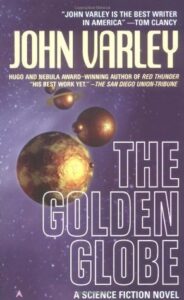
Winner of the Hugo and Nebula Awards, John Varley is truly one of the "greats" of science fiction, comparable only to Heinlein, Herbert, Asimov, and Clark. Now the all-time master returns -- with his long-awaited epic novel of life beyond the great beyond...All the universe is a stage, and Sparky Valentine is its itinerant thespian. He makes his way from planet to planet as part of a motley theater troupe, bringing Shakespeare -- a version of it anyway -- to the outer reaches of earth's solar system. He journeys through the outlands, where thousands of artificial satellites drift, conglomerates of junk and rock welded together to support meager communities of human life. Here Sparky plies his trade, transforming himself from young to old, fat to thin, man to woman, by altering magnetic implants beneath his skin. Indispensable hardware for a career actor and an interstellar con man wanted for murder -- for while Sparky Valentine may have a song in his heart, he also has a price on his head. But his galactic roamings are bringing him closer to home, closer to justice -- and closer to the truth of his strange and prolonged existence...
Mary Doria Russell's debut novel, The Sparrow, took us on a journey to a distant planet and into the center of the human soul. A critically acclaimed bestseller, The Sparrow was chosen as one of Entertainment Weekly's Ten Best Books of the Year, a finalist for the Book-of-the-Month Club's First Fiction Prize and the winner of the James M. Tiptree Memorial Award. Now, in Children of God, Russell further establishes herself as one of the most innovative, entertaining and philosophically provocative novelists writing today.
The only member of the original mission to the planet Rakhat to return to Earth, Father Emilio Sandoz has barely begun to recover from his ordeal when the Society of Jesus calls upon him for help in preparing for another mission to Alpha Centauri. Despite his objections and fear, he cannot escape his past or the future.
Old friends, new discoveries and difficult questions await Emilio as he struggles for inner peace and understanding in a moral universe whose boundaries now extend beyond the solar system and whose future lies with children born in a faraway place.
Strikingly original, richly plotted, replete with memorable characters and filled with humanity and humor, Children of God is an unforgettable and uplifting novel that is a potent successor to The Sparrow and a startlingly imaginative adventure for newcomers to Mary Doria Russell’s special literary magic.
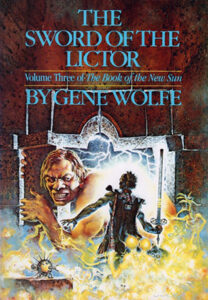
Severian the Torturer, possessor of the miracle-producing gem, the Claw of the Conciliator, experiences strange adventures as he journeys across the savage land of Urth
The Shadow of the Torturer is the tale of young Severian, an apprentice in the Guild of Torturers on the world called Urth, exiled for committing the ultimate sin of his profession -- showing mercy toward his victim.
The Claw of the Conciliator continues the saga of Severian, banished from his home, as he undertakes a mythic quest to discover the awesome power of an ancient relic, and learn the truth about his hidden destiny.
The Book of the New Sun is unanimously acclaimed as Gene Wolfe's most remarkable work, hailed as "a masterpiece of science fantasy comparable in importance to the major works of Tolkien and Lewis" by Publishers Weekly, and "one of the most ambitious works of speculative fiction in the twentieth century" by The Magazine of Fantasy and Science Fiction. Shadow & Claw brings together the first two books of the tetralogy in one volume.
Fraa Erasmas is a young avout living in the Concent of Saunt Edhar, a sanctuary for mathematicians, scientists, and philosophers, protected from the corrupting influences of the outside "saecular" world by ancient stone, honored traditions, and complex rituals. Over the centuries, cities and governments have risen and fallen beyond the concent's walls. Three times during history's darkest epochs violence born of superstition and ignorance has invaded and devastated the cloistered mathic community. Yet the avout have always managed to adapt in the wake of catastrophe, becoming out of necessity even more austere and less dependent on technology and material things. And Erasmas has no fear of the outside—the Extramuros—for the last of the terrible times was long, long ago.
Now, in celebration of the week-long, once-in-a-decade rite of Apert, the fraas and suurs prepare to venture beyond the concent's gates—at the same time opening them wide to welcome the curious "extras" in. During his first Apert as a fraa, Erasmas eagerly anticipates reconnecting with the landmarks and family he hasn't seen since he was "collected." But before the week is out, both the existence he abandoned and the one he embraced will stand poised on the brink of cataclysmic change.
Powerful unforeseen forces jeopardize the peaceful stability of mathic life and the established ennui of the Extramuros—a threat that only an unsteady alliance of saecular and avout can oppose—as, one by one, Erasmas and his colleagues, teachers, and friends are summoned forth from the safety of the concent in hopes of warding off global disaster. Suddenly burdened with a staggering responsibility, Erasmas finds himself a major player in a drama that will determine the future of his world—as he sets out on an extraordinary odyssey that will carry him to the most dangerous, inhospitable corners of the planet . . . and beyond.
Welcome Back!
Track your reading progress and sync your library.