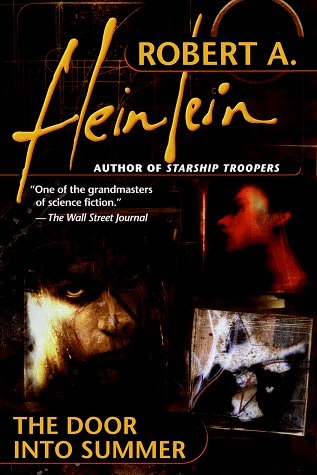
Electronics engineer Dan Davis has finally made the invention of a lifetime: a household robot with extraordinary abilities, destined to dramatically change the landscape of everyday routine. Then, Dan was tricked by an unscrupulous greedy business partner and a greedier fiancee into spending thirty years in suspended animation, the long sleep, just when he was on the verge of a success beyond his wildest dreams.
They never imagine that the future time in which Dan, a modern-day and future-time, Rip Van Winkle, will awaken has mastered time travel, giving him a way to get back to them, and at them, and get his revenge!.
The capstone and crowning achievement of Heinlein's famous Future History, Time Enough for Love follows Lazarus Long through a vast and magnificent timescape of centuries and worlds. Heinlein's longest and most ambitious work, it is the story of a man so in love with Life that he refused to stop living it; and so in love with Time that he became his own ancestor.
Andrew Harlan is an Eternal, a man whose job it is to range through past and present Centuries, monitoring and, where necessary, altering Time's myriad cause-and-effect relationships. But when Harlan meets and falls for a non-Eternal woman, he seeks to use the awesome powers and techniques of the Eternals to twist time for his own purposes, so that he and his love can survive together.
The multiple-award-winning SF master returns to the universe that is his greatest success--the world of Hyperion and The Fall of Hyperion--to tell a story of love and memory, triumph and terror in a novel even more magnificent than its predecessors.
Two hundred and seventy-four years after the fall of the WorldWeb in Fall of Hyperion, Raoul Endymion is sent on a quest. Retrieving Aenea from the Sphinx before the Church troops reach her is only the beginning. With help from a blue-skinned android named A. Bettik, Raoul and Aenea travel the river Tethys, pursued by Father Captain Frederico DeSoya, an influential warrior-priest and his troops. The shrike continues to make enigmatic appearances, and while many questions were raised in Hyperion and Fall of Hyperion, still more are raised here. Raoul's quest will continue.
In the stunning continuation of the epic adventure begun in Hyperion, Simmons returns us to a far future resplendent with drama and invention. On the world of Hyperion, the mysterious Time Tombs are opening. And the secrets they contain mean that nothing--nothing anywhere in the universe--will ever be the same.
When a stranger attempting to deliver a cryptic message is shot dead at his table, Dr. Richard Ames is thrown headfirst into danger, intrigue, and other dimensions, where a plot to rescue a sentient computer could alter human history...
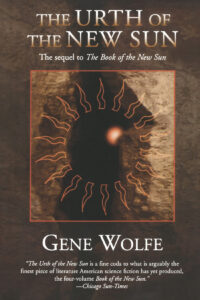
The long awaited sequel to Gene Wolfe’s four-volume classic, The Book of the New Sun. We return to the world of Severian, now the Autarch of Urth, as he leaves the planet on one of the huge spaceships of the alien Hierodules to travel across time and space to face his greatest test, to become the legendary New Sun or die. The strange, rich, original spaceship scenes give way to travels in time, wherein Severian revisits times and places which fill in parts of the background of the four-volume work, that will thrill and intrigue particularly all readers of the earlier books. But The Urth of the New Sun is an independent structure all of a piece, an integral masterpiece to shelve beside the classics, one itself.
When the Time Traveller courageously stepped out of his machine for the first time, he found himself in the year 802,700--and everything had changed. In this unfamiliar, utopian age creatures seemed to dwell together in perfect harmony. The Time Traveller thought he could study these marvelous beings--unearth their secret and then return to his own time--until he discovered that his invention, his only avenue of escape, had been stolen.
H. G. Wells's famous novel of one man's astonishing journey beyond the conventional limits of the imagination first appeared in 1895. It won him immediate recognition and has been regarded ever since as one of the great masterpieces in the literature of science fiction.
The War of the Worlds
H. G. Wells's science fiction classic, the first novel to explore the possibilities of intelligent life from other planets, is still startling and vivid nearly a century after its appearance, and a half century after Orson Welles's infamous 1938 radio adaptation.
This daring portrayal of aliens landing on English soil, with its themes of interplanetary imperialism, technological holocaust, and chaos, is central to the career of H. G. Wells, who died at the dawn of the atomic age. The survival of mankind in the face of "vast and cool and unsympathetic" scientific powers spinning out of control was a crucial theme throughout his work. Visionary, shocking, and chilling, The War of the Worlds has lost none of its impact since its first publication in 1898.
For Kivrin, preparing an on-site study of one of the deadliest eras in humanity's history was as simple as receiving inoculations against the diseases of the fourteenth century and inventing an alibi for a woman traveling alone. For her instructors in the twenty-first century, it meant painstaking calculations and careful monitoring of the rendezvous location where Kivrin would be received.
But a crisis strangely linking past and future strands Kivrin in a bygone age as her fellows try desperately to rescue her. In a time of superstition and fear, Kivrin--barely of age herself--finds she has become an unlikely angel of hope during one of history's darkest hours.
Connie Willis draws upon her understanding of the universalities of human nature to explore the ageless issues of evil, suffering, and the indomitable will of the human spirit.
Welcome Back!
Track your reading progress and sync your library.