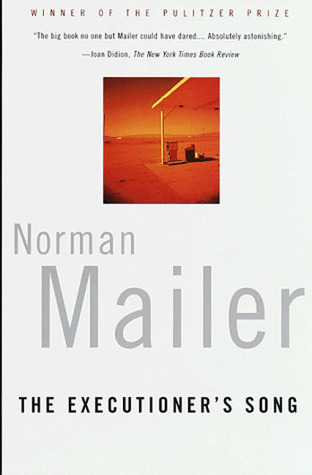
In what is arguably his greatest work, America’s most heroically ambitious writer follows the short, blighted career of Gary Gilmore, an intractably violent product of America’s prisons who became notorious for two reasons: first, for robbing two men in 1976, then killing them in cold blood; and, second, after being tried and convicted, for insisting on dying for his crime. To do so, he had to fight a system that seemed paradoxically intent on keeping him alive long after it had sentenced him to death.
Norman Mailer tells Gilmore’s story–and those of the men and women caught up in his procession toward the firing squad–with implacable authority, steely compassion, and a restraint that evokes the parched landscapes and stern theology of Gilmore’s Utah. The Executioner’s Song is a trip down the wrong side of the tracks to the deepest sources of American loneliness and violence. It is a towering achievement–impossible to put down, impossible to forget.
This unusual fictional memoir - in good part autobiographical - narrates without self-pity and often with humor the adventures of a penniless British writer among the down-and-outs of two great cities. The Parisian episode is fascinating for its expose of the kitchens of posh French restaurants, where the narrator works at the bottom of the culinary echelon as dishwasher, or plongeur. In London, while waiting for a job, he experiences the world of tramps, street people, and free lodging houses. In the tales of both cities we learn some sobering Orwellian truths about poverty and of society.
Prosecuting attorney in the Manson trial, Vincent Bugliosi held a unique insider's position in one of the most baffling and horrifying cases of the twentieth century: the cold-blooded Tate-LaBianca murders carried out by Charles Manson and four of his followers. What motivated Manson in his seemingly mindless selection of victims, and what was his hold over the young women who obeyed his orders? Here is the gripping story of this famous and haunting crime. 50 pages of b/w photographs.
Discovered in the attic where she spent the final years of her life, Anne Frank’s Diary has become a timeless classic; a powerful reminder of the horrors of war and a moving testament to the resilience of the human spirit.
In 1942, as the Nazis occupied Holland, thirteen-year-old Anne Frank and her Jewish family fled their home in Amsterdam and went into hiding. For the next two years, until they were betrayed to the Gestapo, the Franks and another family lived in the cramped “Secret Annexe” of an old office building. Cut off from the outside world, they endured hunger, boredom, the strain of close quarters, and the constant fear of discovery and death.
Through it all, Anne documented her experiences in a diary filled with vivid observations. At times thoughtful, poignant, and even unexpectedly funny, her writing offers a remarkable window into the strength and vulnerability of the human spirit. It’s both a compelling self-portrait of a bright, spirited young woman and a heartbreaking glimpse of a life that should have been far longer.
Author Erik Larson imbues the incredible events surrounding the 1893 Chicago World's Fair with such drama that readers may find themselves checking the book's categorization to be sure that 'The Devil in the White City' is not, in fact, a highly imaginative novel. Larson tells the stories of two men: Daniel H. Burnham, the architect responsible for the fair's construction, and H.H. Holmes, a serial killer masquerading as a charming doctor.
Burnham's challenge was immense. In a short period of time, he was forced to overcome the death of his partner and numerous other obstacles to construct the famous "White City" around which the fair was built. His efforts to complete the project, and the fair's incredible success, are skillfully related along with entertaining appearances by such notables as Buffalo Bill Cody, Susan B. Anthony, and Thomas Edison.
The activities of the sinister Dr. Holmes, who is believed to be responsible for scores of murders around the time of the fair, are equally remarkable. He devised and erected the World's Fair Hotel, complete with crematorium and gas chamber, near the fairgrounds and used the event as well as his own charismatic personality to lure victims.
Combining the stories of an architect and a killer in one book, mostly in alternating chapters, seems like an odd choice but it works. The magical appeal and horrifying dark side of 19th-century Chicago are both revealed through Larson's skillful writing. - John Moe
In the Deep South of the 1950s, journalist John Howard Griffin decided to cross the color line. Using medication that darkened his skin to deep brown, he exchanged his privileged life as a Southern white man for the disenfranchised world of an unemployed black man. His audacious, still chillingly relevant eyewitness history is a work about race and humanity-that in this new millennium still has something important to say to every American.
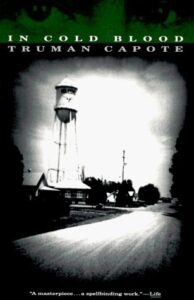
On November 15, 1959, in the small town of Holcomb, Kansas, four members of the Clutter family were savagely murdered by blasts from a shotgun held a few inches from their faces. There was no apparent motive for the crime, and there were almost no clues.
As Truman Capote reconstructs the murder and the investigation that led to the capture, trial, and execution of the killers, he generates both mesmerizing suspense and astonishing empathy. In Cold Blood is a work that transcends its moment, yielding poignant insights into the nature of American violence.
A multilayered, bone-chilling narrative of messianic delusion, savage violence, polygamy, and unyielding faith. This is vintage Krakauer, an utterly compelling work of nonfiction that illuminates an otherwise confounding realm of human behavior.
Jon Krakauer’s literary reputation rests on insightful chronicles of lives conducted at the outer limits. In Under The Banner of Heaven: A Story of Violent Faith, he shifts his focus from extremes of physical adventure to extremes of religious belief within our own borders. At the core of his book is an appalling double murder committed by two Mormon Fundamentalist brothers, Ron and Dan Lafferty, who insist they received a revelation from God commanding them to kill their blameless victims. Beginning with a meticulously researched account of this "divinely inspired" crime, Krakauer constructs a multilayered, bone-chilling narrative of messianic delusion, savage violence, polygamy, and unyielding faith. Along the way, he uncovers a shadowy offshoot of America’s fastest-growing religion, and raises provocative questions about the nature of religious belief.
Krakauer takes readers inside isolated communities in the American West, Canada, and Mexico, where some forty-thousand Mormon Fundamentalists believe the mainstream Mormon Church went unforgivably astray when it renounced polygamy. Defying both civil authorities and the Mormon establishment in Salt Lake City, the leaders of these outlaw sects are zealots who answer only to God. Marrying prodigiously and with virtual impunity (the leader of the largest fundamentalist church took seventy-five "plural wives," several of whom were wed to him when they were fourteen or fifteen and he was in his eighties), fundamentalist prophets exercise absolute control over the lives of their followers, and preach that any day now the world will be swept clean in a hurricane of fire, sparing only their most obedient adherents.
Weaving the story of the Lafferty brothers and their fanatical brethren with a clear-eyed look at Mormonism’s violent past, Krakauer examines the underbelly of the most successful homegrown faith in the United States, and finds a distinctly American brand of religious extremism. The result is vintage Krakauer, an utterly compelling work of nonfiction that illuminates an otherwise confounding realm of human behavior.
Welcome Back!
Track your reading progress and sync your library.