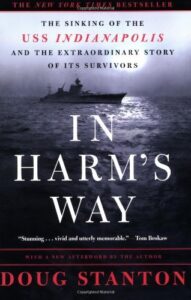
A harrowing, adrenaline-charged account of America's worst naval disaster — and of the heroism of the men who, against all odds, survived. Interweaving the stories of survivors, Doug Stanton has brought this astonishing human drama to life in a narrative that is at once immediate and timeless. The definitive account of a little-known chapter in World War II history, In Harm's Way is destined to become a classic tale of war, survival, and extraordinary courage.
On July 30, 1945, the USS Indianapolis was torpedoed in the South Pacific by a Japanese submarine. An estimated 300 men were killed upon impact; close to 900 sailors were cast into the Pacific Ocean, where they remained undetected by the navy for nearly four days and nights. Battered by a savage sea, they struggled to stay alive, fighting off sharks, hypothermia, and dementia. The captain's subsequent court-martial left many questions unanswered: How did the navy fail to realize the Indianapolis was missing? And perhaps most amazing of all, how did these 317 men manage to survive?
As good a rifle company as any, Easy Company, 506th Airborne Division, US Army, kept getting tough assignments--responsible for everything from parachuting into France early DDay morning to the capture of Hitler's Eagle's Nest at Berchtesgaden. In "Band of Brothers," Ambrose tells of the men in this brave unit who fought, went hungry, froze & died, a company that took 150% casualties & considered the Purple Heart a badge of office. Drawing on hours of interviews with survivors as well as the soldiers' journals & letters, Stephen Ambrose recounts the stories, often in the men's own words, of these American heroes. Foreword "We wanted those wings"; Camp Toccoa, 7-12/42 "Stand up & hook up"; Benning, Mackall, Bragg, Shanks, 12/42-9/43 "Duties of the latrine orderly"; Aldbourne, 9/43-3/44 "Look out, Hitler! Here we come!"; Slapton Sands, Uppottery, 4/1-6/5/44 "Follow me"; Normandy, 6/6/44 "Move out!"; Carentan, 6/7-7/12/44 Healing wounds & scrubbed missions; Aldbourne, 7/13-9/16/44 "Hell's highway"; Holland, 9/17-10/1/44 Island; Holland, 10/2-11/25/44 Resting, recovering & refitting: Mourmelon-le-Grand, 11/26-12/18/44 "They got us surrounded-the poor bastards"; Bastogne, 12/19-31/44 Breaking point; Bastogne, 1/1-13/45 Attack; Noville, 1/14-17/45 Patrol: Haguenau, 1/18-2/23/45 "Best feeling in the world": Mourmelon, 2/25-4/2/45 Getting to know the enemy: Germany, 4/2-30/45 Drinking Hitler's champagne; Berchtesgaden, 5/1-8/45 Soldier's dream life; Austria, 5/8-7/31/45 Postwar careers; 1945-91 Acknowledgments & Sources Index
WAS THE JAPANESE ATTACK ON PEARL HARBOR INEVITABLE?
It’s November 1941. Japan and the US are teetering on a knife-edge as leaders on both sides of the Pacific strive to prevent war between them. But failed diplomacy, foiled negotiations, and possible duplicity in the Roosevelt administration thwart their attempts.
Drawing on now-declassified original documents, Diplomats & Admirals reveals the inside story of one fateful year, including:
• How the hidden agendas of powerful civilian and military leaders pushed the two nations toward war • The miscommunications, misjudgments, and blunders that doomed efforts at peace • China’s role in the US ultimatum that triggered the attack on Pearl Harbor • Why the carrier-to-carrier showdown at Coral Sea proved a fatal mistake for Japan • How courageous US navy pilots snatched victory from defeat at the Battle of Midway
The defining events of WWII could have ended very differently. Combining perspectives from both military and civilian leaders, Diplomats & Admirals uncovers new insights into the Pacific naval battles that shaped the world—and the men behind them.
On October 3, 1993, about a hundred U.S. soldiers were dropped by helicopter into a teeming market in the heart of Mogadishu, Somalia, to abduct two top lieutenants of a Somali warlord. The action was supposed to take an hour. Instead, they spent a long and terrible night fighting thousands of armed Somalis. By morning, eighteen Americans were dead, and more than seventy badly injured. Mark Bowden's gripping narrative is one of the most exciting accounts of modern war ever written--a riveting story that captures the heroism, courage and brutality of battle.
Hitler boasted that The Third Reich would last a thousand years. It lasted only 12. But those 12 years contained some of the most catastrophic events Western civilization has ever known.
No other powerful empire ever bequeathed such mountains of evidence about its birth and destruction as the Third Reich. When the bitter war was over, and before the Nazis could destroy their files, the Allied demand for unconditional surrender produced an almost hour-by-hour record of the nightmare empire built by Adolph Hitler. This record included the testimony of Nazi leaders and of concentration camp inmates, the diaries of officials, transcripts of secret conferences, army orders, private letters—all the vast paperwork behind Hitler's drive to conquer the world.
The famed foreign correspondent and historian William L. Shirer, who had watched and reported on the Nazis since 1925, spent five and a half years sifting through this massive documentation. The result is a monumental study that has been widely acclaimed as the definitive record of one of the most frightening chapters in the history of mankind.
This worldwide bestseller has been acclaimed as the definitive book on Nazi Germany; it is a classic work.
The accounts of how the United States got involved and how Hitler used Mussolini and Japan are astonishing, and the coverage of the war-from Germany's early successes to her eventual defeat-is must reading
Written on the front lines in Vietnam, Dispatches became an immediate classic of war reportage when it was published in 1977.
From its terrifying opening pages to its final eloquent words, Dispatches makes us see, in unforgettable and unflinching detail, the chaos and fervor of the war and the surreal insanity of life in that singular combat zone. Michael Herr’s unsparing, unorthodox retellings of the day-to-day events in Vietnam take on the force of poetry, rendering clarity from one of the most incomprehensible and nightmarish events of our time.
Dispatches is among the most blistering and compassionate accounts of war in our literature.
The Proud Tower, the Pulitzer Prize–winning The Guns of August, and The Zimmerman Telegram comprise Barbara W. Tuchman’s classic histories of the First World War era
In this landmark, Pulitzer Prize–winning account, renowned historian Barbara W. Tuchman re-creates the first month of World War I: thirty days in the summer of 1914 that determined the course of the conflict, the century, and ultimately our present world. Beginning with the funeral of Edward VII, Tuchman traces each step that led to the inevitable clash. And inevitable it was, with all sides plotting their war for a generation. Dizzyingly comprehensive and spectacularly portrayed with her famous talent for evoking the characters of the war’s key players, Tuchman’s magnum opus is a classic for the ages.
On a clear night in late June 2005, four U.S. Navy SEALs left their base in northern Afghanistan for the mountainous Pakistani border. Their mission was to capture or kill a notorious al Qaeda leader known to be ensconced in a Taliban stronghold surrounded by a small but heavily armed force. Less then twenty-four hours later, only one of those Navy SEALs remained alive.
This is the story of fire team leader Marcus Luttrell, the sole survivor of Operation Redwing, and the desperate battle in the mountains that led, ultimately, to the largest loss of life in Navy SEAL history. But it is also, more than anything, the story of his teammates, who fought ferociously beside him until he was the last one left-blasted unconscious by a rocket grenade, blown over a cliff, but still armed and still breathing. Over the next four days, badly injured and presumed dead, Luttrell fought off six al Qaeda assassins who were sent to finish him, then crawled for seven miles through the mountains before he was taken in by a Pashtun tribe, who risked everything to protect him from the encircling Taliban killers.
A six-foot-five-inch Texan, Leading Petty Officer Luttrell takes us, blow-by-blow, through the brutal training of America's warrior elite and the relentless rites of passage required by the Navy SEALs. He transports us to a monstrous battle fought in the desolate peaks of Afghanistan, where the beleaguered American team plummeted headlong a thousand feet down a mountain as they fought back through flying shale and rocks. In this rich , moving chronicle of courage, honor, and patriotism, Marcus Luttrell delivers one of the most powerful narratives ever written about modern warfare-and a tribute to his teammates, who made the ultimate sacrifice for their country.
Welcome Back!
Track your reading progress and sync your library.