
The book that changed the consciousness of a country―and the world.
Landmark, groundbreaking, classic―these adjectives barely describe the earthshaking and long-lasting effects of Betty Friedan’s The Feminine Mystique. This is the book that defined “the problem that has no name,” that launched the Second Wave of the feminist movement, and has been awakening women and men with its insights into social relations, which still remain fresh, ever since. A national bestseller, with over 1 million copies sold.

Since its first publication in two volumes between 1918-1923, The Decline of the West has ranked as one of the most widely read and most talked about books of our time. In all its various editions, it has sold nearly 100,000 copies. A twentieth-century Cassandra, Oswald Spengler thoroughly probed the origin and "fate" of our civilization, and the result can be (and has been) read as a prophesy of the Nazi regime. His challenging views have led to harsh criticism over the years, but the knowledge and eloquence that went into his sweeping study of Western culture have kept The Decline of the West alive. As the face of Germany and Europe as a whole continues to change each day, The Decline of the West cannot be ignored.
The abridgment, prepared by the German scholar Helmut Werner, with the blessing of the Spengler estate, consists of selections from the original (translated into English by Charles Francis Atkinson) linked by explanatory passages which have been put into English by Arthur Helps. H. Stuart Hughes has written a new introduction for this edition.
In this engrossing and highly controversial philosophy of history, Spengler describes how we have entered into a centuries-long "world-historical" phase comparable to late antiquity. Guided by the philosophies of Goethe and Nietzsche, he rejects linear progression, and instead presents a world view based on the cyclical rise and decline of civilizations. He argues that a culture blossoms from the soil of a definable landscape and dies when it has exhausted all of its possibilities.
Despite Spengler's reputation today as an extreme pessimist, The Decline of the West remains essential reading for anyone interested in the history of civilization.
This landmark book is a founding work in the literature of black protest. W. E. B. Du Bois (1868–1963) played a key role in developing the strategy and program that dominated early 20th-century black protest in America. In this collection of essays, first published together in 1903, he eloquently affirms that it is beneath the dignity of a human being to beg for those rights that belong inherently to all mankind. He also charges that the strategy of accommodation to white supremacy advanced by Booker T. Washington, then the most influential black leader in America, would only serve to perpetuate black oppression. Publication of The Souls of Black Folk was a dramatic event that helped to polarize black leaders into two groups: the more conservative followers of Washington and the more radical supporters of aggressive protest. Its influence cannot be overstated. It is essential reading for everyone interested in African-American history and the struggle for civil rights in America.
A good book may have the power to change the way we see the world, but a great book actually becomes part of our daily consciousness, pervading our thinking to the point that we take it for granted, and we forget how provocative and challenging its ideas once were—and still are. The Structure of Scientific Revolutions is that kind of book. When it was first published in 1962, it was a landmark event in the history and philosophy of science. Fifty years later, it still has many lessons to teach.
With The Structure of Scientific Revolutions, Kuhn challenged long-standing linear notions of scientific progress, arguing that transformative ideas don’t arise from the day-to-day, gradual process of experimentation and data accumulation but that the revolutions in science, those breakthrough moments that disrupt accepted thinking and offer unanticipated ideas, occur outside of “normal science,” as he called it. Though Kuhn was writing when physics ruled the sciences, his ideas on how scientific revolutions bring order to the anomalies that amass over time in research experiments are still instructive in our biotech age.
This new edition of Kuhn’s essential work in the history of science includes an insightful introduction by Ian Hacking, which clarifies terms popularized by Kuhn, including paradigm and incommensurability, and applies Kuhn’s ideas to the science of today. Usefully keyed to the separate sections of the book, Hacking’s introduction provides important background information as well as a contemporary context. Newly designed, with an expanded index, this edition will be eagerly welcomed by the next generation of readers seeking to understand the history of our perspectives on science.
Newly translated and unabridged in English for the first time, Simone de Beauvoir's masterwork is a powerful analysis of the Western notion of "woman," and a groundbreaking exploration of inequality and otherness. This long-awaited new edition reinstates significant portions of the original French text that were cut in the first English translation. Vital and groundbreaking, Beauvoir's pioneering and impressive text remains as pertinent today as it was back then, and will continue to provoke and inspire generations of men and women to come.
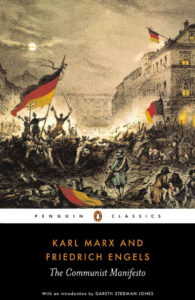
The Communist Manifesto, Marx and Engels' revolutionary 1848 summons to the working classes, is one of the most influential political theories ever formulated. After four years of collaboration, the authors produced this incisive account of their idea of Communism, in which they envisage a society without classes, private property, or a state. They argue that increasing exploitation of industrial workers will eventually lead to a revolution in which capitalism is overthrown. Their vision transformed the world irrevocably, and remains relevant as a depiction of global capitalism today.
From two of our most fiercely moral voices, a passionate call to arms against our era’s most pervasive human rights violation: the oppression of women and girls in the developing world.
With Pulitzer Prize winners Nicholas D. Kristof and Sheryl WuDunn as our guides, we undertake an odyssey through Africa and Asia to meet the extraordinary women struggling there, among them a Cambodian teenager sold into sex slavery and an Ethiopian woman who suffered devastating injuries in childbirth. Drawing on the breadth of their combined reporting experience, Kristof and WuDunn depict our world with anger, sadness, clarity, and, ultimately, hope.
They show how a little help can transform the lives of women and girls abroad. That Cambodian girl eventually escaped from her brothel and, with assistance from an aid group, built a thriving retail business that supports her family. The Ethiopian woman had her injuries repaired and in time became a surgeon. A Zimbabwean mother of five, counseled to return to school, earned her doctorate and became an expert on AIDS.
Through these stories, Kristof and WuDunn help us see that the key to economic progress lies in unleashing women’s potential. They make clear how so many people have helped to do just that, and how we can each do our part. Throughout much of the world, the greatest unexploited economic resource is the female half of the population. Countries such as China have prospered precisely because they emancipated women and brought them into the formal economy. Unleashing that process globally is not only the right thing to do; it’s also the best strategy for fighting poverty.
Deeply felt, pragmatic, and inspirational, Half the Sky is essential reading for every global citizen.
The King James Version is an Early Modern English translation of the Christian Bible for the Church of England, which was commissioned in 1604 and published in 1611. The 80 books of the King James Version include 39 books of the Old Testament, 14 books of Apocrypha, and the 27 books of the New Testament.
A landmark volume in science writing by one of the great minds of our time, Stephen Hawking’s book explores such profound questions as: How did the universe begin—and what made its start possible? Does time always flow forward? Is the universe unending—or are there boundaries? Are there other dimensions in space? What will happen when it all ends?
Told in language we all can understand, A Brief History of Time plunges into the exotic realms of black holes and quarks, of antimatter and “arrows of time,” of the big bang and a bigger God—where the possibilities are wondrous and unexpected. With exciting images and profound imagination, Stephen Hawking brings us closer to the ultimate secrets at the very heart of creation.
Welcome Back!
Track your reading progress and sync your library.