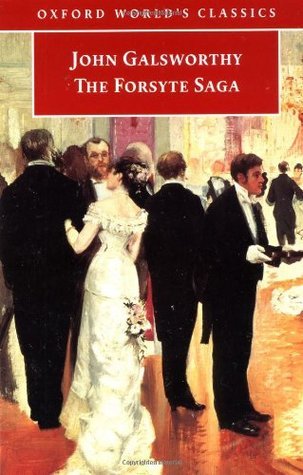
John Galsworthy, a Nobel Prize-winning author, chronicles the ebbing social power of the commercial upper-middle-class Forsyte family through three generations, beginning in Victorian London during the 1880s and ending in the early 1920s.
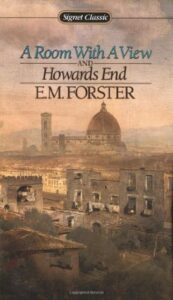
Wit and intelligence are the hallmarks of these two probing portraits of the English character written by E.M. Forster. Both are stories of extreme contrasts--in values, social class and cultural perspectives. Romantic relationships lead to conventional happiness in the delightful social comedy A Room with a View, and to unexpected scandal in the richer, deeply moving novel Howards End.
Howards End, which rivals A Passage to India as Forster's greatest work, makes a country house in Hertfordshire the center and the symbol for what Lionel Trilling called a class war about who would inherit England. Commerce clashes with culture, greed with gentility.
A Room with a View brings home the stuffiness of upper-middle-class Edwardian society in a tremendously funny comedy that pairs a well-bred young lady with a lusty railway clerk and satirizes both the clergy and the English notion of respectability.
Quintessentially British, these two novels have become twentieth-century classics. With an introduction and bibliography by Benjamin DeMott.
A novel that chronicles the lives of two women who could not be more different: Becky Sharp, an orphan whose only resources are her vast ambitions, her native wit, and her loose morals; and her schoolmate Amelia Sedley, a typically naive Victorian heroine, the pampered daughter of a wealthy family.
"But you do," he went on, not waiting for contradiction. "You love the boy body and soul, plainly, directly, as he loves you, and no other word expresses it ..."
Lucy has her rigid, middle-class life mapped out for her, until she visits Florence with her uptight cousin Charlotte, and finds her neatly ordered existence thrown off balance. Her eyes are opened by the unconventional characters she meets at the Pension Bertolini: flamboyant romantic novelist Eleanor Lavish, the Cockney Signora, curious Mr Emerson and, most of all, his passionate son George.
Lucy finds herself torn between the intensity of life in Italy and the repressed morals of Edwardian England, personified in her terminally dull fiancé Cecil Vyse. Will she ever learn to follow her own heart?
The complex story of a notorious law-suit in which love and inheritance are set against the classic urban background of 19th-century London, where fog on the river, seeping into the very bones of the characters, symbolizes the corruption of the legal system and the society which supports it.
“Jarndyce and Jarndyce” is an infamous lawsuit that has been in process for generations. Nobody can remember exactly how the case started but many different individuals have found their fortunes caught up in it. Esther Summerson watches as her friends and neighbours are consumed by their hopes and disappointments with the proceedings. But while the intricate puzzles of the lawsuit are being debated by lawyers, other more dramatic mysteries are unfolding that involve heartbreak, lost children, blackmail and murder.
The fog and cold that permeate Bleak House mirror a Victorian England mired in spiritual insolvency. Dickens brought all his passion, brilliance, and narrative verve to this huge novel of lives entangled in a multi-generational lawsuit—and through it, he achieved, at age 41, a stature almost Shakespearean.
The most nostalgic and reflective of Evelyn Waugh's novels, Brideshead Revisited looks back to the golden age before the Second World War. It tells the story of Charles Ryder's infatuation with the Marchmains and the rapidly-disappearing world of privilege they inhabit. Enchanted first by Sebastian at Oxford, then by his doomed Catholic family, in particular his remote sister, Julia, Charles comes finally to recognize only his spiritual and social distance from them.
With The Mirror & the Light, Hilary Mantel brings to a triumphant close the trilogy she began with her peerless, Booker Prize-winning novels, Wolf Hall and Bring Up the Bodies. She traces the final years of Thomas Cromwell, the boy from nowhere who climbs to the heights of power, offering a defining portrait of predator and prey, of a ferocious contest between present and past, between royal will and a common man’s vision: of a modern nation making itself through conflict, passion and courage.
The story begins in May 1536: Anne Boleyn is dead, decapitated in the space of a heartbeat by a hired French executioner. As her remains are bundled into oblivion, Cromwell breakfasts with the victors. The blacksmith’s son from Putney emerges from the spring’s bloodbath to continue his climb to power and wealth, while his formidable master, Henry VIII, settles to short-lived happiness with his third queen, Jane Seymour.
Cromwell, a man with only his wits to rely on, has no great family to back him, no private army. Despite rebellion at home, traitors plotting abroad and the threat of invasion testing Henry’s regime to the breaking point, Cromwell’s robust imagination sees a new country in the mirror of the future. All of England lies at his feet, ripe for innovation and religious reform. But as fortune’s wheel turns, Cromwell’s enemies are gathering in the shadows. The inevitable question remains: how long can anyone survive under Henry’s cruel and capricious gaze?
Eagerly awaited and eight years in the making, The Mirror & the Light completes Cromwell’s journey from self-made man to one of the most feared, influential figures of his time. Portrayed by Mantel with pathos and terrific energy, Cromwell is as complex as he is unforgettable: a politician and a fixer, a husband and a father, a man who both defied and defined his age.
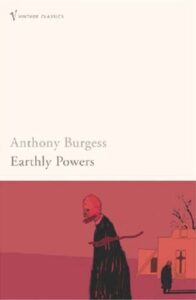
Anthony Burgess, author of A Clockwork Orange, is regarded as one of the most original and daring writers in the English language. His work is illuminated by a dazzling imagination, by a gift for character and plot, by a talent for surprise.
In Earthly Powers Burgess created his masterpiece. At its center are two twentieth-century men who represent different kinds of power—Kenneth Toomey, eminent novelist, a man who has outlived his contemporaries to survive into honored, bitter, luxurious old age as a celebrity of dubious notoriety; and Don Carlo Campanati, a man of God, eventually beloved Pope, who rises through the Vatican as a shrewd manipulator to become the architect of church revolution and a candidate for sainthood.
Through the lives of these two modern men Burgess explores the very essence of power. As each pursues his career—one to sainthood, one to wealthy exile—their relationship becomes the heart of a narrative that incorporates almost everyone of fame and distinction in the social, literary, and political life of America and Europe. This astonishing company is joined together by the art of a great novelist into an explosive and entertaining tour de force that will captivate fans of sweeping historic fiction.
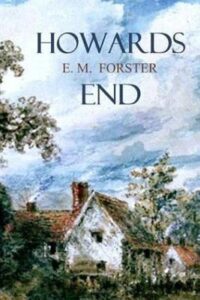
Howards End is considered by many to be E. M. Forster’s masterpiece. First published in 1910, this beguiling and completely captivating tale explores social conventions, codes of conduct, and relationships in turn-of-the-century Edwardian England. The story revolves around three families: the Wilcoxes, rich capitalists with a fortune made in the colonies; the half-German Schlegel siblings, whose cultural pursuits have much in common with the Bloomsbury Group—a loose collective of friends and relatives who were united by an abiding belief in the importance of the arts; and the Basts, an impoverished young couple from a lower-class background. A chance encounter, impetuous youth, love, and ambition play into the inheritance of Howards End, the Wilcox’s charming country home.
Howards End was adapted as a film in 1992 by the Merchant-Ivory team, starring Vanessa Redgrave, Emma Thompson, Anthony Hopkins, and Helena Bonham-Carter.
Welcome Back!
Track your reading progress and sync your library.