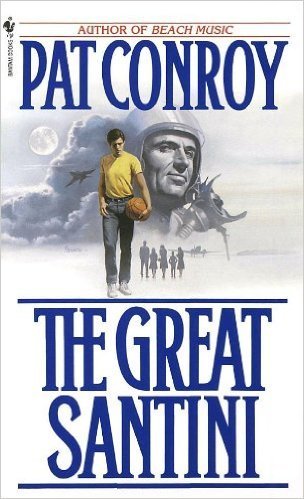
An American expatriate in Rome unearths his family legacy in this sweeping novel by the acclaimed author of The Prince of Tides and The Great Santini
A Southerner living abroad, Jack McCall is scarred by tragedy and betrayal. His desperate desire to find peace after his wife’s suicide draws him into a painful, intimate search for the one haunting secret in his family’s past that can heal his anguished heart. Spanning three generations and two continents, from the contemporary ruins of the American South to the ancient ruins of Rome, from the unutterable horrors of the Holocaust to the lingering trauma of Vietnam, Beach Music sings with life’s pain and glory. It is a novel of lyric intensity and searing truth, another masterpiece among Pat Conroy’s legendary and beloved novels.
When Siddalee Walker, oldest daughter of Vivi Abbott Walker, Ya-Ya extraordinaire, is interviewed in the New York Times about a hit play she's directed, her mother gets described as a "tap-dancing child abuser." Enraged, Vivi disowns Sidda. Devastated, Sidda begs forgiveness, and postpones her upcoming wedding. All looks bleak until the Ya-Yas step in and convince Vivi to send Sidda a scrapbook of their girlhood mementos, called "Divine Secrets of the Ya-Ya Sisterhood." As Sidda struggles to analyze her mother, she comes face to face with the tangled beauty of imperfect love, and the fact that forgiveness, more than understanding, is often what the heart longs for.
The one and only Pat Conroy returns, with a big, sprawling novel that is at once a love letter to Charleston and to lifelong friendship.
Against the sumptuous backdrop of Charleston, South Carolina, South of Broad gathers a unique cast of sinners and saints. Leopold Bloom King, our narrator, is the son of an amiable, loving father who teaches science at the local high school. His mother, an ex-nun, is the high school principal and a well-known Joyce scholar. After Leo's older brother commits suicide at the age of thirteen, the family struggles with the shattering effects of his death, and Leo, lonely and isolated, searches for something to sustain him. Eventually, he finds his answer when he becomes part of a tightly knit group of high school seniors that includes friends Sheba and Trevor Poe, glamorous twins with an alcoholic mother and a prison-escapee father; hardscrabble mountain runaways Niles and Starla Whitehead; socialite Molly Huger and her boyfriend, Chadworth Rutledge X; and an ever-widening circle whose liaisons will ripple across two decades-from 1960s counterculture through the dawn of the AIDS crisis in the 1980s.
The ties among them endure for years, surviving marriages happy and troubled, unrequited loves and unspoken longings, hard-won successes and devastating breakdowns, and Charleston's dark legacy of racism and class divisions. But the final test of friendship that brings them to San Francisco is something no one is prepared for. South of Broad is Pat Conroy at his finest; a long-awaited work from a great American writer whose passion for life and language knows no bounds.
The one thing you can depend on in Cold Sassy, Georgia, is that word gets around--fast. When Grandpa E. Rucker Blakeslee announces one July morning in 1906 that he's aiming to marry the young and freckledy milliner, Miss Love Simpson--a bare three weeks after Granny Blakeslee has gone to her reward--the news is served up all over town with that afternoon's dinner. And young Will Tweedy suddenly finds himself eyewitness to a major scandal. Boggled by the sheer audacity of it all, and not a little jealous of his grandpa's new wife, Will nevertheless approves of this May-December match and follows its progress with just a smidgen of youthful prurience. As the newlyweds' chaperone, conspirator, and confidant, Will is privy to his one-armed, renegade grandfather's second adolescence; meanwhile, he does some growing up of his own. He gets run over by a train and lives to tell about it; he kisses his first girl, and survives that too. Olive Ann Burns has given us a timeless, funny, resplendent novel - about a romance that rocks an entire town, about a boy's passage through the momentous but elusive year when childhood melts into adolescence, and about just how people lived and died in a small Southern town at the turn of the century. Inhabited by characters who are wise and loony, unimpeachably pious and deliciously irreverent, Cold Sassy, Georgia, is the perfect setting for the debut of a storyteller of rare brio, exuberance, and style.
Twelve-year-old CeeCee is in trouble. For years she’s been the caretaker of her psychotic mother, Camille— the crown-wearing, lipstick-smeared laughingstock of an entire town. Though it’s 1967 and they live in Ohio, Camille believes it’s 1951 and she’s just been crowned the Vidalia Onion Queen of Georgia.
The day CeeCee discovers Camille in the front yard wearing a tattered prom dress and tiara as she blows kisses to passing motorists, she knows her mother has completely flipped. When tragedy strikes, Tootie Caldwell, a previously unknown great-aunt comes to CeeCee’s rescue and whisks her away to Savannah. Within hours of her arrival, CeeCee is catapulted into a perfumed world of prosperity and Southern eccentricities—a world that appears to be run entirely by women.
While Tootie is busy saving Savannah’s endangered historic homes from the wrecking ball, CeeCee encounters a cast of unforgettable, eccentric characters. From the mysterious Thelma Rae Goodpepper, who bathes in an outdoor tub under the watchful eyes of a voyeuristic peacock, to Oletta Jones, the all-knowing household cook, to Violene Hobbs, the loud-mouthed widow who entertains a local police officer in her yellow see-through peignoir, the women of Gaston Street keep CeeCee entertained and enthralled for an entire summer.
But CeeCee’s view of the world is challenged in ways she could have never imagined: there are secrets to keep, injustices to face, and loyalties to uphold. Just as she begins to find her ballast and experiences a sense of belonging, her newfound joy collides with the long-held fear that her mother’s legacy has left her destined for destruction.
Laugh-out-loud funny, at times heartbreaking, and written in a pitch-perfect voice, Saving CeeCee Honeycutt is a spirited Southern tale that explores the intricate frailties and strengths of female relationships while illuminating the journey of a young girl who loses her mother but finds many others.
"When compared to the fact that he might very well be dead by this time tomorrow, whether he was courageous or not today was pointless, empty. When compared to the fact that he might be dead tomorrow, everything was pointless. Life was pointless. Whether he looked at a tree or not was pointless. It just didn't make any difference. It was pointless to the tree, it was pointless to every man in his outfit, pointless to everybody in the whole world. Who cared? It was not pointless only to him; and when he was dead, when he ceased to exist, it would be pointless to him too. More important: Not only would it be pointless, it would have been pointless, all along."
Such is the ultimate significance of war in The Thin Red Line (1962), James Jones's fictional account of the battle between American and Japanese troops on the island of Guadalcanal. The narrative shifts effortlessly among multiple viewpoints within C-for-Charlie Company, from commanding officer Capt. James Stein, his psychotic first sergeant Eddie Welsh, and the young privates they send into battle. The descriptions of combat conditions—and the mental states it induces—are unflinchingly realistic, including the dialog (in which a certain word Norman Mailer rendered as "fug" 15 years earlier in The Naked and the Dead appears properly spelled on numerous occasions). This is more than a classic of combat fiction; it is one of the most significant explorations of male identity in American literature, establishing Jones as a novelist of the caliber of Herman Melville and Stephen Crane.
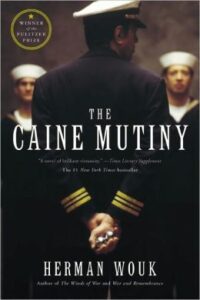
The novel that inspired the now-classic film The Caine Mutiny and the hit Broadway play The Caine Mutiny Court-Martial, Herman Wouk's boldly dramatic, brilliantly entertaining novel of life-and mutiny-on a Navy warship in the Pacific theater was immediately embraced, upon its original publication in 1951, as one of the first serious works of American fiction to grapple with the moral complexities and the human consequences of World War II. In the intervening half century, The Caine Mutiny has become a perennial favorite of readers young and old, has sold millions of copies throughout the world, and has achieved the status of a modern classic.
Magenta is a harrowing journey into war-torn Sarajevo, and into the blackest reaches of the human condition. The novel follows a journalist, Silva, as she and her team make their way deep into a city under siege, in order to recover the body of Thierry, an award-winning filmmaker who has been killed there. But the postmodern odyssey that follows is beyond anything Silva could have expected, as she must make her way through a world in which good and evil lose their meaning, where survival is the only remaining value, and where there is always greater terror lurking around the next corner of the dark and broken labyrinth that a once great city has become. Even if Silva herself survives the city, the abyss she has stared into will have stared back into her - and changed everything.
Welcome Back!
Track your reading progress and sync your library.