14 short stories set in a universe of scanners, planoforming ships and animal-derived Underpeople.
1 No, No, Not Rogov! (1959) 2 War No. 81-Q (1928) 3 Mark Elf (1957) 4 The Queen of the Afternoon (1978) 5 When the People Fell (1959) 6 Think Blue, Count Two (1963) 7 The Colonel Came Back from the Nothing-at-All (1979) 8 From Gustible’s Planet (1962) 9 Drunkboat (1963) 10 Western Science Is So Wonderful (1958) 11 Nancy (1959) 12 The Fife of Bodidharma (1959) 13 Angerhelm (1959) 14 The Good Friends (1963)
“First Edition: May 1979” stated on the copyright page.
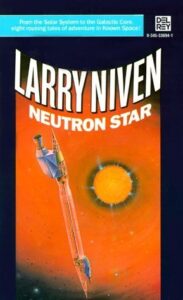
Come to Larry Niven's Universe and meet all the Thrints, Bandersnatchi, Puppeteers -- and a host of other wonderfully created characters. Visit Lookitthat, Down, and Jinx -- indeed, an entire galaxy of planets found only in these stories that trace man's expansion and colonization throughout Known Space. A spectacular cycle of the future . . . a 10,000-year history of man on Earth and in space!
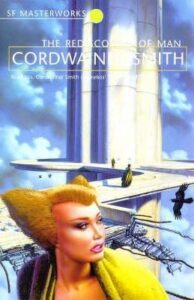
Cordwainer Smith was one of the original visionaries to think of humanity in terms of thousands of years in the future, spread out across the universe. This brilliant collection, often cited as the first of its kind, explores fundamental questions about ourselves and our treatment of the universe (and other beings) around us and ultimately what it means to be human. Contents: * Cordwainer Smith: The Shaper of Myths (1975) • essay by John J. Pierce [as by J. J. Pierce] * The Instrumentality of Mankind (timeline) (1975) • essay by John J. Pierce * Scanners Live in Vain [The Instrumentality of Mankind] (1950) / novelette by Cordwainer Smith: meet Martel, a human altered to be part machine-a scanner-to be able withstand the trauma space travel has on the body. Despite the stigma placed on him and his kind, he is able to regrasp his humanity to save another; Fantasy Book #6 ’50 * The Lady Who Sailed The Soul [The Instrumentality of Mankind] (1960) / novelette by Cordwainer Smith, Genevieve Linebarger; Galaxy Apr ’60 * The Game of Rat and Dragon [The Instrumentality of Mankind] (1955) / short story by Cordwainer Smith; Galaxy Oct ’55 * The Burning of the Brain [The Instrumentality of Mankind] (1958) / short story by Cordwainer Smith; If Oct ’58 * Golden the Ship Was - Oh! Oh! Oh! [The Instrumentality of Mankind] (1959) / short story by Cordwainer Smith, Genevieve Linebarger; Amazing Apr ’59 * The Crime and the Glory of Commander Suzdal [The Instrumentality of Mankind] (1964) / short story by Cordwainer Smith; Amazing May ’64 * The Dead Lady of Clown Town [The Instrumentality of Mankind] (1964) / novella by Cordwainer Smith: get to know the underpeople-animals genetically altered to exist in human form, to better serve their human owners-and meet D'Joan, a dog-woman who will make readers question who is more human: the animals who simply want to be recognized as having the same right to life, or the people who created them to be inferior; Galaxy Aug ’64 * Under Old Earth [The Instrumentality of Mankind] (1966) / novelette by Cordwainer Smith; Galaxy Feb ’66 * Mother Hitton's Littul Kittons [The Instrumentality of Mankind] (1961) / novelette by Cordwainer Smith; Galaxy Jun ’61 * Alpha Ralpha Boulevard [The Instrumentality of Mankind] (1961) / novelette by Cordwainer Smith; Galaxy Jun ’61 * The Ballad of Lost C'mell [The Instrumentality of Mankind] (1962) / novelette by Cordwainer Smith: the notion of love being the most important equalizer there is, is put into action when an underperson, C'mell, falls in love with Lord Jestocost. Who is to say her love for him is not as valid as any true-born human? She might be of cat descent, but she is all woman!; Galaxy Oct ’62 * A Planet Named Shayol [The Instrumentality of Mankind] (1961) / novelette by Cordwainer Smith: it is an underperson of bull descent, and beings so mutilated and deformed from their original human condition to be now considered demons of a hellish land, who retain and display the most humanity when Mankind commits the most inhumane action of all; Galaxy Oct ’61
aka: Paul M. A. Linebarger, Paul Myron Anthony Linebarger, Paul Linebarger, Felix C. Forrest, Carmichael Smith, Kordvejner Smit. .
Harlan Ellison is probably best known as a script writer for sci-fi and fantasy movies and TV series such as the original Outer Limits, The Hunger, Logan's Run, and Babylon Five. But his range is much broader than that, encompassing stories, novels, essays, reviews, reminiscences, plays, even fake autobiographies. The Essential Ellison, a special limited edition personally signed and numbered by Ellison, contains 74 unabridged works, including such classics as "A Boy and His Dog," "Xenogenesis," and "Mefisto in Onyx."
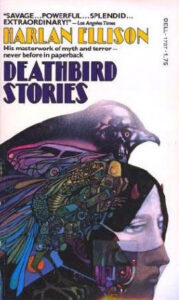
AND I AWOKE AND FOUND ME HERE ON THE COLD HILL'S SIDE Man seeks to get into bed with anything new and different, or die trying. But when the new and different was not human...would he die trying?
THE MAN WHO WALKED HOME - The first-time astronaut, stuck in the far future, slid ever so slowly toward a present whose past was his future and whose future was his past...
I'M TOO BIG BUT I LOVE TO PLAY - If genuine aliens are to communicate meaningfully, one must make himself into an analogue of the other. But how can you tell the difference between what is human - and what is merely identical?
Contents: And I Awoke and Found Me Here on the Cold Hill's Side (1972) The Snows Are Melted, the Snows Are Gone (1969) The Peacefulness of Vivyan (1971) Mamma Come Home (1968) Help (1968) Painwise (1972) Faithful to Thee, Terra, in Our Fashion (1969) The Man Doors Said Hello To (1970) The Man Who Walked Home (1972) Forever to a Hudson Bay Blanket (1972) I'll Be Waiting for You When the Swimming Pool Is Empty (1971) I'm Too Big but I Love to Play (1970) Birth of a Salesman (1968) Mother in the Sky with Diamonds (1971) Beam Us Home (1969)
Wizardry, transforming its master into a cloud of fine mist...cloning, duplicating the ideal man ten times over...Utopia, in a city where almost everyone is perfectly happy...
Ursula Le Guin, author of The Earthsea Trilogy, has a special way of blending stirring adventure with fantasy that has made comparison with such masters as C.S. Lewis and J.R.R. Tolkien inevitable.
Now, in The Wind's Twelve Quarters, seventeen of her favorite stories reaffirm Ursula Le Guin as one of America's outstanding writers.
CONTENTS:
Foreword Semley's Necklace April in Paris The Masters Darkness Box The Word of Unbinding The Rule of Names Winter's King The Good Trip Nine Lives Things A Trip to the Head Vaster than Empires and More Slow The Stars Below The Field of Vision Direction of the Road The Ones Who Walk Away from Omelas The Day Before the Revolution
The recipient of numerous literary prizes, including the National Book Award, the Kafka Award, and the Pushcart Prize, Ursula K. Le Guin is renowned for her lyrical writing, rich characters, and diverse worlds. The Wind's Twelve Quarters collects seventeen powerful stories, each with an introduction by the author, ranging from fantasy to intriguing scientific concepts, from medieval settings to the future.
Including an insightful foreword by Le Guin, describing her experience, her inspirations, and her approach to writing, this stunning collection explores human values, relationships, and survival, and showcases the myriad talents of one of the most provocative writers of our time.
The most honored anthology of fantastic fiction ever published, featuring the works of such luminaries as Isaac Asimov, Robert Silverberg, Philip Jose Farmer, Robert Bloch, Philip K. Dick, Larry Niven, Fritz Leiber, Poul Anderson, Damon Knight, J.G. Ballard, John Brunner, Frederik Pohl, Roger Zelazny and Samuel Delany.
Contents xi • Foreword: Year 2002 (Dangerous Visions 35th Anniversary Edition) • (2002) • essay by Michael Moorcock xiii • Introduction: Year 2002 (Dangerous Visions 35th Anniversary Edition • (2002) • essay by Harlan Ellison xxiii • Foreword 1-The Second Revolution • (1967) • essay by Isaac Asimov xxxiii • Introduction: Thirty-Two Soothsayers • (1967) • essay by Harlan Ellison (variant of Thirty-Two Soothsayers) xxxix • Foreword 2-Harlan and I • (1967) • essay by Isaac Asimov 1 • Evensong • (1967) • shortstory by Lester del Rey 9 • Flies • (1967) • shortstory by Robert Silverberg 21 • The Day After the Day the Martians Came • (1967) • shortstory by Frederik Pohl (variant of The Day the Martians Came) 30 • Riders of the Purple Wage • (1967) • novella by Philip José Farmer 105 • The Malley System • (1967) • shortstory by Miriam Allen deFord 115 • A Toy for Juliette • (1967) • shortstory by Robert Bloch 128 • The Prowler in the City at the Edge of the World • (1967) • novelette by Harlan Ellison 154 • The Night That All Time Broke Out • (1967) • shortstory by Brian W. Aldiss 169 • The Man Who Went to the Moon - Twice • (1967) • shortstory by Howard Rodman 181 • Faith of Our Fathers • (1967) • novelette by Philip K. Dick 216 • The Jigsaw Man • [Known Space] • (1967) • shortstory by Larry Niven 231 • Gonna Roll the Bones • (1967) • novelette by Fritz Leiber 256 • Lord Randy, My Son • (1967) • shortstory by Joe L. Hensley 272 • Eutopia • (1967) • novelette by Poul Anderson 295 • Incident in Moderan • [Moderan] • (1967) • shortstory by David R. Bunch 299 • The Escaping • (1967) • shortstory by David R. Bunch 305 • The Doll-House • (1967) • shortstory by James Cross 326 • Sex and/or Mr. Morrison • (1967) • shortstory by Carol Emshwiller 338 • Shall the Dust Praise Thee? • (1967) • shortstory by Damon Knight 344 • If All Men Were Brothers, Would You Let One Marry Your Sister? • (1967) • novella by Theodore Sturgeon 390 • What Happened to Auguste Clarot? • (1967) • shortstory by Larry Eisenberg 396 • Ersatz • (1967) • shortstory by Henry Slesar 404 • Go, Go, Go, Said the Bird • (1967) • shortstory by Sonya Dorman 412 • The Happy Breed • (1967) • shortstory by John Sladek [as by John T. Sladek ] 433 • Encounter with a Hick • (1967) • shortstory by Jonathan Brand 439 • From the Government Printing Office • (1967) • shortstory by Kris Neville 447 • Land of the Great Horses • (1967) • shortstory by R. A. Lafferty 458 • The Recognition • (1967) • shortstory by J. G. Ballard 472 • Judas • (1967) • shortstory by John Brunner 483 • Test to Destruction • (1967) • novelette by Keith Laumer 510 • Carcinoma Angels • (1967) • shortstory by Norman Spinrad 523 • Auto-da-Fé • (1967) • shortstory by Roger Zelazny 532 • Aye, and Gomorrah . . . • (1967) • shortstory by Samuel R. Delany
Axiomatic is a collection of Greg Egan's short stories that appeared in various science fiction magazines (mostly Interzone and Asimov's) between 1989 and 1992.
Contents: The Infinite Assassin (1991) The Hundred Light-Year Diary (1992) Eugene (1990) The Caress (1990) Blood Sisters (1991) Axiomatic (1990) The Safe-Deposit Box (1990) Seeing (1995) A Kidnapping (1995) Learning to Be Me (1990) The Moat (1991) The Walk (1992) The Cutie (1989) Into Darkness (1992) Appropriate Love (1991) The Moral Virologist (1990) Closer (1992) Unstable Orbits in the Space of Lies (1992)
Welcome Back!
Track your reading progress and sync your library.