In the four most bloody and courageous days of our nation’s history, two armies fought for two dreams. One dreamed of freedom, the other of a way of life. Far more than rifles and bullets were carried into battle. There were memories. There were promises. There was love. And far more than men fell on those Pennsylvania fields. Shattered futures, forgotten innocence, and crippled beauty were also the casualties of war. The Killer Angels is unique, sweeping, unforgettable—a dramatic re-creation of the battleground for America’s destiny.
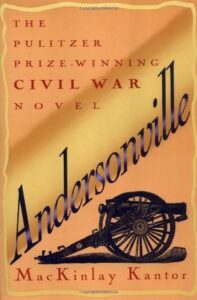
Acclaimed as the greatest novel ever written about the War Between the States, this searing Pulitzer Prize-winning book captures all the glory and shame of America's most tragic conflict in the vivid, crowded world of Andersonville, and the people who lived outside its barricades. Based on the author's extensive research and nearly 25 years in the making, MacKinlay Kantor's best-selling masterwork tells the heartbreaking story of the notorious Georgia prison where 50,000 Northern soldiers suffered - and 14,000 died - and of the people whose lives were changed by the grim camp where the best and the worst of the Civil War came together. Here is the savagery of the camp commandant, the deep compassion of a nearby planter and his gentle daughter, the merging of valor and viciousness within the stockade itself, and the day-to-day fight for survival among the cowards, cutthroats, innocents, and idealists thrown together by the brutal struggle between North and South. A moving portrait of the bravery of people faced with hopeless tragedy, this is the inspiring American classic of an unforgettable period in American history.
Enriched Classics offer readers accessible editions of great works of literature enhanced by helpful notes and commentary. Each book includes educational tools alongside the text, enabling students and readers alike to gain a deeper and more developed understanding of the writer and their work.
Henry Fleming has joined the Union army because of his romantic ideas of military life, but soon finds himself in the middle of a battle against a regiment of Confederate soldiers. Terrified, Henry deserts his comrades. Upon returning to his regiment, he struggles with his shame as he tries to redeem himself and prove his courage.
The Red Badge of Courage is Stephen Crane’s second book, notable for its realism and the fact that Crane had never personally experienced battle. Crane drew heavy inspiration from Century Magazine, a periodical known for its articles about the American Civil War. However, he criticized the articles for their lack of emotional depth and decided to write a war novel of his own. The manuscript was first serialized in December 1894 by The Philadelphia Press and quickly won Crane international acclaim before he died in June 1900 at the age of 28.
A big, powerful saga of men in combat, written over the course of thirty-five years by a highly decorated Vietnam veteran.
Intense, powerful, and compelling, Matterhorn is an epic war novel in the tradition of Norman Mailer's The Naked and the Dead and James Jones's The Thin Red Line. It is the timeless story of a young Marine lieutenant, Waino Mellas, and his comrades in Bravo Company, who are dropped into the mountain jungle of Vietnam as boys and forced to fight their way into manhood. Standing in their way are not merely the North Vietnamese but also monsoon rain and mud, leeches and tigers, disease and malnutrition. Almost as daunting, it turns out, are the obstacles they discover between each other: racial tension, competing ambitions, and duplicitous superior officers. But when the company finds itself surrounded and outnumbered by a massive enemy regiment, the Marines are thrust into the raw and all-consuming terror of combat. The experience will change them forever.
Written over the course of thirty years by a highly decorated Vietnam veteran, Matterhorn is a visceral and spellbinding novel about what it is like to be a young man at war. It is an unforgettable novel that transforms the tragedy of Vietnam into a powerful and universal story of courage, camaraderie, and sacrifice: a parable not only of the war in Vietnam but of all war, and a testament to the redemptive power of literature.
A graduate of Yale University and a Rhodes Scholar at Oxford University, Karl Marlantes served as a Marine in Vietnam, where he was awarded the Navy Cross, the Bronze Star, two Navy Commendation Medals for valor, two Purple Hearts, and ten air medals. This is his first novel. He lives in rural Washington State.
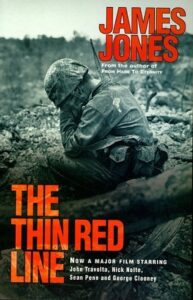
"When compared to the fact that he might very well be dead by this time tomorrow, whether he was courageous or not today was pointless, empty. When compared to the fact that he might be dead tomorrow, everything was pointless. Life was pointless. Whether he looked at a tree or not was pointless. It just didn't make any difference. It was pointless to the tree, it was pointless to every man in his outfit, pointless to everybody in the whole world. Who cared? It was not pointless only to him; and when he was dead, when he ceased to exist, it would be pointless to him too. More important: Not only would it be pointless, it would have been pointless, all along."
Such is the ultimate significance of war in The Thin Red Line (1962), James Jones's fictional account of the battle between American and Japanese troops on the island of Guadalcanal. The narrative shifts effortlessly among multiple viewpoints within C-for-Charlie Company, from commanding officer Capt. James Stein, his psychotic first sergeant Eddie Welsh, and the young privates they send into battle. The descriptions of combat conditions—and the mental states it induces—are unflinchingly realistic, including the dialog (in which a certain word Norman Mailer rendered as "fug" 15 years earlier in The Naked and the Dead appears properly spelled on numerous occasions). This is more than a classic of combat fiction; it is one of the most significant explorations of male identity in American literature, establishing Jones as a novelist of the caliber of Herman Melville and Stephen Crane.
London is poised on the brink of World War II. Timid, scrawny Willie Beech -- the abused child of a single mother -- is evacuated to the English countryside. At first, he is terrified of everything, of the country sounds and sights, even of Mr. Tom, the gruff, kindly old man who has taken him in. But gradually Willie forgets the hate and despair of his past. He learns to love a world he never knew existed, a world of friendship and affection in which harsh words and daily beatings have no place. Then a telegram comes. Willie must return to his mother in London. When weeks pass by with no word from Willie, Mr. Tom sets out for London to look for the young boy he has come to love as a son.
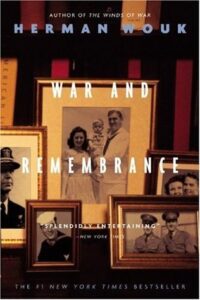
War and Remembrance is a historical romance. The subject is World War II, the viewpoint American. A prologue, The Winds of War, published in 1971, set the historical frame for this work by picturing the events leading up to Pearl Harbor. This is a novel of America at war, from Pearl Harbor to Hiroshima.
The time is World War II. The place is a brutal prison camp deep in Japanese-occupied territory. Here, within the seething mass of humanity, one man, an American corporal, seeks dominance over both captives and captors alike. His weapons are human courage, unblinking understanding of human weaknesses, and total willingness to exploit every opportunity to enlarge his power and corrupt or destroy anyone who stands in his path.
Like no other masterpiece of historical fiction, Herman Wouk's sweeping epic of World War II is the great novel of America's Greatest Generation.
Wouk's spellbinding narrative captures the tide of global events, as well as all the drama, romance, heroism, and tragedy of World War II, as it immerses us in the lives of a single American family drawn into the very center of the war's maelstrom.
The Winds of War and its sequel War and Remembrance stand as the crowning achievement of one of America's most celebrated storytellers.
Welcome Back!
Track your reading progress and sync your library.