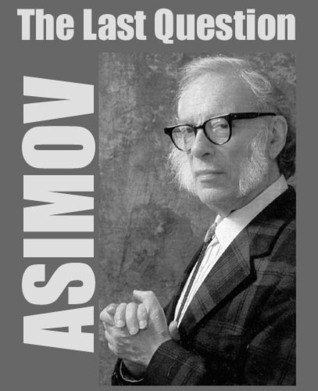
¿Es posible revertir el inevitable final del Universo, o el mundo debe acabar de todas formas? es la pregunta que desde un día del siglo XXI, hasta generaciones y generaciones posteriores en el tiempo, hacen los humanos a los ordenadores.
En un relato aparentemente sencillo sobre un asunto sobrecogedor, el fin de los días, Asimov demuestra, una vez más, una mente preclara y una mano maestra para sobrecoger al lector y dejarlo en vilo, incluso después de la lectura.
Alternate cover edition of ISBN-13: 978-0140286809, ISBN-10/ASIN: 0140286802
For the first time in English, all the fiction by the writer who has been called “the greatest Spanish-language writer of our century” collected in a single volume
A Penguin Classics Deluxe Edition with flaps and deckle-edged paper
For some fifty years, in intriguing and ingenious fictions that reimagined the very form of the short story—from his 1935 debut with A Universal History of Iniquity through his immensely influential collections Ficciones and The Aleph, the enigmatic prose poems of The Maker, up to his final work in the 1980s, Shakespeare’s Memory—Jorge Luis Borges returned again and again to his celebrated themes: dreams, duels, labyrinths, mirrors, infinite libraries, the manipulations of chance, gauchos, knife fighters, tigers, and the elusive nature of identity itself. Playfully experimenting with ostensibly subliterary genres, he took the detective story and turned it into metaphysics; he took fantasy writing and made it, with its questioning and reinventing of everyday reality, central to the craft of fiction; he took the literary essay and put it to use reviewing wholly imaginary books.
Bringing together for the first time in English all of Borges’s magical stories, and all of them newly rendered into English in brilliant translations by Andrew Hurley, Collected Fictions is the perfect one-volume compendium for all who have long loved Borges, and a superb introduction to the master’s work for all who have yet to discover this singular genius.
Ijon Tichy travels undercover to a robot world, joining an organization to clean up world history thru time travel.
Things go crazy immediately. His spaceship runs into gravitational vortices at relativistic speeds, resulting in massive time anomalies. It may be a blessing in disguise. The reason he couldn’t get out of the way was that a meteor had shattered the drive regulator & rudder. He could no longer steer his ship. He had a spare rudder, but couldn’t install it. It was a two-man job & he was alone. So when other versions of him start appearing, all he should need do is team up with one of them, fix the rudder & leave the gravitational vortex field.
After that gets straightened out, he goes undercover. A ship’s computer has mutineed & started its own colony, reproducing itself on a previously uninhabited planet. The insurance company paid the shipowner’s claim, & now believes that the ship, it’s computer & all its progeny belong to them. Tichy disguises himself as a robot & goes to investigate.
On another voyage, he heads to a planet where the government irrigation agency has irrigated beyond all need & refused to give up power. People live in water & are jailed in dry cells if they violate the love of water.
After his modern voyages, he comes back from 2166 to recruit himself as a member of THEOHIPPIP, the Teleotelechronistic-Historical Engineering to Optimize the Hyperputerized Implementation of Paleological Programming & Interplanetary Planning. History is in a mess because of all the time travelers. THEOHIPPIP's mission is: “For World History to be regulated, cleaned up, straightened out, adjusted & perfected, all in accordance with the principles of humanitarianism, rationalism & general esthetics. You can understand, surely, that with such a shambles & slaughterhouse in one’s family tree it’s awkward to go calling on important cosmic civilizations!...If need be, alterations will be made even before the rise of man, so that he arises better.”
Isaac Asimov's I, Robot launches readers on an adventure into a not-so-distant future where man and machine , struggle to redefinelife, love, and consciousness—and where the stakes are nothing less than survival. Filled with unforgettable characters, mind-bending speculation, and nonstop action, I, Robot is a powerful reading experience from one of the master storytellers of our time.
I, ROBOT
They mustn't harm a human being, they must obey human orders, and they must protect their own existence...but only so long as that doesn't violate rules one and two. With these Three Laws of Robotics, humanity embarked on perhaps its greatest adventure: the invention of the first positronic man. It was a bold new era of evolution that would open up enormous possibilities—and unforeseen risks. For the scientists who invented the earliest robots weren't content that their creations should ' remain programmed helpers, companions, and semisentient worker-machines. And soon the robots themselves; aware of their own intelligence, power, and humanity, aren't either.
As humans and robots struggle to survive together—and sometimes against each other—on earth and in space, the future of both hangs in the balance. Human men and women confront robots gone mad, telepathic robots, robot politicians, and vast robotic intelligences that may already secretly control the world. And both are asking the same questions: What is human? And is humanity obsolete?
In l, Robot Isaac Asimov changes forever our perception of robots, and human beings and updates the timeless myth of man's dream to play god. with all its rewards—and terrors. --front flap
The Lottery, one of the most terrifying stories written in this century, created a sensation when it was first published in The New Yorker. "Power and haunting," and "nights of unrest" were typical reader responses. This collection, the only one to appear during Shirley Jackson's lifetime, unites "The Lottery" with twenty-four equally unusual stories. Together they demonstrate Jackson's remarkable range--from the hilarious to the truly horrible--and power as a storyteller.
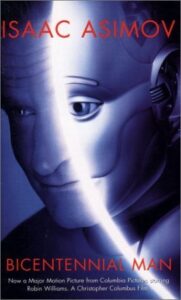
Andrew was one of Earth's first house robot domestic servants—smoothly designed and functional. But when Andrew started to develop special talents which exceeded the confines of his allotted positronic pathways, he abandoned his domestic duties in favour of more intellectual pursuits. As time passed, Andrew acquired knowledge, feelings and ambitions way beyond anything ever experienced by any other mechanical men. And he found himself launched on to a career which would bring him fame fortune — and danger. For a robot who wants to be human must also be prepared to die...
In the Bicentennial Man, Isaac Asimov returns to his first and most enduring love — robotics. The result is a brilliant book of first-class entertainment and mind-spinning ideas which confirm Asimov's supreme status as Grand Master of science fiction.
Content
"Feminine Intuition" (1969) "Waterclap" (1970) "That Thou Art Mindful of Him" (1974) "Stranger in Paradise" (1974) "The Life and Times of Multivac" (1975) "The Winnowing" (1976) "The Bicentennial Man" (1976) "Marching In" (1976) "Old-Fashioned" (1976) "The Tercentenary Incident" (1976) "Birth of a Notion" (1976)
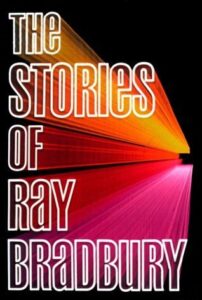
Drunk, and in charge of a bicycle / introduction by Ray Bradbury-- The night -- Homecoming-- Uncle Einar -- The traveler -- The lake -- The coffin -- The crowd -- The scythe -- There was an old woman -- There will come soft rains -- Mars is heaven -- The silent towns -- The earth men -- The off season -- The million-year picnic -- The fox and the forest -- Kaleidoscope -- The rocket man -- Marionettes, inc. -- No particular night or morning -- The city -- The fire balloons -- The last night of the world -- The veldt -- The long rain -- The great fire -- The wilderness -- A sound of thunder -- The murderer -- The April witch -- Invisible boy -- The golden kite, the silver wind -- The fog horn -- The black black and white game -- Embroidery -- The golden apples of the sun -- Powerhouse -- Hail and farewell -- The great wide world over there -- The playground -- Skeleton -- The man upstairs -- Touched with fire -- The emissary -- The jar -- The small assasin -- The next in line -- Jack-in-the-box -- The leave-taking -- Exorcism -- The happiness machine -- Calling Mexico -- The wonderful ice cream suit -- Dark they were, and golden-eyed -- The strawberry window -- A scent of sarsaparilla -- The Picasso summer -- The day it rained forever -- A medicine for melancholy -- The shoreline at sunset -- Fever dream -- The town where no one got off -- All summer in a day -- Frost and fire -- The anthem sprinters -- And so died Riabouchinska -- Boys! Raise giant mushrooms in your cellar! -- The vacation -- The illustrated woman -- Some live like Lazarus -- The best of all possible worlds -- The one who waits -- Tyrannosaurus Rex -- The screaming woman -- The terrible conflagration up at the place -- Night call, collect -- The tombling day -- The haunting of the new -- Tomorrow's child -- I sing the body electric! -- The women -- The inspired chicken motel -- Yes, we'll gather at the river -- Have I got a chocolate bar for you! -- A story of love -- The parrot who met Papa -- The October game -- Punishment without crime -- A piece of wood -- The blue bottle -- Long after midnight -- The utterly perfect murder -- The better part of wisdom -- Interval in sunlight -- The black ferris -- Farewell summer -- McGillahee's brat -- The aqueduct -- Gotcha! -- The end of the beginning.
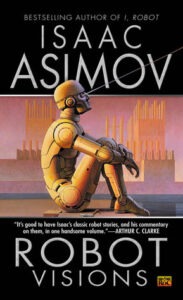
From Isaac Asimov, the Hugo Award-winning Grand Master of Science Fiction whose name is synonymous with the science of robotics, comes five decades of robot visions: thirty-four landmark stories and essays—including three rare tales—gathered together in one volume.
Meet all of Asimov’s most famous creations including: Robbie, the very first robot that his imagination brought to life; Susan Calvin, the original robot psychologist; Stephen Byerley, the humanoid robot; and the famous human/robot detective team of Lije Bailey and R. Daneel Olivaw, who have appeared in such bestselling novels as The Robots of Dawn and Robots and Empire.
Let the master himself guide you through the key moments in the fictional history of robot-human relations—from the most primitive computers and mobile machines to the first robot to become a man. (back cover)
Contents:
Robot Visions • cover and interior artwork by Ralph McQuarrie Introduction: The Robot Chronicles • essay by Isaac Asimov Robot Visions / short story by Isaac Asimov Too Bad! (1989) / short story by Isaac Asimov Robbie (1940) / short story by Isaac Asimov (variant of Strange Playfellow) Reason [Mike Donovan] (1941) / short story by Isaac Asimov Liar! [Susan Calvin] (1941) / short story by Isaac Asimov Runaround [Mike Donovan] (1942) / novelette by Isaac Asimov Evidence [Susan Calvin] (1946) / novelette by Isaac Asimov Little Lost Robot [Susan Calvin] (1947) / novelette by Isaac Asimov The Evitable Conflict [Susan Calvin] (1950) / novelette by Isaac Asimov Feminine Intuition [Susan Calvin] (1969) / novelette by Isaac Asimov The Bicentennial Man (1976) / novelette by Isaac Asimov Someday (1956) / short story by Isaac Asimov Think! (1977) / short story by Isaac Asimov Segregationist (1967) / short story by Isaac Asimov Mirror Image [Elijah Bailey/R. Daneel Olivaw] (1972) / short story by Isaac Asimov Lenny [Susan Calvin] (1958) / short story by Isaac Asimov Galley Slave [Susan Calvin] (1957) / novelette by Isaac Asimov Christmas Without Rodney (1988) / short story by Isaac Asimov Essays by Isaac Asimov: Robots I Have Known (1954); The New Teachers (1976); Whatever You Wish (1977); The Friends We Make (1977); Our Intelligent Tools (1977); The Laws of Robotics (1979); Future Fantastic (1989); The Machine and the Robot (1978); The New Profession (1979); The Robot As Enemy? (1979); Intelligences Together (1979); My Robots (1987); The Laws of Humanics (1987); Cybernetic Organism (1987); The Sense of Humor (1988); Robots in Combination (1988).
The volume features many black-and-white illustrations by Ralph McQuarrie.
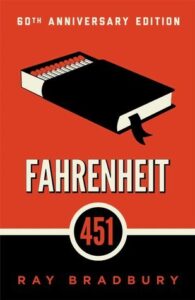
Fahrenheit 451 ofrece la historia de un sombrío y horroroso futuro. Montag, el protagonista, pertenece a una extraña brigada de bomberos cuya misión, paradójicamente, no es la de sofocar incendios sino la de provocarlos, para quemar libros. Porque en el país de Montag está terminantemente prohibido leer. Porque leer obliga a pensar, y en el país de Montag esta prohibido pensar. Porque leer impide ser ingenuamente feliz, y en el país de Montag hay que ser feliz a la fuerza...
Welcome Back!
Track your reading progress and sync your library.