The year is 1327. Franciscans in a wealthy Italian abbey are suspected of heresy, and Brother William of Baskerville arrives to investigate. When his delicate mission is suddenly overshadowed by seven bizarre deaths, Brother William turns to the logic of Aristotle, the theology of Aquinas, and the empirical insights of Roger Bacon to find the killer. He collects evidence, deciphers secret symbols and coded manuscripts, and digs into the eerie labyrinth of the abbey (“where the most interesting things happen at night”) armed with a wry sense of humor and a ferocious curiosity.
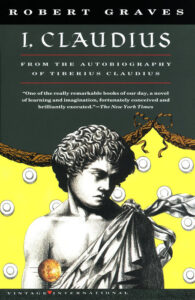
A modern classic of historical fiction written in the form of Claudius's autobiography.
Tiberius Claudius Drusus Nero Germanicus lived from 10 B.C. to 54 A.D. Despised as a weakling and dismissed as an idiot because of his physical infirmities, Claudius survived the intrigues and poisonings that marked the reigns of Augustus, Tiberius, and the mad Caligula to become emperor of Rome in 41 A.D. The first part of Robert Graves’s two-part account of the life of Tiberius Claudius, I, Claudius stands as a landmark historical novel of the 20th century from one of its great writers.
"But you do," he went on, not waiting for contradiction. "You love the boy body and soul, plainly, directly, as he loves you, and no other word expresses it ..."
Lucy has her rigid, middle-class life mapped out for her, until she visits Florence with her uptight cousin Charlotte, and finds her neatly ordered existence thrown off balance. Her eyes are opened by the unconventional characters she meets at the Pension Bertolini: flamboyant romantic novelist Eleanor Lavish, the Cockney Signora, curious Mr Emerson and, most of all, his passionate son George.
Lucy finds herself torn between the intensity of life in Italy and the repressed morals of Edwardian England, personified in her terminally dull fiancé Cecil Vyse. Will she ever learn to follow her own heart?
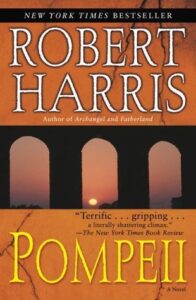
All along the Mediterranean coast, the Roman empire's richest citizens are relaxing in their luxurious villas, enjoying the last days of summer. The world's largest navy lies peacefully at anchor in Misenum. The tourists are spending their money in the seaside resorts of Baiae, Herculaneum, and Pompeii.
But the carefree lifestyle and gorgeous weather belie an impending cataclysm, and only one man is worried. The young engineer Marcus Attilius Primus has just taken charge of the Aqua Augusta, the enormous aqueduct that brings fresh water to a quarter of a million people in nine towns around the Bay of Naples. His predecessor has disappeared. Springs are failing for the first time in generations. And now there is a crisis on the Augusta's sixty-mile main line—somewhere to the north of Pompeii, on the slopes of Mount Vesuvius.
Attilius—decent, practical, and incorruptible—promises Pliny, the famous scholar who commands the navy, that he can repair the aqueduct before the reservoir runs dry. His plan is to travel to Pompeii and put together an expedition, then head out to the place where he believes the fault lies. But Pompeii proves to be a corrupt and violent town, and Attilius soon discovers that there are powerful forces at work—both natural and man-made—threatening to destroy him.
With his trademark elegance and intelligence, Robert Harris, bestselling author of Archangel and Fatherland, re-creates a world on the brink of disaster.
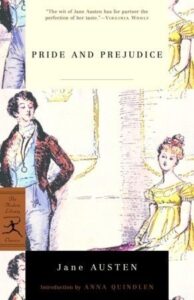
Since its immediate success in 1813, Pride and Prejudice has remained one of the most popular novels in the English language. Jane Austen called this brilliant work "her own darling child" and its vivacious heroine, Elizabeth Bennet, "as delightful a creature as ever appeared in print." The romantic clash between the opinionated Elizabeth and her proud beau, Mr. Darcy, is a splendid performance of civilized sparring. And Jane Austen's radiant wit sparkles as her characters dance a delicate quadrille of flirtation and intrigue, making this book the most superb comedy of manners of Regency England.
A gothic masterpiece of tempestuous passions and dark secrets, Charlotte Brontë's Jane Eyre is edited with an introduction and notes by Stevie Davis in Penguin Classics.
Charlotte Brontë tells the story of orphaned Jane Eyre, who grows up in the home of her heartless aunt, enduring loneliness and cruelty. This troubled childhood strengthens Jane's natural independence and spirit - which prove necessary when she finds employment as a governess to the young ward of Byronic, brooding Mr Rochester. As her feelings for Rochester develop, Jane gradually uncovers Thornfield Hall's terrible secret, forcing her to make a choice. Should she stay with Rochester and live with the consequences, or follow her convictions - even if it means leaving the man she loves? A novel of intense power and intrigue, Jane Eyre dazzled readers with its passionate depiction of a woman's search for equality and freedom.
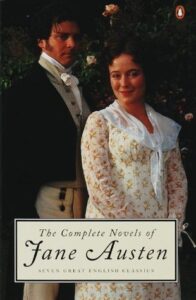
Few novelists have conveyed the subtleties and nuances of their own social milieu with the wit and insight of Jane Austen. Through her vivacious and spirited heroines and their circle, she paints vivid portraits of English middle-class life as the eighteenth century came to a close. Each of the novels is a love story and a story about marriage — marriage for love, for financial security, for social status. But they are not mere romances; ironic, comic and wise, they are masterly studies of the society Jane Austen observed. The seven novels in this volume contain some of the most brilliant, dazzling prose in the English language. --back cover
Emma / Lady Susan / Mansfield Park / Northanger Abbey / Persuasion / Pride and Prejudice / Sense and Sensibility
Scarlett O'Hara, the beautiful, spoiled daughter of a well-to-do Georgia plantation owner, must use every means at her disposal to claw her way out of the poverty she finds herself in after Sherman's March to the Sea.
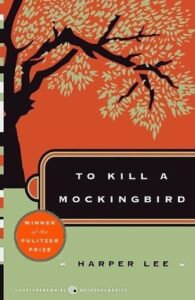
"Shoot all the bluejays you want, if you can hit 'em, but remember it's a sin to kill a mockingbird."
A lawyer's advice to his children as he defends the real mockingbird of Harper Lee's classic novel - a black man charged with the rape of a white girl. Through the young eyes of Scout and Jem Finch, Harper Lee explores with exuberant humour the irrationality of adult attitudes to race and class in the Deep South of the 1930s. The conscience of a town steeped in prejudice, violence and hypocrisy is pricked by the stamina of one man's struggle for justice. But the weight of history will only tolerate so much.
"To Kill A Mockingbird" became both an instant bestseller and a critical success when it was first published in 1960. It went on to win the Pulitzer Prize in 1961 and was later made into an Academy Award-winning film.
Welcome Back!
Track your reading progress and sync your library.