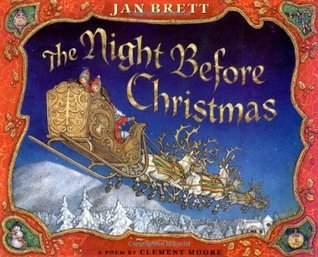
This poem first appeared in a newspaper in Troy, New York, USA, on December 23, 1823, as “A Visit From St. Nicholas”. No one claimed authorship until 13 years later. Clement Clarke Moore, a professor and poet, said that he wrote the piece for his children. Unbeknownst to him, his housekeeper had sent it to the newspaper to be published. However, the family of Henry Livingston Jr. contended that their father had been reciting “A Visit from St. Nicholas” for 15 years prior to publication. Regardless of the true author, the poem is now a Christmas classic.
“Seeing is believing, but sometimes the most real things in the world are the things we can't see.”
Late one Christmas Eve after the town has gone to sleep, the boy boards the mysterious train that waits for him: the Polar Express bound for the North Pole. When he arrives, Santa offers the boy any gift he desires. The boy modestly asks for one bell from the harness of the reindeer. The gift is granted. On the way home the bell is lost. On Christmas morning, the boy finds the bell under the tree. The mother of the boy admires the bell, but laments that it is broken—for you see, only believers can hear the sound of the bell.
Awarded the prestigious Caldecott Medal in 1986, 'The Polar Express 'has sold more than 7 million copies, become a classic holiday movie, and been translated into stage productions that take place across the United States during the holiday season.
When heaven prepares for the birth of Christ, the Littlest Angel is not sure what he can give the Baby, but his gift turns out to be the best of all. Ages 4-8.
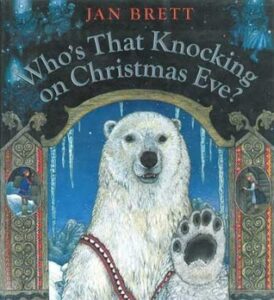
Every year, trolls knock down Kyri's door and gobble up her Christmas feast. But this year, the trolls are in for a a boy and his pet ice bear on their way to Oslo have come in from the cold. And once the ice bear is finished with the trolls, you can bet they won't come knocking next Christmas Eve!
Once again, Jan Brett creates an original Christmas story full of warmth and magic. Featuring beautiful borders, intricate illustrations, and a stunning display of the Northern Lights, Who's That Knocking on Christmas Eve? will rightfully take its place among Jan's Christmas favorites with the whole family.
O. Henry's classic tale of the wisest gifts of Christmas is itself a gift to share and treasure.
In a shabby New York flat, Della sobs as she counts the few coins she has saved to buy a Christmas present for her husband, Jim. One dollar and eighty-seven cents is all the money she has in the world. A gift worthy of her devotion will require a great sacrifice: selling her long, beautiful hair. Set in New York at the turn of the twentieth century, this classic piece of American literature tells the story of a young couple and the value of love.
Jim, meanwhile, has made a sacrifice for Della that is no less difficult. As they exchange gifts on Christmas Eve, the discovery of what each has done fills them with despair, until they realize that the true gifts of Christmas can be found more readily in their humble apartment than in any fine store. Set in New York at the turn of the twentieth century, this classic piece of American literature tells the story of a young couple and the value of love.
O. Henry paints a masterly portrait of unfaltering love, a haven from the harsh world outside. The poignancy of his story is captured in Zwerger's eloquent art, wherein every glance, every gesture, tells a subtle truth.
"Journey with this tiny star as it seeks its purpose in the Milky Way Galaxy and discovers that it is destined to participate in a wonderful Christmas event."
Captivating character, vivid illustrations, and engaging storyline complement this spectacular and unique re-telling of the announcement of the birth of Baby Jesus.
This book has received three awards in 2016: -- SILVER MEDAL WINNER in the 2016 Illumination Awards in the category of Holiday Books -- FINALIST in the 2016 IAN Book of the Year Awards in the category of Children's Illustrated Books -- 2016 PINNACLE Book Awards in the category of Children's Fiction
“I’ve left some clues for you. If you want them, turn the page. If you don’t, put the book back on the shelf, please.”
So begins the latest whirlwind romance from the bestselling authors of Nick & Norah’s Infinite Playlist. Lily has left a red notebook full of challenges on a favorite bookstore shelf, waiting for just the right guy to come along and accept its dares. But is Dash that right guy? Or are Dash and Lily only destined to trade dares, dreams, and desires in the notebook they pass back and forth at locations across New York? Could their in-person selves possibly connect as well as their notebook versions? Or will they be a comic mismatch of disastrous proportions?
Rachel Cohn and David Levithan have written a love story that will have readers perusing bookstore shelves, looking and longing for a love (and a red notebook) of their own.
"The Grinch hated Christmas! The whole Christmas season! Now, please don't ask why. No one quite knows the reason."
Dr. Seuss's small-hearted Grinch ranks right up there with Scrooge when it comes to the crankiest, scowling holiday grumps of all time.
For 53 years, the Grinch has lived in a cave on the side of a mountain, looming above the Whos in Whoville. The noisy holiday preparations and infernal singing of the happy little citizens below annoy him to no end. The Grinch decides this frivolous merriment must stop. His "wonderful, awful" idea is to don a Santa outfit, strap heavy antlers on his poor, quivering dog Max, construct a makeshift sleigh, head down to Whoville, and strip the chafingly cheerful Whos of their Yuletide glee once and for all.
Looking quite out of place and very disturbing in his makeshift Santa get-up, the Grinch slithers down chimneys with empty bags and stealing the Whos' presents, their food, even the logs from their humble Who-fires. He takes the ramshackle sleigh to Mt. Crumpit to dump it and waits to hear the sobs of the Whos when they wake up and discover the trappings of Christmas have disappeared. Imagine the Whos' dismay when they discover the evil-doings of Grinch in his anti-Santa guise. But what is that sound? It's not sobbing, but singing! Children simultaneously adore and fear this triumphant, twisted Seussian testimonial to the undaunted cheerfulness of the Whos, the transcendent nature of joy, and of course, the growth potential of a heart that's two sizes too small.
This holiday classic is perfect for reading aloud to your favorite little Whos.
"The woods are lovely, dark and deep, But I have promises to keep, And miles to go before I sleep, And miles to go before I sleep."
Written by Robert Frost in 1922, and first published in 1923, the poem that begins "Whose woods these are I think I know" surely holds a special place in American hearts. Frost was a poet who could and did speak to everyone, but rarely more memorably than in this evocation of the quiet delights of winter.
For this special edition with a new design, trim size, and three new spreads, Susan Jeffers has added more detail and subtle color to her sweeping backgrounds of frosty New England scenes. There are more animals to find among the trees, and the kindly figure with his "promises to keep" exudes warmth as he stops to appreciate the quiet delights of winter. The handsome new vellum jacket will attract new and old fans as it evokes a frost-covered windowpane. It is truly one to share with the whole family.
Illustrated in Full color
Welcome Back!
Track your reading progress and sync your library.