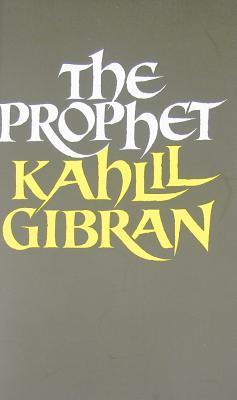
Kahlil Gibran’s masterpiece, The Prophet, is one of the most beloved classics of our time. Published in 1923, it has been translated into more than twenty languages, and the American editions alone have sold more than nine million copies.
The Prophet is a collection of poetic essays that are philosophical, spiritual, and, above all, inspirational. Gibran’s musings are divided into twenty-eight chapters covering such sprawling topics as love, marriage, children, giving, eating and drinking, work, joy and sorrow, housing, clothes, buying and selling, crime and punishment, laws, freedom, reason and passion, pain, self-knowledge, teaching, friendship, talking, time, good and evil, prayer, pleasure, beauty, religion, and death.
Herman Hesse's classic novel has delighted, inspired, and influenced generations of readers, writers, and thinkers. In this story of a wealthy Indian Brahmin who casts off a life of privilege to seek spiritual fulfillment. Hesse synthesizes disparate philosophies--Eastern religions, Jungian archetypes, Western individualism--into a unique vision of life as expressed through one man's search for true meaning.
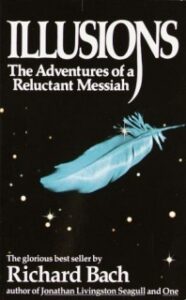
In the cloud-washed airspace between the cornfields of Illinois and blue infinity, a man puts his faith in the propeller of his biplane. For disillusioned writer and itinerant barnstormer Richard Bach, belief is as real as a full tank of gas and sparks firing in the cylinders...until he meets Donald Shimoda — former mechanic and self-described messiah who can make wrenches fly and Richard's imagination soar....
In Illusions, Richard Bach takes to the air to discover the ageless truths that give our souls wings: that people don't need airplanes to soar...that even the darkest clouds have meaning once we lift ourselves above them... and that messiahs can be found in the unlikeliest places — like hay fields, one-traffic-light midwestern towns, and most of all, deep within ourselves.
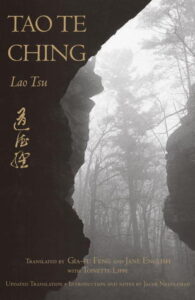
A lucid translation of the well-known Taoist classic by a leading scholar-now in a Shambhala Pocket Library edition.
Written more than two thousand years ago, the Tao Teh Ching, or -The Classic of the Way and Its Virtue, - is one of the true classics of the world of spiritual literature.
Traditionally attributed to the legendary -Old Master, - Lao Tzu, the Tao Teh Ching teaches that the qualities of the enlightened sage or ideal ruler are identical with those of the perfected individual.
Today, Lao Tzu's words are as useful in mastering the arts of leadership in business and politics as they are in developing a sense of balance and harmony in everyday life. To follow the Tao or Way of all things and realize their true nature is to embody humility, spontaneity, and generosity.
John C. H. Wu has done a remarkable job of rendering this subtle text into English while retaining the freshness and depth of the original. A jurist and scholar, Dr. Wu was a recognized authority on Taoism and the translator of several Taoist and Zen texts and of Chinese poetry.
This book is part of the Shambhala Pocket Library series. The Shambhala Pocket Library is a collection of short, portable teachings from notable figures across religious traditions and classic texts.
The covers in this series are rendered by Colorado artist Robert Spellman. The books in this collection distill the wisdom and heart of the work Shambhala Publications has published over 50 years into a compact format that is collectible, reader-friendly, and applicable to everyday life.
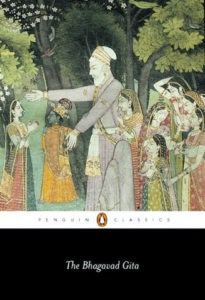
The Mahabharata incorporates Bhagavad-Gita, a sacred Hindu text that takes the form of a philosophical dialogue in which Krishna instructs Arjuna, the prince, in ethical matters and the nature of God.
Krishna expounds the nature and the way that humans can come to know God to Arjuna, the warrior prince in the Bhagavad-Gita.
Mahabharata, a Sanskrit epic, contains the text of the Bhagavad-Gita.
This early epic poem recounts the conversation between the warrior and his charioteer, the divine manifestation. It sets out the important lessons to learn to change the outcome of the war in the moments before a great battle that the warrior fights, and culminates in revealing the true cosmic warrior and counselling him to search for the universal perfection of life. This most important work ranges from yoga postures to dense moral discussion and serves as a practical guide to living well.
The Celestine Prophecy contains secrets that are currently changing our world. Drawing on the ancient wisdom found in a Peruvian manuscript, it tells you how to make connections between the events happening in your own life right now...and lets you see what is going to happen to you in the years to come.
The story it tells is a gripping one of adventure and discovery, but it is also a guidebook that has the power to crystalize your perceptions of why you are where you are in life...and to direct your steps with a new energy and optimism as you head into tomorrow.
A book that comes along just once in a lifetime to change lives forever.
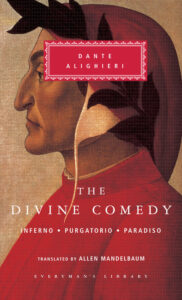
This Everyman’s Library edition–containing in one volume all three cantos, Inferno, Purgatorio, and Paradiso–includes an introduction by Nobel Prize—winning poet Eugenio Montale, a chronology, notes, and a bibliography. Also included are forty-two drawings selected from Botticelli’s marvelous late-fifteenth-century series of illustrations.
Translated in this edition by Allen Mandelbaum, The Divine Comedy begins in a shadowed forest on Good Friday in the year 1300. It proceeds on a journey that, in its intense recreation of the depths and the heights of human experience, has become the key with which Western civilization has sought to unlock the mystery of its own identity.
Mandelbaum’s astonishingly Dantean translation, which captures so much of the life of the original, renders whole for us the masterpiece of that genius whom our greatest poets have recognized as a central model for all poets.
John Milton's Paradise Lost is one of the greatest epic poems in the English language. It tells the story of the Fall of Man, a tale of immense drama and excitement, of rebellion and treachery, of innocence pitted against corruption, in which God and Satan fight a bitter battle for control of mankind's destiny. The struggle rages across three worlds - heaven, hell, and earth - as Satan and his band of rebel angels plot their revenge against God. At the center of the conflict are Adam and Eve, who are motivated by all too human temptations but whose ultimate downfall is unyielding love.
Marked by Milton's characteristic erudition, Paradise Lost is a work epic both in scale and, notoriously, in ambition. For nearly 350 years, it has held generation upon generation of audiences in rapt attention, and its profound influence can be seen in almost every corner of Western culture.
Librarian's note: An alternate cover edition can be found here
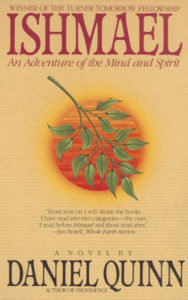
TEACHER SEEKS PUPIL. Must have an earnest desire to save the world. Apply in person.
It was just a three-line ad in the personals section, but it launched the adventure of a lifetime...
So begins Ishmael, an utterly unique and captivating novel that has earned a large and passionate following among readers and critics alike—one of the most beloved and bestselling novels of spiritual adventure ever published.
Welcome Back!
Track your reading progress and sync your library.