Presented in the form of a dialogue between Socrates and three different interlocutors, this classic text is an enquiry into the notion of a perfect community and the ideal individual within it. During the conversation, other questions are raised: what is goodness?; what is reality?; and what is knowledge? The Republic also addresses the purpose of education and the role of both women and men as guardians of the people. With remarkable lucidity and deft use of allegory, Plato arrives at a depiction of a state bound by harmony and ruled by philosopher kings.
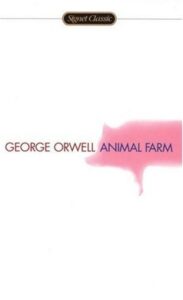
After years of exploitation, neglect, and despair, the animals of Manor Farm revolt. They drive owner Mr. Jones off the land and rechristen the property Animal Farm, a utopia of equality and mutual support. But Napoleon, a young boar who assumes command after the rebellion, is hungry for power. And as the pigs consolidate control, all the good intentions of Animal Farm are crushed by a new and inevitable tyranny.
George Orwell’s Animal Farm, the chilling allegorical satire about the working class and the gripping rhetoric of despots, illustrates just how easy the slide into oppression and totalitarianism can be.
Revised Previously published as Animal Farm , this edition of Animal Farm (AmazonClassics Edition) includes editorial revisions.
Anthem is Ayn Rand's classic tale of a dystopian future of the great "We"—a world that deprives individuals of a name or independence—that anticipates her later masterpieces, The Fountainhead and Atlas Shrugged.
They existed only to serve the state. They were conceived in controlled Palaces of Mating. They died in the Home of the Useless. From cradle to grave, the crowd was one—the great WE.
In all that was left of humanity, there was only one man who dared to think, seek, and love. He lived in the dark ages of the future. In a loveless world, he dared to love the woman of his choice. In an age that had lost all trace of science and civilization, he had the courage to seek and find knowledge. But these were not the crimes for which he would be hunted. He was marked for death because he had committed the unpardonable sin: He had stood forth from the mindless human herd. He was a man alone. He had rediscovered the lost and holy word—I.
"I worship individuals for their highest possibilities as individuals, and I loathe humanity, for its failure to live up to these possibilities." —Ayn Rand
For nearly a century, the original version of Upton Sinclair's classic novel has remained almost entirely unknown.
When it was published in serial form in 1905, it was a full third longer than the censored, commercial edition published in book form the following year. That expurgated commercial edition edited out much of the ethnic flavor of the original, as well as some of the goriest descriptions of the meat-packing industry and much of Sinclair's most pointed social and political commentary.
The text of this new edition is as it appeared in the original uncensored edition of 1905. It contains the full 36 chapters as originally published, rather than the 31 of the expurgated edition.
A new foreword describes the discovery in the 1980s of the original edition and its subsequent suppression, and a new introduction places the novel in historical context by explaining the pattern of censorship in the shorter commercial edition.
Winner of both the Hugo and Nebula Awards, the powerful, classic story about a man who receives an operation that turns him into a genius...and introduces him to heartache.
Charlie Gordon is about to embark upon an unprecedented journey. Born with an unusually low IQ, he has been chosen as the perfect subject for an experimental surgery that researchers hope will increase his intelligence – a procedure that has already been highly successful when tested on a lab mouse named Algernon.
As the treatment takes effect, Charlie's intelligence expands until it surpasses that of the doctors who engineered his metamorphosis. The experiment appears to be a scientific breakthrough of paramount importance, until Algernon suddenly deteriorates. Will the same happen to Charlie?
In Sapiens, he explored our past. In Homo Deus, he looked to our future. Now, one of the most innovative thinkers on the planet turns to the present to make sense of today's most pressing issues.
How do computers and robots change the meaning of being human? How do we deal with the epidemic of fake news? Are nations and religions still relevant? What should we teach our children?
Yuval Noah Harari's 21 Lessons for the 21st Century is a probing and visionary investigation into today's most urgent issues as we move into the uncharted territory of the future. As technology advances faster than our understanding of it, hacking becomes a tactic of war, and the world feels more polarized than ever, Harari addresses the challenge of navigating life in the face of constant and disorienting change and raises the important questions we need to ask ourselves in order to survive.
In twenty-one accessible chapters that are both provocative and profound, Harari builds on the ideas explored in his previous books, untangling political, technological, social, and existential issues and offering advice on how to prepare for a very different future from the world we now live in: How can we retain freedom of choice when Big Data is watching us? What will the future workforce look like, and how should we ready ourselves for it? How should we deal with the threat of terrorism? Why is liberal democracy in crisis?
Harari's unique ability to make sense of where we have come from and where we are going has captured the imaginations of millions of readers. Here he invites us to consider values, meaning, and personal engagement in a world full of noise and uncertainty. When we are deluged with irrelevant information, clarity is power. Presenting complex contemporary challenges clearly and accessibly, 21 Lessons for the 21st Century is essential reading.
· The government is expanding. · Taxes are increasing. · More senseless wars are being planned. · Inflation is ballooning. · Our basic freedoms are disappearing.
The Founding Fathers didn't want any of this. In fact, they said so quite clearly in the Constitution of the United States of America. Unfortunately, that beautiful, ingenious, and revolutionary document is being ignored more and more in Washington. If we are to enjoy peace, freedom, and prosperity once again, we absolutely must return to the principles upon which America was founded. But finally, there is hope . . .
In THE REVOLUTION, Texas congressman and presidential candidate Ron Paul has exposed the core truths behind everything threatening America, from the real reasons behind the collapse of the dollar and the looming financial crisis, to terrorism and the loss of our precious civil liberties. In this book, Ron Paul provides answers to questions that few even dare to ask.
Despite a media blackout, this septuagenarian physician-turned-congressman sparked a movement that has attracted a legion of young, dedicated, enthusiastic supporters . . . a phenomenon that has amazed veteran political observers and made more than one political rival envious. Candidates across America are already running as "Ron Paul Republicans."
"Dr. Paul cured my apathy," says a popular campaign sign. THE REVOLUTION may cure yours as well.
Born in the town of Sighet, Transylvania, Elie Wiesel was a teenager when he and his family were taken from their home in 1944 to Auschwitz concentration camp, and then to Buchenwald. Night is the terrifying record of Elie Wiesel's memories of the death of his family, the death of his own innocence, and his despair as a deeply observant Jew confronting the absolute evil of man. This new translation by his wife and most frequent translator, Marion Wiesel, corrects important details and presents the most accurate rendering in English of Elie Wiesel's testimony to what happened in the camps and of his unforgettable message that this horror must simply never be allowed to happen again.
The Waste Land, first published in 1922, is often regarded as T.S. Eliot's masterpiece, as well as one of the most important poems of the 20th century and a central work of modernist poetry.
The work, divided in 5 sections, juxtaposes the legend of the Holy Grail and the Fisher King, with a snapshot of early twentieth-century British society. In contemporary times, it is often read published within The Waste Land and Other Poems and has come to be Eliot's most popular poem.
T.S. Elliot was a poet, essayist, publisher, playwright, literary critic and editor. Born in 1888 in St. Louis (MO, USA), he is considered one of the 20th century's major poets, and a central figure in English-language Modernist poetry."In ten years' time," wrote Edmund Wilson in Axel's Castle (1931), "Elliot has left upon English poetry a mark more unmistakable than that of any other poet writing in English." In 1948, Eliot was awarded the Nobel Price "for his work as a trail-blazing pioneer of modern poetry."
Welcome Back!
Track your reading progress and sync your library.