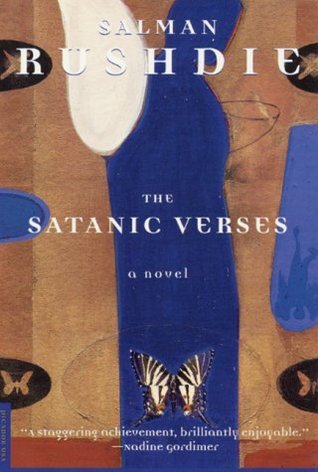
Just before dawn one winter’s morning, a hijacked jetliner explodes above the English Channel. Through the falling debris, two figures, Gibreel Farishta, the biggest star in India, and Saladin Chamcha, an expatriate returning from his first visit to Bombay in fifteen years, plummet from the sky, washing up on the snow-covered sands of an English beach, and proceed through a series of metamorphoses, dreams, and revelations.
An alternative cover edition for this ISBN can be found here.
Saleem Sinai is born at the stroke of midnight on August 15, 1947, the very moment of India’s independence. Greeted by fireworks displays, cheering crowds, and Prime Minister Nehru himself, Saleem grows up to learn the ominous consequences of this coincidence. His every act is mirrored and magnified in events that sway the course of national affairs; his health and well-being are inextricably bound to those of his nation; his life is inseparable, at times indistinguishable, from the history of his country. Perhaps most remarkable are the telepathic powers linking him with India’s 1,000 other “midnight’s children,” all born in that initial hour and endowed with magical gifts.
This novel is at once a fascinating family saga and an astonishing evocation of a vast land and its people–a brilliant incarnation of the universal human comedy. Twenty-five years after its publication, Midnight’ s Children stands apart as both an epochal work of fiction and a brilliant performance by one of the great literary voices of our time.
A tall, yellow-haired young European traveller calling himself 'Mogor dell'Amore', the Mughal of Love, arrives at the court of the real Grand Mughal, the Emperor Akbar, with a tale to tell that begins to obsess the whole imperial capital. The stranger claims to be the child of a lost Mughal princess, the youngest sister of Akbar's grandfather Babar: Qara Koz, 'Lady Black Eyes', a great beauty believed to possess powers of enchantment and sorcery, who is taken captive first by an Uzbek warlord, then by the Shah of Persia, and finally becomes the lover of a certain Argalia, a Florentine soldier of fortune, commander of the armies of the Ottoman Sultan. When Argalia returns home with his Mughal mistress the city is mesmerized by her presence, and much trouble ensues. The Enchantress of Florence is the story of a woman attempting to command her own destiny in a man's world. It brings together two cities that barely know each other - the hedonistic Mughal capital, in which the brilliant emperor wrestles daily with questions of belief, desire and the treachery of sons, and the equally sensual Florentine world of powerful courtesans, humanist philosophy and inhuman torture, where Argalia's boyhood friend "il Machia" - Niccolo' Machiavelli - is learning, the hard way, about the true brutality of power. These two worlds, so far apart, turn out to be uncannily alike, and the enchantments of women hold sway over them both. But is Mogor's story true? And if so, then what happened to the lost princess? And if he's a liar, must he die?
This is the story of Maximilian Ophuls, America’s counterterrorism chief, one of the makers of the modern world; his Kashmiri Muslim driver and subsequent killer, a mysterious figure who calls himself Shalimar the clown; Max’s illegitimate daughter India; and a woman who links them, whose revelation finally explains them all. It is an epic narrative that moves from California to Kashmir, France, and England, and back to California again. Along the way there are tales of princesses lured from their homes by demons, legends of kings forced to defend their kingdoms against evil. And there is always love, gained and lost, uncommonly beautiful and mortally dangerous.
Alternate cover edition of ISBN-13: 978-0140286809, ISBN-10/ASIN: 0140286802
For the first time in English, all the fiction by the writer who has been called “the greatest Spanish-language writer of our century” collected in a single volume
A Penguin Classics Deluxe Edition with flaps and deckle-edged paper
For some fifty years, in intriguing and ingenious fictions that reimagined the very form of the short story—from his 1935 debut with A Universal History of Iniquity through his immensely influential collections Ficciones and The Aleph, the enigmatic prose poems of The Maker, up to his final work in the 1980s, Shakespeare’s Memory—Jorge Luis Borges returned again and again to his celebrated themes: dreams, duels, labyrinths, mirrors, infinite libraries, the manipulations of chance, gauchos, knife fighters, tigers, and the elusive nature of identity itself. Playfully experimenting with ostensibly subliterary genres, he took the detective story and turned it into metaphysics; he took fantasy writing and made it, with its questioning and reinventing of everyday reality, central to the craft of fiction; he took the literary essay and put it to use reviewing wholly imaginary books.
Bringing together for the first time in English all of Borges’s magical stories, and all of them newly rendered into English in brilliant translations by Andrew Hurley, Collected Fictions is the perfect one-volume compendium for all who have long loved Borges, and a superb introduction to the master’s work for all who have yet to discover this singular genius.
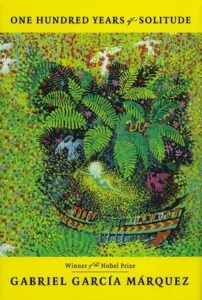
Probably García Márquez finest and most famous work. One Hundred Years of Solitude tells the story of the rise and fall, birth and death of a mythical town of Macondo through the history of the Buendia family. Inventive, amusing, magnetic, sad, alive with unforgettable men and women, and with a truth and understanding that strike the soul. One Hundred Years of Solitude is a masterpiece of the art of fiction.
Full of philosophical puzzles and supernatural surprises, these stories contain some of Borges's most fully realized human characters. With uncanny insight, he takes us inside the minds of an unrepentant Nazi, an imprisoned Mayan priest, fanatical Christian theologians, a woman plotting vengeance on her father’s “killer,” and a man awaiting his assassin in a Buenos Aires guest house. This volume also contains the hauntingly brief vignettes about literary imagination and personal identity collected in The Maker, which Borges wrote as failing eyesight and public fame began to undermine his sense of self.
For more than seventy years, Penguin has been the leading publisher of classic literature in the English-speaking world. With more than 1,700 titles, Penguin Classics represents a global bookshelf of the best works throughout history and across genres and disciplines. Readers trust the series to provide authoritative texts enhanced by introductions and notes by distinguished scholars and contemporary authors, as well as up-to-date translations by award-winning translators.
The seventeen pieces in Ficciones demonstrate the whirlwind of Borges's genius and mirror the precision and potency of his intellect and inventiveness, his piercing irony, his skepticism, and his obsession with fantasy. Borges sends us on a journey into a compelling, bizarre, and profoundly resonant realm; we enter the fearful sphere of Pascal's abyss, the surreal and literal labyrinth of books, and the iconography of eternal return. To enter the worlds in Ficciones is to enter the mind of Jorge Luis Borges, wherein lies Heaven, Hell, and everything else in between.
Part One: The Garden of Forking Paths Prologue Tlön, Uqbar, Orbis Tertius (1940) The Approach to Al-Mu'tasim (1936, not included in the 1941 edition) Pierre Menard, Author of the Quixote (1939) The Circular Ruins (1940) The Lottery in Babylon (1941) An Examination of the Work of Herbert Quain (1941) The Library of Babel (1941) The Garden of Forking Paths (1941) Part Two: Artifices Prologue Funes the Memorious (1942) The Form of the Sword (1942) Theme of the Traitor and the Hero (1944) Death and the Compass (1942) The Secret Miracle (1943) Three Versions of Judas (1944) The End (1953, 2nd edition only) The Sect of the Phoenix (1952, 2nd edition only) The South (1953, 2nd edition only)
Although his work has been restricted to the short story, the essay, and poetry, Jorge Luis Borges of Argentina is recognized all over the world as one of the most original and significant figures in modern literature. In his preface, Andre Maurois writes: "Borges is a great writer who has composed only little essays or short narratives. Yet they suffice for us to call him great because of their wonderful intelligence, their wealth of invention, and their tight, almost mathematical style."
Labyrinths is a representative selection of Borges' writing, some forty pieces drawn from various books of his published over the years. The translations are by Harriet de Onis, Anthony Kerrigan, and others, including the editors, who have provided a biographical and critical introduction, as well as an extensive bibliography.
Welcome Back!
Track your reading progress and sync your library.