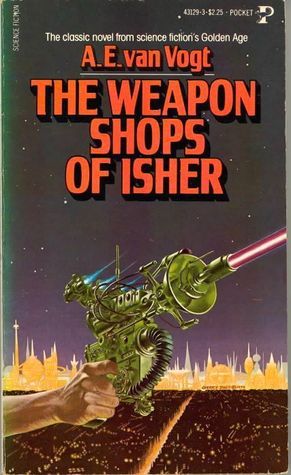
With the publication, in the July 1941 issue of Astounding Science Fiction magazine, of the story Seesaw, van Vogt began unfolding the complex tale of the oppressive Empire of Isher and the mysterious Weapon Shops. This volume, The Weapon Shops of Isher, includes the first three parts of the saga and introduces perhaps the most famous political slogan of science fiction: The Right to Buy Weapons is the Right to Be Free. Born at the height of Nazi conquest, the Isher stories suggested that an oppressive government could never completely subjugate its own citizens if they were well armed. The audience appeal was immediate and has endured long beyond other stories of alien invasion, global conflict and post war nuclear angst.
A spaceship captain determined to gather a cupful of the sun. . .a nubile young witch who yearns to taste human love. . .an expedition that hunts dinosaurs across the fragile and dangerous chasm of time. . . These strange and wonderful tales of beauty and terror will transport you from the begininng of time to the outermost limits of the future. Selected from his best-selling collections "The Golden Apples Of The Sun" and "R Is For Rocket," here are thirty-two superb stories from one of the master fantastics of our age--the inimitable Ray Bradbury.
CONTENTS 1 • The Fog Horn • (1951) • short story by Ray Bradbury 10 • The April Witch • [The Elliott Family] • (1952) • short story by Ray Bradbury 21 • The Wilderness • [The Martian Chronicles] • (1952) • short story by Ray Bradbury 31 • The Fruit at the Bottom of the Bowl • non-genre • (1948) • short story by Ray Bradbury 43 • The Flying Machine • (1953) • short story by Ray Bradbury 49 • The Murderer • (1953) • short story by Ray Bradbury 58 • The Golden Kite, the Silver Wind • (1953) • short story by Ray Bradbury 63 • I See You Never • non-genre • (1947) • short story by Ray Bradbury 67 • Embroidery • (1951) • short story by Ray Bradbury 71 • The Big Black and White Game • (1945) • short story by Ray Bradbury 83 • The Great Wide World Over There • (1952) • short story by Ray Bradbury 96 • Powerhouse • (1948) • short story by Ray Bradbury 106 • En la Noche • (1952) • short story by Ray Bradbury 111 • Sun and Shadow • non-genre • (1953) • short story by Ray Bradbury 119 • The Meadow • (1953) • short story by Ray Bradbury 135 • The Garbage Collector • (1953) • short story by Ray Bradbury 141 • The Great Fire • [Green Town] • (1949) • short story by Ray Bradbury 148 • The Golden Apples of the Sun • (1953) • short story by Ray Bradbury 157 • R Is for Rocket • (1943) • short story by Ray Bradbury 174 • The End of the Beginning • (1956) • short story by Ray Bradbury 180 • The Rocket • (1950) • short story by Ray Bradbury 191 • The Rocket Man • (1951) • short story by Ray Bradbury 203 • A Sound of Thunder • (1952) • short story by Ray Bradbury 216 • The Long Rain • (1950) • short story by Ray Bradbury 231 • The Exiles • (1949) • short story by Ray Bradbury 246 • Here There Be Tygers • (1951) • short story by Ray Bradbury 260 • The Strawberry Window • (1955) • short story by Ray Bradbury 269 • The Dragon • (1955) • short story by Ray Bradbury 273 • Frost and Fire • (1946) • novella by Ray Bradbury 316 • Uncle Einar • [The Elliott Family] • (1947) • short story by Ray Bradbury 324 • The Time Machine • [Dandelion Wine] • (1955) • short story by Ray Bradbury 332 • The Sound of Summer Running • [Dandelion Wine] • (1956) • short story by Ray Bradbury
HARD TIMES That's what leads Manson Everard to answer an ad offering "high pay and foreign travel for men and women with military experience." But compared to where - and when - he's going, "hard times" in the 20th-century U.S.A. are easy!
9 • Time Patrol • [Time Patrol • 1] • (1955) • novelette by Poul Anderson 65 • Brave to Be a King • [Time Patrol • 2] • (1959) • novelette by Poul Anderson 125 • Gibraltar Falls • [Time Patrol • 3] • (1975) • shortstory by Poul Anderson 141 • The Only Game in Town • [Time Patrol • 4] • (1960) • novelette by Poul Anderson 187 • Delenda Est • [Time Patrol • 5] • (1955) • novelette by Poul Anderson
One moment Joseph Schwartz is a happily retired tailor in 1949 Chicago. The next he's a helpless stranger on Earth during the heyday of the first Galactic Empire. Earth, he soon learns, is a backwater, just a pebble in the sky, despised by all the other 200 million planets of the Empire because its people dare to claim it's the original home of man. And Earth is poor, with great areas of radioactivity ruining much of its soil--so poor that everyone is sentenced to death at the age of sixty.
Joseph Schwartz is sixty-two.
This is young Isaac Asimov's first novel, full of wonders and ideas, the book that launched the novels of the Galactic Empire, culminating in the Foundation books and novels. It is also one of that select group of SF adventures that since the early 1950s has hooked generations of teenagers on reading science fiction. This is Golden Age SF at its finest.
"By His Bootstraps" is a science fiction novella by American writer Robert A. Heinlein. It plays with some of the inherent paradoxes that would be caused by time travel.
The story was published in the October 1941 issue of Astounding Science Fiction under the pen name Anson MacDonald; the same issue has "Common Sense" under Heinlein's name. "By His Bootstraps" was reprinted in Heinlein's 1959 collection The Menace From Earth, and in several subsequent anthologies.
Isaac Asimov's I, Robot launches readers on an adventure into a not-so-distant future where man and machine , struggle to redefinelife, love, and consciousness—and where the stakes are nothing less than survival. Filled with unforgettable characters, mind-bending speculation, and nonstop action, I, Robot is a powerful reading experience from one of the master storytellers of our time.
I, ROBOT
They mustn't harm a human being, they must obey human orders, and they must protect their own existence...but only so long as that doesn't violate rules one and two. With these Three Laws of Robotics, humanity embarked on perhaps its greatest adventure: the invention of the first positronic man. It was a bold new era of evolution that would open up enormous possibilities—and unforeseen risks. For the scientists who invented the earliest robots weren't content that their creations should ' remain programmed helpers, companions, and semisentient worker-machines. And soon the robots themselves; aware of their own intelligence, power, and humanity, aren't either.
As humans and robots struggle to survive together—and sometimes against each other—on earth and in space, the future of both hangs in the balance. Human men and women confront robots gone mad, telepathic robots, robot politicians, and vast robotic intelligences that may already secretly control the world. And both are asking the same questions: What is human? And is humanity obsolete?
In l, Robot Isaac Asimov changes forever our perception of robots, and human beings and updates the timeless myth of man's dream to play god. with all its rewards—and terrors. --front flap
In 1941, Astounding Science Fiction magazine published a short story by a little-known writer named Isaac Asimov. The story was called "Nightfall", and many years later it has long been recognized as a classic, its author a legend. Now, the Grand Master of Science Fiction teams with Robert Silverberg, one of the field's top award-winning authors, to explore and expand an apocalyptic tale that is more spellbinding today than ever before -- Nightfall: The Novel.
Imagine living on a planet with six suns that never experiences darkness. Imagine never having seen the stars. Then, one by one the suns start to set, gradually leading into darkness for the first time ever. Kalgash is a world on the edge of chaos, torn between the madness of religious fanaticism and the unyielding rationalism of scientists. Lurking beneath it all is a collective, instinctual fear of the Darkness. For Kalgash knows only the perpetual light of day; to its inhabitants, a gathering twilight portends unspeakable horror. And only a handful of people on the planet are prepared to face the truth, their six suns are setting all at once for the first time in over two thousand years, signaling the end of civilization as it explodes in the awesome splendor of Nightfall.
Encompassing the psychology of disaster, the tenacity of the human spirit, and, ultimately, the regenerative power of hope, Nightfall is a tale rich in character and suspense that only the unique collaboration of Isaac Asimov and Robert Silverberg could create.
THE COMPLETE ROBOT is the definitive anthology of Asimov's stunning visions of a robotic future…
In these stories, Isaac Asimov creates the Three Laws of Robotics and ushers in the Robot Age: when Earth is ruled by master-machines and when robots are more human than mankind. Contents
9 • Introduction (The Complete Robot) • (1982) • essay by Isaac Asimov 15 • A Boy's Best Friend • (1975) • short story by Isaac Asimov 19 • Sally • (1953) • short story by Isaac Asimov 41 • Someday • (1956) • short story by Isaac Asimov 55 • Point of View • [Multivac] • (1975) • short story by Isaac Asimov 59 • Think! • (1977) • short story by Isaac Asimov 70 • True Love • (1977) • short story by Isaac Asimov 77 • Robot AL-76 Goes Astray • (1942) • short story by Isaac Asimov 93 • Victory Unintentional • (1942) • short story by Isaac Asimov 117 • Stranger in Paradise • (1974) • novelette by Isaac Asimov 151 • Light Verse • (1973) • short story by Isaac Asimov 157 • Segregationist • (1967) • short story by Isaac Asimov 164 • Robbie • (1940) • short story by Isaac Asimov (variant of Strange Playfellow) 191 • Let's Get Together • (1957) • short story by Isaac Asimov 211 • Mirror Image • [Elijah Bailey / R. Daneel Olivaw] • (1972) • short story by Isaac Asimov 231 • The Tercentenary Incident • (1976) • short story by Isaac Asimov 253 • First Law • [Mike Donovan] • (1956) • short story by Isaac Asimov 257 • Runaround • [Mike Donovan] • (1942) • novelette by Isaac Asimov 280 • Reason • [Mike Donovan] • (1941) • short story by Isaac Asimov 302 • Catch That Rabbit • [Mike Donovan] • (1944) • short story by Isaac Asimov 329 • Liar! • [Susan Calvin] • (1941) • short story by Isaac Asimov 350 • Satisfaction Guaranteed • [Susan Calvin] • (1951) • short story by Isaac Asimov 368 • Lenny • [Susan Calvin] • (1958) • short story by Isaac Asimov 385 • Galley Slave • [Susan Calvin] • (1957) • novelette by Isaac Asimov 427 • Little Lost Robot • [Susan Calvin] • (1947) • novelette by Isaac Asimov 459 • Risk • [Susan Calvin] • (1955) • novelette by Isaac Asimov 490 • Escape! • [Susan Calvin] • (1945) • short story by Isaac Asimov 518 • Evidence • [Susan Calvin] • (1946) • novelette by Isaac Asimov 546 • The Evitable Conflict • [Susan Calvin] • (1950) • novelette by Isaac Asimov 575 • Feminine Intuition • [Susan Calvin] • (1969) • novelette by Isaac Asimov 605 • ... That Thou Art Mindful of Him • (1974) • novelette by Isaac Asimov (variant of —That Thou Art Mindful of Him!) 635 • The Bicentennial Man • (1976) • novelette by Isaac Asimov 683 • A Last Word • (1982) • essay by Isaac Asimov
THE COMPLETE ROBOT is the ultimate collection of timeless, amazing and amusing robot stories from the greatest science fiction writer of all time, offering golden insights into robot thought processes. Asimov's Three Laws of Robotics were programmed into real computers thirty years ago at the Massachusetts Institute of Technology - with surprising results. Readers of today still have many surprises in store...
Welcome Back!
Track your reading progress and sync your library.