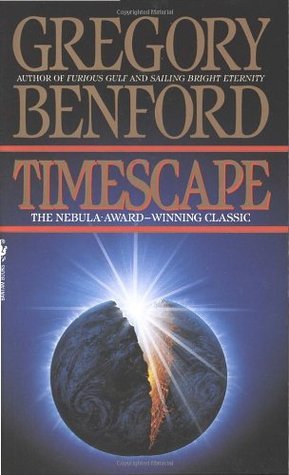
The author of Tides of Light offers his Nebula Award-winning SF classic—a combination of hard science, bold speculation, and human drama. In the year 1998, a group of scientists works desperately to communicate with the scientists of 1962, warning of an ecological disaster that will destroy the oceans in the future—if it is not averted in the past.
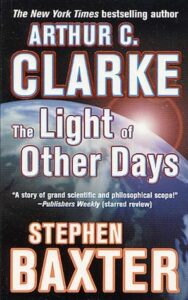
When a brilliant, driven industrialist harnesses the cutting edge of quantum physics to enable people everywhere, at trivial cost, to see one another at all times: around every corner, through every wall, into everyone's most private, hidden, and even intimate moments. It amounts to the sudden and complete abolition of human privacy--forever.
Then, as society reels, the same technology proves able to look backwards in time as well. What happens next is a story only Arthur C. Clarke and Stephen Baxter could tell. The Light of Other Days is a novel that will change your view of what it is to be human.
The Peace War is quintessential hard-science adventure. The Peace Authority conquered the world with a weapon that never should have been a weapon--the "bobble," a spherical force-field impenetrable by any force known to mankind. Encasing governmental installations and military bases in bobbles, the Authority becomes virtually omnipotent. But they've never caught Paul Hoehler, the maverick who invented the technology, and who has been working quietly for decades to develop a way to defeat the Authority. With the help of an underground network of determined, independent scientists and a teenager who may be the apprentice genius he's needed for so long, he will shake the world, in the fast-paced hard-science thriller that garnered Vinge the first of his four Hugo nominations for best novel.
Larry Greenberg's telepathic tendencies had been trained and developed to a critical level. The trouble was that if these psychic interchanges were strong enough, a man could end up not knowing who he really was. And when Larry's mind is taken over by a sinister alien force, he has to fight to retain his sanity - and divert a disaster that threatens all mankind...
Axiomatic is a collection of Greg Egan's short stories that appeared in various science fiction magazines (mostly Interzone and Asimov's) between 1989 and 1992.
Contents: The Infinite Assassin (1991) The Hundred Light-Year Diary (1992) Eugene (1990) The Caress (1990) Blood Sisters (1991) Axiomatic (1990) The Safe-Deposit Box (1990) Seeing (1995) A Kidnapping (1995) Learning to Be Me (1990) The Moat (1991) The Walk (1992) The Cutie (1989) Into Darkness (1992) Appropriate Love (1991) The Moral Virologist (1990) Closer (1992) Unstable Orbits in the Space of Lies (1992)
By the end of the 30th century humanity has the capability to travel the universe, to journey beyond earth and beyond the confines of the vulnerable human frame.The descendants of centuries of scientific, cultural and physical development divide into fleshers — true Homo sapiens; Gleisner robots — embodying human minds within machines that interact with the physical world; and polises — supercomputers teeming with intelligent software, containing the direct copies of billions of human personalities now existing only in the virtual reality of the polis.Diaspora is the story of Yatima — a polis being created from random mutations of the Konishi polis base mind seed — and of humankind, Of an astrophysical accident that spurs the thousandfold cloning of the polises. Of the discovery of an alien race and of a kink in time that means humanity — whatever form it takes — will never again be threatened by acts of God.
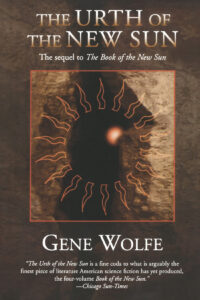
The long awaited sequel to Gene Wolfe’s four-volume classic, The Book of the New Sun. We return to the world of Severian, now the Autarch of Urth, as he leaves the planet on one of the huge spaceships of the alien Hierodules to travel across time and space to face his greatest test, to become the legendary New Sun or die. The strange, rich, original spaceship scenes give way to travels in time, wherein Severian revisits times and places which fill in parts of the background of the four-volume work, that will thrill and intrigue particularly all readers of the earlier books. But The Urth of the New Sun is an independent structure all of a piece, an integral masterpiece to shelve beside the classics, one itself.
In the year 2034, Theo Guderian, a French physicist, made an amusing but impractical discovery: the means to use a one-way, fixed-focus time warp that opened into a place in the Rhine River valley during the idyllic Pliocene Epoch, six million years ago. But, as time went on, a certain usefulness developed. The misfits and mavericks of the future—many of them brilliant people—began to seek this exit door to a mysterious past. In 2110, a particularly strange and interesting group was preparing to make the journey—a starship captain, a girl athlete, a paleontologist, a woman priest, and others who had reason to flee the technological perfection of twenty-second-century life.
Thus begins this dazzling fantasy novel that invites comparisons with the work of J.R.R. Tolkien, Arthur C. Clarke, and Ursula Le Guin. It opens up a whole world of wonder, not in far-flung galaxies but in our own distant past on Earth—a world that will captivate not only science-fiction and fantasy fans but also those who enjoy literate thrillers.
The group that passes through the time-portal finds an unforeseen strangeness on the other side. Far from being uninhabited, Pliocene Europe is the home of two warring races from another planet. There is the knightly race of the Tanu—handsome, arrogant, and possessing vast powers of psychokinesis and telepathy. And there is the outcast race of Firvulag—dwarfish, malevolent, and gifted with their own supernormal skills. Taken captive by the Tanu and transported through the primordial European landscape, the humans manage to break free, join in an uneasy alliance with the forest-dwelling Firvulag, and, finally, launch an attack against the Tanu city of light on the banks of a river that, eons later, would be called the Rhine.
Myth and legend, wit and violence, speculative science and breathtaking imagination mingle in this romantic fantasy, which is the first volume in a series about the exile world.
It's fifty years from tomorrow. A microscopic black hole has accidentally fallen into the Earth's core and the entire planet is in danger of being destroyed within two years. A team of scientists frantically searches for a way to prevent the ultimate disaster. But while they look for an answer, others argue that the only way to save the Earth is to let its human inhabitants become extinct: to let the million-year evolutionary clock rewind and start over.
From an underground lab in New Zealand to a spacestation in Low Earth Orbit, from an endangered species conservation ark in Africa to a home in New Orleans, Earth spans exotic settings and challenging new ideas. It's peopled with extraordinary characters: a brilliant, devoted young scientist who discovers his life's work may be responsible for destroying the world; a hard-bitten shuttle pilot who vows to learn the secret of her husband's tragic death; a legendary Novel laureate whose relationship with the planet borders on the mystical; a midwestern youth who leaves behind the boredom of suburban American life for the dangers of the unknown; a Maori billionaire who fears that all his money cannot control his fate — or the fate of the world.
But, above all Earth is a profound, impassioned testament about our own responsibility to our endangered planet.
Welcome Back!
Track your reading progress and sync your library.