
Life can be hard: your lover cheats on you; you lose a family member; you can’t pay the bills – and it can be great: you’ve had the hottest sex of your life; you get that plum job; you muster the courage to write your novel. Sugar – the once-anonymous online columnist at The Rumpus, now revealed as Cheryl Strayed, author of the bestselling memoir Wild – is the person thousands turn to for advice. Tiny Beautiful Things brings the best of Dear Sugar in one place and includes never-before-published columns and a new introduction by Steve Almond. Rich with humor, insight, compassion – and absolute honesty – this bookis a balm for everything life throws our way.
Books similar to Tiny Beautiful Things: Advice on Love and Life from Dear Sugar
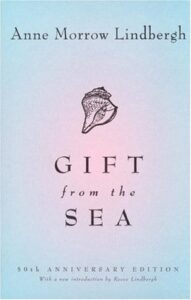
In this inimitable, beloved classic—graceful, lucid and lyrical—Anne Morrow Lindbergh shares her meditations on youth and age; love and marriage; peace, solitude and contentment as she set them down during a brief vacation by the sea. Drawing inspiration from the shells on the shore, Lindbergh’s musings on the shape of a woman’s life bring new understanding to both men and women at any stage of life. A mother of five, an acclaimed writer and a pioneering aviator, Lindbergh casts an unsentimental eye on the trappings of modernity that threaten to overwhelm us: the time-saving gadgets that complicate rather than simplify, the multiple commitments that take us from our families. And by recording her thoughts during a brief escape from everyday demands, she helps readers find a space for contemplation and creativity within their own lives.
With great wisdom and insight Lindbergh describes the shifting shapes of relationships and marriage, presenting a vision of life as it is lived in an enduring and evolving partnership. A groundbreaking, best-selling work when it was originally published in 1955, Gift from the Sea continues to be discovered by new generations of readers. With a new introduction by Lindbergh’s daughter Reeve, this fiftieth-anniversary edition will give those who are revisiting the book and those who are coming upon it for the first time fresh insight into the life of this remarkable woman.
The sea and the beach are elements that have been woven throughout Anne Morrow Lindbergh’s life. She spent her childhood summers with her family on a Maine island. After her marriage to Charles Lindbergh in 1929, she accompanied him on his survey flights around the North Atlantic to launch the first transoceanic airlines. The Lindberghs eventually established a permanent home on the Connecticut coast, where they lived quietly, wrote books and raised their family.
After the children left home for lives of their own, the Lindberghs traveled extensively to Africa and the Pacific for environmental research.
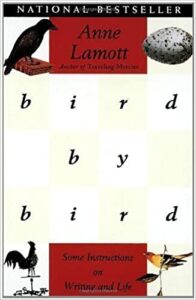
"Thirty years ago my older brother, who was ten years old at the time, was trying to get a report on birds written that he'd had three months to write. [It] was due the next day. We were out at our family cabin in Bolinas, and he was at the kitchen table close to tears, surrounded by binder paper and pencils and unopened books on birds, immobilized by the hugeness of the task ahead. Then my father sat down beside him, put his arm around my brother's shoulder, and said. 'Bird by bird, buddy. Just take it bird by bird.'"
With this basic instruction always in mind, Anne Lamott returns to offer us a new gift: a step-by-step guide on how to write and on how to manage the writer's life. From "Getting Started,' with "Short Assignments," through "Shitty First Drafts," "Character," "Plot," "Dialogue." all the way from "False Starts" to "How Do You Know When You're Done?" Lamott encourages, instructs, and inspires. She discusses "Writers Block," "Writing Groups," and "Publication." Bracingly honest, she is also one of the funniest people alive.
If you have ever wondered what it takes to be a writer, what it means to be a writer, what the contents of your school lunches said about what your parents were really like, this book is for you. From faith, love, and grace to pain, jealousy, and fear, Lamott insists that you keep your eyes open, and then shows you how to survive. And always, from the life of the artist she turns to the art of life.
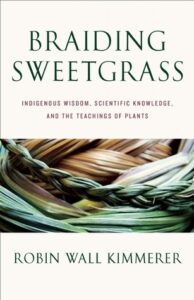
As a botanist, Robin Wall Kimmerer has been trained to ask questions of nature with the tools of science. As a member of the Citizen Potawatomi Nation, she embraces the notion that plants and animals are our oldest teachers. In Braiding Sweetgrass, Kimmerer brings these lenses of knowledge together to show that the awakening of a wider ecological consciousness requires the acknowledgment and celebration of our reciprocal relationship with the rest of the living world. For only when we can hear the languages of other beings are we capable of understanding the generosity of the earth, and learning to give our own gifts in return.
An unforgettable true story about the potential for mercy to redeem us, and a clarion call to end mass incarceration in America — from one of the most inspiring lawyers of our time.
Bryan Stevenson was a young lawyer when he founded the Equal Justice Initiative, a nonprofit law office in Montgomery, Alabama, dedicated to defending the poor, the incarcerated, and the wrongly condemned.
Just Mercy tells the story of EJI, from the early days with a small staff facing the nation’s highest death sentencing and execution rates, through a successful campaign to challenge the cruel practice of sentencing children to die in prison, to revolutionary projects designed to confront Americans with our history of racial injustice.
One of EJI’s first clients was Walter McMillian, a young Black man who was sentenced to die for the murder of a young white woman that he didn’t commit. The case exemplifies how the death penalty in America is a direct descendant of lynching — a system that treats the rich and guilty better than the poor and innocent.
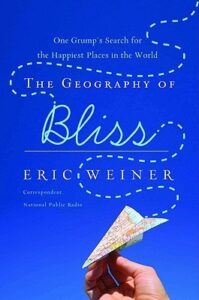
Weiner spent a decade as a foreign correspondent reporting from such discontented locales as Iraq, Afghanistan, and Indonesia. Unhappy people living in profoundly unstable states, he notes, inspire pathos and make for good copy, but not for good karma. So Weiner, admitted grump and self-help book aficionado, undertook a year's research to travel the globe, looking for the "unheralded happy places." The result is this book, equal parts laugh-out-loud funny and philosophical, a journey into both the definition of and the destination for true contentment.
Apparently, the happiest places on earth include, somewhat unexpectedly, Iceland, Bhutan, and India. Weiner also visits the country deemed most malcontent, Moldova, and finds real merit in the claim.
But the question remains: What makes people happy? Is it the freedom of the West or the myriad restrictions of Singapore? The simple ashrams of India or the glittering shopping malls of Qatar? From the youthful drunkenness of Iceland to the despond of Slough, a sad but resilient town in Heathrow's flight path, Weiner offers wry yet profound observations about the way people relate to circumstance and fate.
Both revealing and inspirational, perhaps the best thing about this hilarious trip across four continents is that for the reader, the "geography of bliss" is wherever they happen to find themselves while reading it.
Pink is my favorite color. I used to say my favorite color was black to be cool, but it is pink—all shades of pink. If I have an accessory, it is probably pink. I read Vogue, and I’m not doing it ironically, though it might seem that way. I once live-tweeted the September issue.
In these funny and insightful essays, Roxane Gay takes us through the journey of her evolution as a woman of color while also taking readers on a ride through culture of the last few years and commenting on the state of feminism today. The portrait that emerges is not only one of an incredibly insightful woman continually growing to understand herself and our society, but also one of our culture.
Bad Feminist is a sharp, funny, and spot-on look at the ways in which the culture we consume becomes who we are, and an inspiring call-to-arms of all the ways we still need to do better.
Feel me, see me, hear me, reach me -- Peculiar benefits -- Typical first year professor -- To scratch, claw or grope clumsily or frantically -- How to be friends with another woman -- Girls, girls, girls -- I once was Miss America -- Garish, glorious spectacles -- Not here to make friends -- How we all lose -- Reaching for catharsis : getting fat right (or wrong) and Diana Spechler's Skinny -- The smooth surfaces of idyll -- The careless language of sexual violence -- What we hunger for -- The illusion of safety/the safety of illusion -- The spectacle of broken men -- A tale of three coming out stories -- Beyond the measure of men -- Some jokes are funnier than others -- Dear young ladies who love Chris Brown -- So much they would let him beat them -- Blurred lines, indeed -- The trouble with Prince Charming, or, He who trespassed against us -- The solace of preparing fried foods and other quaint remembrances from 1960s Mississippi : thoughts on The help -- Surviving Django -- Beyond the struggle narrative -- The morality of Tyler Perry -- The last day of a young black man -- When less is more -- The politics of respectability -- When Twitter does what journalism cannot -- The alienable rights of women -- Holding out for a hero -- A tale of two profiles -- The racism we all carry -- Tragedy, call, compassion, response -- Bad feminist : take one -- Bad feminist : take two
Tara Westover was 17 the first time she set foot in a classroom. Born to survivalists in the mountains of Idaho, she prepared for the end of the world by stockpiling home-canned peaches and sleeping with her "head-for-the-hills bag". In the summer she stewed herbs for her mother, a midwife and healer, and in the winter she salvaged in her father's junkyard.
Her father forbade hospitals, so Tara never saw a doctor or nurse. Gashes and concussions, even burns from explosions, were all treated at home with herbalism. The family was so isolated from mainstream society that there was no one to ensure the children received an education and no one to intervene when one of Tara's older brothers became violent.
Then, lacking any formal education, Tara began to educate herself. She taught herself enough mathematics and grammar to be admitted to Brigham Young University, where she studied history, learning for the first time about important world events like the Holocaust and the civil rights movement. Her quest for knowledge transformed her, taking her over oceans and across continents, to Harvard and to Cambridge. Only then would she wonder if she'd traveled too far, if there was still a way home.
Educated is an account of the struggle for self-invention. It is a tale of fierce family loyalty and of the grief that comes with severing the closest of ties. With the acute insight that distinguishes all great writers, Westover has crafted a universal coming-of-age story that gets to the heart of what an education is and what it offers: the perspective to see one's life through new eyes and the will to change it.
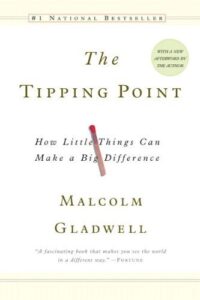
From the bestselling author of The Bomber Mafia: discover Malcolm Gladwell's breakthrough debut and explore the science behind viral trends in business, marketing, and human behavior. The tipping point is that magic moment when an idea, trend, or social behavior crosses a threshold, tips, and spreads like wildfire. Just as a single sick person can start an epidemic of the flu, so too can a small but precisely targeted push cause a fashion trend, the popularity of a new product, or a drop in the crime rate. This widely acclaimed bestseller, in which Malcolm Gladwell explores and brilliantly illuminates the tipping point phenomenon, is already changing the way people throughout the world think about selling products and disseminating ideas.
Welcome Back!
Track your reading progress and sync your library.