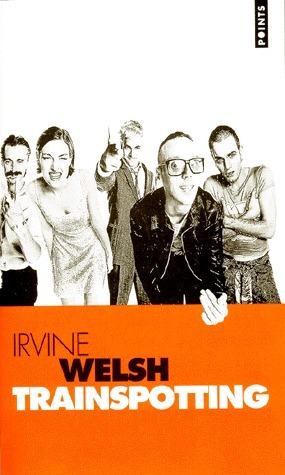
Ils sont quatre amis inséparables qui ont en commun une enfance, une ville, des voisins, le chômage. Et surtout une dévotion appliquée pour une seule et unique héroïne en forme de seringue. On entend ces quatre-là, on les écoute : chacun raconte son Edimbourg, entre deux pintes de bière, après un fix, avant une tasse de thé, ou pendant une baston à coup d’aiguilles à tricoter taillées en pointe. On voit les corps mangés par le virus, la drogue, les hallucinations, et puis quelque chose se détache : on est d’Edimbourg, mais comme on est de Fresnes ou de la Santé. Il faut s’échapper. Livre culte des années 1990, Trainspotting a été porté à l’écran par Dany Boyle.
Mark Renton has it all: he's good-looking, young, with a pretty girlfriend and a place at university. But there's no room for him in the 1980s. Thatcher's government is destroying working-class communities across Britain, and the post-war certainties of full employment, educational opportunity and a welfare state are gone. When his family starts to fracture, Mark's life swings out of control and he succumbs to the defeatism which has taken hold in Edinburgh's grimmer areas. The way out is heroin.
It's no better for his friends. Spud Murphy is paid off from his job, Tommy Lawrence feels himself being sucked into a life of petty crime and violence - the worlds of the thieving Matty Connell and psychotic Franco Begbie. Only Sick Boy, the supreme manipulator of the opposite sex, seems to ride the current, scamming and hustling his way through it all.
Skagboys charts their journey from likely lads to young men addicted to the heroin which has flooded their disintegrating community. This is the 1980s: a time of drugs, poverty, AIDS, violence, political strife and hatred - but a lot of laughs, and maybe just a little love; a decade which changed Britain for ever. The prequel to the world-renowned Trainspotting, this is an exhilarating and moving book, full of the scabrous humour, salty vernacular and appalling behaviour that has made Irvine Welsh a household name.
In Coney Island, Brooklyn, lonely widow Sarah Goldfarb wants nothing more than to lose weight and appear on a television game show. In her obsessive quest, she becomes addicted to diet pills, while her junkie son, Harry, along with his girlfriend, Marion, and best friend, Tyrone, attempt to secure an illicit shortcut to wealth and leisure by selling heroin.
Entranced by the gleaming visions of their futures, these four convince themselves that unexpected setbacks are only temporary. Even as their lives slowly deteriorate around them, they cling to their delusions and become utterly consumed in a spiral of drugs and addiction, refusing to see that they have instead created their own worst nightmares.
"Selby's place is in the front rank of American novelists . . . To understand Selby's work is to understand the anguish of America." —The New York Times Book Review
With the Christmas season upon him, Detective Sergeant Bruce Robertson of Edinburgh's finest is gearing up socially—kicking things off with a week of sex and drugs in Amsterdam.
There are some sizable flies in the ointment, though: a missing wife and child, a nagging cocaine habit, some painful below-the-belt eczema, and a string of demanding extramarital affairs. The last thing Robertson needs is a messy, racially fraught murder, even if it means overtime—and the opportunity to clinch the promotion he craves. Then there's that nutritionally demanding (and psychologically acute) intestinal parasite in his gut. Yes, things are going badly for this utterly corrupt tribune of the law, but in an Irvine Welsh novel nothing is ever so bad that it can't get a whole lot worse. . .
Fear and Loathing in Las Vegas is the best chronicle of drug-soaked, addle-brained, rollicking good times ever committed to the printed page. It is also the tale of a long weekend road trip that has gone down in the annals of American pop culture as one of the strangest journeys ever undertaken.
A gargantuan, mind-altering tragi-comedy about the Pursuit of Happiness in America.
Set in an addicts' halfway house and a tennis academy, and featuring the most endearingly screwed-up family to come along in recent fiction, Infinite Jest explores essential questions about what entertainment is and why it has come to so dominate our lives; about how our desire for entertainment affects our need to connect with other people; and about what the pleasures we choose say about who we are.
Equal parts philosophical quest and screwball comedy, Infinite Jest bends every rule of fiction without sacrificing for a moment its own entertainment value. It is an exuberant, uniquely American exploration of the passions that make us human—and one of those rare books that renew the idea of what a novel can do.
Clear-eyed and spirited, Taylor Greer grew up poor in rural Kentucky with the goals of avoiding pregnancy and getting away. But when she heads west with high hopes and a barely functional car, she meets the human condition head-on. By the time Taylor arrives in Tucson, Arizona, she has acquired a completely unexpected child, a three-year-old American Indian girl named Turtle, and must somehow come to terms with both motherhood and the necessity for putting down roots. Hers is a story about love and friendship, abandonment and belonging, and the discovery of surprising resources in apparently empty places.
One of Bukowski's best, this beer-soaked, deliciously degenerate novel follows the wanderings of aspiring writer Henry Chinaski across World War II-era America. Deferred from military service, Chinaski travels from city to city, moving listlessly from one odd job to another, always needing money but never badly enough to keep a job. His day-to-day existence spirals into an endless litany of pathetic whores, sordid rooms, dreary embraces, and drunken brawls, as he makes his bitter, brilliant way from one drink to the next.
Charles Bukowski's posthumous legend continues to grow. Factotum is a masterfully vivid evocation of slow-paced, low-life urbanity and alcoholism, and an excellent introduction to the fictional world of Charles Bukowski.
The lives of three very different groups of people--gangsters on the streets of Manila, middle-class suburban families, and a group of street children and the psychologist studying them--intertwine in an intricately woven tale, set in the Philippines, that spans three generations. 22,500 first printing.
Welcome Back!
Track your reading progress and sync your library.