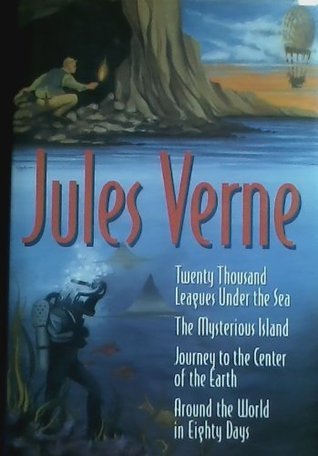
Twenty Thousand Leagues Under the Sea / The Mysterious Island / Journey to the Centre of the Earth / Around the World in Eighty Days
English (translation)
Original French
English (translation)
Original French
This edition features George Orwell’s best-known novels—1984 and Animal Farm—with an introduction by Christopher Hitchens.
In 1984, London is a grim city where Big Brother is always watching you and the Thought Police can practically read your mind. Winston Smith joins a secret revolutionary organisation called The Brotherhood, dedicated to the destruction of the Party. Together with his beloved Julia, he hazards his life in a deadly match against the powers that be.
Animal Farm is Orwell’s classic satire of the Russian Revolution - an account of the bold struggle, initiated by the animals, that transforms Mr. Jones’s Manor Farm into Animal Farm - a wholly democratic society built on the credo that All Animals Are Created Equal. But are they? AUTHOR: George Orwell (1903-1950) was born in India and served with the Imperial Police in Burma before joining the Republican Army in the Spanish Civil War. Orwell was the author of six novels as well as numerous essays and nonfiction works.
Foundation begins a new chapter in the story of man's future. As the Old Empire crumbles into barbarism throughout the million worlds of the galaxy, Hari Seldon and his band of psychologists must create a new entity, the Foundation-dedicated to art, science, and technology-as the beginning of a new empire.
Foundation and Empire describes the mighty struggle for power amid the chaos of the stars in which man stands at the threshold of a new enlightened life which could easily be destroyed by the old forces of barbarism.
Second Foundation follows the Seldon Plan after the First Empire's defeat and describes its greatest threat-a dangerous mutant strain gone wild, which produces a mind capable of bending men's wills, directing their thoughts, reshaping their desires, and destroying the universe.
This adaptation for BBC Radio 4 was first broadcast in 1973 with a cast which included Lee Montague, Maurice Denham, John Justin, Angela Plesence, Wolfe Morris, Julian Glover and Prunella Scales.
The astonishing novel Brave New World, originally published in 1932, presents Aldous Huxley's vision of the future--of a world utterly transformed. Through the most efficient scientific and psychological engineering, people are genetically designed to be passive and therefore consistently useful to the ruling class. This powerful work of speculative fiction sheds a blazing critical light on the present and is considered to be Aldous Huxley's most enduring masterpiece.
The non-fiction work Brave New World Revisited, published in 1958, is a fascinating work in which Huxley uses his tremendous knowledge of human relations to compare the modern-day world with his prophetic fantasy envisioned in Brave New World, including the threats to humanity, such as over-population, propaganda, and chemical persuasion.
The Sirens of Titan is an outrageous romp through space, time, and morality. The richest, most depraved man on Earth, Malachi Constant, is offered a chance to take a space journey to distant worlds with a beautiful woman at his side. Of course there's a catch to the invitation—and a prophetic vision about the purpose of human life that only Vonnegut has the courage to tell.
Drunk, and in charge of a bicycle / introduction by Ray Bradbury--
The night --
Homecoming--
Uncle Einar --
The traveler --
The lake --
The coffin --
The crowd --
The scythe --
There was an old woman --
There will come soft rains --
Mars is heaven --
The silent towns --
The earth men --
The off season --
The million-year picnic --
The fox and the forest --
Kaleidoscope --
The rocket man --
Marionettes, inc. --
No particular night or morning --
The city --
The fire balloons --
The last night of the world --
The veldt --
The long rain --
The great fire --
The wilderness --
A sound of thunder --
The murderer --
The April witch --
Invisible boy --
The golden kite, the silver wind --
The fog horn --
The black black and white game --
Embroidery --
The golden apples of the sun --
Powerhouse --
Hail and farewell --
The great wide world over there --
The playground --
Skeleton --
The man upstairs --
Touched with fire --
The emissary --
The jar --
The small assasin --
The next in line --
Jack-in-the-box --
The leave-taking --
Exorcism --
The happiness machine --
Calling Mexico --
The wonderful ice cream suit --
Dark they were, and golden-eyed --
The strawberry window --
A scent of sarsaparilla --
The Picasso summer --
The day it rained forever --
A medicine for melancholy --
The shoreline at sunset --
Fever dream --
The town where no one got off --
All summer in a day --
Frost and fire --
The anthem sprinters --
And so died Riabouchinska --
Boys! Raise giant mushrooms in your cellar! --
The vacation --
The illustrated woman --
Some live like Lazarus --
The best of all possible worlds --
The one who waits --
Tyrannosaurus Rex --
The screaming woman --
The terrible conflagration up at the place --
Night call, collect --
The tombling day --
The haunting of the new --
Tomorrow's child --
I sing the body electric! --
The women --
The inspired chicken motel --
Yes, we'll gather at the river --
Have I got a chocolate bar for you! --
A story of love --
The parrot who met Papa --
The October game --
Punishment without crime --
A piece of wood --
The blue bottle --
Long after midnight --
The utterly perfect murder --
The better part of wisdom --
Interval in sunlight --
The black ferris --
Farewell summer --
McGillahee's brat --
The aqueduct --
Gotcha! --
The end of the beginning.
Unique Elements
Two of Wells’s best-loved science fiction novels
The Time Machine , H. G. Wells ’s first novel, was published in 1895. It is a tale of Darwinian evolution taken to its extreme. Its protagonist, a young scientist, travels 800,000 years into the future and discovers a dying earth inhabited by two bizarre humanoid the brutal Morlocks and the kind but nearly helpless Eloi.
The Invisible Man, first published in 1897 , tells the story of an adventurous scientist discovering the formula for invisibility—a secret that drives him mad. It combines chilling terror, suspense, and acute psychological insight.
Based on the true story of Alexander Selkirk, who survived alone for almost five years on an uninhabited island off the coast of Chile, The Mysterious Island is considered by many to be Jules Verne’s masterpiece. “Wide-eyed mid-nineteenth-century humanistic optimism in a breezy, blissfully readable translation by Stump” (Kirkus Reviews), here is the enthralling tale of five men and a dog who land in a balloon on a faraway, fantastic island of bewildering goings-on and their struggle to survive as they uncover the island’s secret.