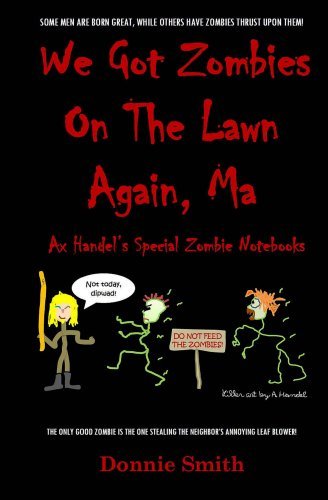
In this humorously irreverent take on zombies, Ax Handel is a present-day nineteen-year-old pizza delivery guy with a short fuse who is determined to take control of his wildly unpredictable life. His comical attempts to make sense of his relationships with his outrageous family members usually end up in disaster. Suddenly, his life changes—possibly for the better—when zombies stumble out of a nearby cemetery. Life has never been easy for Ax and his mother, and they refuse to be scared off by a horde of the dying impaired. Without any help from Ma, whose hard-living, heavy-metal past has left her strangely sympathetic to the plight of the zombies, or his volatile ex-girlfriend, Zenobia, who’s certain he’s a head case, or even his zoned-out fugitive father, it’s up to Ax to protect his little town of Karbunkle and what little he owns, while getting revenge on some bad-mannered, lumbering stiffs.
Books similar to We Got Zombies on the Lawn Again, Ma
Charting the whole of Arthur Dent's odyssey through space are:
THE HITCHHIKER'S GUIDE TO THE GALAXY. One Thursday lunchtime the Earth gets unexpectedly demolished to make way for a new hyperspace bypass. For Arthur Dent, who has only just had his house demolished that morning, this seems already to be more than he can cope with. Sadly, however, the weekend has only just begun, and the Galaxy is a very very very large and startling place.
THE RESTAURANT AT THE END OF THE UNIVERSE. When all questions of space, time, matter and the nature of being have been resolved, only one question remains --- "Where shall we have dinner?" The Restaurant at the End of the Universe provides the ultimate gastronomic experience, and for once there is no morning after to worry about.
LIFE, THE UNIVERSE AND EVERYTHING. In consequence of a number of stunning catastrophes, Arthur Dent is surprised to find himself living in a hideously miserable cave on prehistoric Earth. However, just as he thinks that things cannot possibly get any worse, they suddenly do. He discovers that the Galaxy is not only mind-boggling big and bewildering but also that most of the things that happen in it are staggeringly unfair.
SO LONG, AND THANKS FOR ALL THE FISH. Just as Arthur Dent's sense of reality is in its dickiest state he suddenly finds the girl of his dreams. He finds her in the last place in the Universe in which he would expect to find anything at all, but which 3,976,000 people will find oddly familiar. They go in search of God's Final Message to His Creation and, in a dramatic break with tradition, actually find it.
“It is a truth universally acknowledged that a zombie in possession of brains must be in want of more brains.”
So begins Pride and Prejudice and Zombies, an expanded edition of the beloved Jane Austen novel featuring all-new scenes of bone-crunching zombie mayhem. As our story opens, a mysterious plague has fallen upon the quiet English village of Meryton—and the dead are returning to life! Feisty heroine Elizabeth Bennet is determined to wipe out the zombie menace, but she’s soon distracted by the arrival of the haughty and arrogant Mr. Darcy. What ensues is a delightful comedy of manners with plenty of civilized sparring between the two young lovers—and even more violent sparring on the blood-soaked battlefield. Can Elizabeth vanquish the spawn of Satan? And overcome the social prejudices of the class-conscious landed gentry? Complete with romance, heartbreak, swordfights, cannibalism, and thousands of rotting corpses,
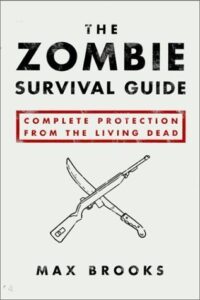
The Zombie Survival Guide is your key to survival against the hordes of undead who may be stalking you right now. Fully illustrated and exhaustively comprehensive, this book covers everything you need to know, including how to understand zombie physiology and behavior, the most effective defense tactics and weaponry, ways to outfit your home for a long siege, and how to survive and adapt in any territory or terrain.
Top 10 Lessons for Surviving a Zombie Attack
1. Organize before they rise! 2. They feel no fear, why should you? 3. Use your head: cut off theirs. 4. Blades don’t need reloading. 5. Ideal protection = tight clothes, short hair. 6. Get up the staircase, then destroy it. 7. Get out of the car, get onto the bike. 8. Keep moving, keep low, keep quiet, keep alert! 9. No place is safe, only safer. 10. The zombie may be gone, but the threat lives on.
Don’t be carefree and foolish with your most precious asset—life. This book is your key to survival against the hordes of undead who may be stalking you right now without your even knowing it. The Zombie Survival Guide offers complete protection through trusted, proven tips for safeguarding yourself and your loved ones against the living dead. It is a book that can save your life.
The Zombie War came unthinkably close to eradicating humanity. Max Brooks, driven by the urgency of preserving the acid-etched first-hand experiences of the survivors from those apocalyptic years, traveled across the United States of America and throughout the world, from decimated cities that once teemed with upwards of thirty million souls to the most remote and inhospitable areas of the planet. He recorded the testimony of men, women, and sometimes children who came face-to-face with the living, or at least the undead, hell of that dreadful time. World War Z is the result. Never before have we had access to a document that so powerfully conveys the depth of fear and horror, and also the ineradicable spirit of resistance, that gripped human society through the plague years.
Ranging from the now infamous village of New Dachang in the United Federation of China, where the epidemiological trail began with the twelve-year-old Patient Zero, to the unnamed northern forests where untold numbers sought a terrible and temporary refuge in the cold, to the United States of Southern Africa, where the Redeker Plan provided hope for humanity at an unspeakable price, to the west-of-the-Rockies redoubt where the North American tide finally started to turn, this invaluable chronicle reflects the full scope and duration of the Zombie War.
Most of all, the book captures with haunting immediacy the human dimension of this epochal event. Facing the often raw and vivid nature of these personal accounts requires a degree of courage on the part of the reader, but the effort is invaluable because, as Mr. Brooks says in his introduction, "By excluding the human factor, aren't we risking the kind of personal detachment from history that may, heaven forbid, lead us one day to repeat it? And in the end, isn't the human factor the only true difference between us and the enemy we now refer to as 'the living dead'?"
Note: Some of the numerical and factual material contained in this edition was previously published under the auspices of the United Nations Postwar Commission.
Time is a resource. Everyone knows it has to be managed.
And on the Discworld that is the job of the Monks of History, who store it and pump it from the places where it's wasted (like underwater - how much time does a codfish need?) to places like cities, where there's never enough time.
But the construction of the world's first truly accurate clock starts a race against, well, time for Lu Tze and his apprentice Lobsang Ludd. Because it will stop time. And that will only be the start of everyone's problems.
"Thief of Time" comes complete with a full supporting cast of heroes, villains, yetis, martial artists and Ronnie, the fifth Horseman of the Apocalypse (who left before they became famous).
It's the night before Hogswatch. And it's too quiet.
Where is the big jolly fat man? Why is Death creeping down chimneys and trying to say Ho Ho Ho? The darkest night of the year is getting a lot darker...
Susan the gothic governess has got to sort it out by morning, otherwise there won't be a morning. Ever again...
The 20th Discworld novel is a festive feast of darkness and Death (but with jolly robins and tinsel too).
Maps in a Mirror brings together nearly all of Orson Scott Card's short fiction written between 1977 and 1990. For those readers who have followed this remarkable talent since the beginning, here are all those amazing stories gathered together in one place, with some extra surprises as well. For the many who are newly come to Card, here is chance to experience the wonder of a writer so versatile that he can handle everything from traditional narrative poetry to modern experimental fiction with equal ease and grace. The brilliant story-telling of the Alvin Maker books is no accident; the breathless excitement evoked by the Ender books is not a once-in-a-lifetime experience. In this enormous volume are forty-six stories, plus ten long, intensely personal essays, unique to this volume. In them the author reveals some of his reasons and motivations for writing, with a good deal of autobiography into the bargain. Contents: Introduction (Book 1: The Hanged Man, Tales of Dread) • essay by Orson Scott Card Eumenides in the Fourth Floor Lavatory (1979) / novelette by Orson Scott Card Quietus (1979) / short story by Orson Scott Card Deep Breathing Exercises (1979) / short story by Orson Scott Card Fat Farm (1980) / short story by Orson Scott Card Closing the Timelid (1979) / short story by Orson Scott Card Freeway Games (1979) / short story by Orson Scott Card A Sepulchre of Songs (1981) / novelette by Orson Scott Card Prior Restraint (1986) / short story by Orson Scott Card The Changed Man and the King of Words (1982) / novelette by Orson Scott Card Memories of My Head (1990) / short story by Orson Scott Card Lost Boys (1989) / short story by Orson Scott Card Afterword (Book 1: The Hanged Man, Tales of Dread) • essay by Orson Scott Card Introduction (Book 2: Flux, Tales of Human Futures) • essay by Orson Scott Card A Thousand Deaths [Tales of Capitol] (1978) / novelette by Orson Scott Card Clap Hands and Sing (1982) / short story by Orson Scott Card Dogwalker (1989) / novelette by Orson Scott Card But We Try Not to Act Like It (1979) / short story by Orson Scott Card I Put My Blue Genes On (1978) / short story by Orson Scott Card In the Doghouse (1978) / short story by Orson Scott Card and Jay A. Parry The Originist [Foundation] (1989) / novella by Orson Scott Card Afterword (Book 2: Flux, Tales of Human Futures) • essay by Orson Scott Card Introduction (Book 3: Maps in a Mirror, Fables and Fantasies) • essay by Orson Scott Card Unaccompanied Sonata (1979) / short story by Orson Scott Card A Cross-Country Trip to Kill Richard Nixon (1980) / novelette by Orson Scott Card The Porcelain Salamander (1981) • short story by Orson Scott Card Middle Woman (1981) / short story by Orson Scott Card The Bully and the Beast (1979) / novella by Orson Scott Card The Princess and the Bear (1980) / novelette by Orson Scott Card Sandmagic [Mither Mages] (1979) / novelette by Orson Scott Card The Best Day (1984) / short story by Orson Scott Card A Plague of Butterflies (1981) / short story by Orson Scott Card The Monkeys Thought 'Twas All in Fun (1979) / novelette by Orson Scott Card Afterword (Book 3: Maps in a Mirror, Fables and Fantasies) • essay by Orson Scott Card Introduction (Book 4: Cruel Miracles, Tales of Death, Hope, and Holiness) • essay by Orson Scott Card Mortal Gods (1979) / short story by Orson Scott Card Saving Grace (1987) / short story by Orson Scott Card Eye for Eye (1987) / novella by Orson Scott Card St. Amy's Tale (1980) / novelette by Orson Scott Card Kingsmeat (1978) / short story by Orson Scott Card Holy (1980) / novelette by Orson Scott Card Afterword (Book 4: Cruel Miracles, Tales of Death, Hope, and Holiness) • essay by Orson Scott Card Introduction (Book 5: Lost Songs, The Hidden Stories) • essay by Orson Scott Card Ender's Game [Ender Wiggin] (1977) / novelette by Orson Scott Card Mikal's Songbird (1978) / novelette by Orson Scott Card Prentice Alvin and the No-Good Plow [The Alvin Maker Saga] (1989) • poem by Orson Scott Card Malpractice (1977) / short story by Orson Scott Card Follower (1978) / short story by Orson Scott Card Hitching (1978) / short story by Orson Scott Card Damn Fine Novel (1989) / short story by Orson Scott Card Billy's Box (1978) / short story by Orson Scott Card The Best Family Home Evening Ever (1978) / short story by Orson Scott Card Bicicleta (1977) / short story by Orson Scott Card I Think Mom and Dad Are Going Crazy, Jerry (1979) / short story by Orson Scott Card Gert Fram (1977) / short story by Orson Scott Card Afterword (Book 5: Lost Songs, The Hidden Stories) • essay by Orson Scott Card
The LitRPG bestseller releasing in a stunning new deluxe hardcover edition, now with a new Afterword.
“How to Defeat a Demon King in Ten Easy Steps is an endlessly inventive and entertaining love letter to all of us underdogs who spent countless hours with a game controller in hand, daydreaming about how we would save the realm.” —Matt Dinniman, New York Times bestselling author of the Dungeon Crawler Carl series
For thousands of years, there has been a cycle: a Demon King rises and conquers, and a Hero is reborn a hundred years later to defeat him. Each time, civilizations are ground to dust beneath the Demon King’s hordes, but humanity has remained secure in the belief that a Hero of legend will always save them. There’s just one slight problem. It’s only been twenty-three years since the Demon King’s latest rise, and this time, he’s already conquered more than half the world. If humanity simply waits for the Hero’s return, there may be no world left for him to save.
And so, Yui Shaw sets out with an ambitious plan. A ten-step plan.
She’ll find a way to obtain the Hero’s legendary sword. She’ll earn obscure classes, gain levels, and increase her skills. She’ll travel to the meticulously-crafted dungeons that seem designed for one specific Hero to complete. And, if she’s truly (un)fortunate, she might even find a fairy.
Welcome Back!
Track your reading progress and sync your library.