

More by Philip José Farmer

At the end of The Fabulous Riverboat, Sam Clemens finally set out in the great iron riverboat Not for Hire to reach the headwaters of the massive river on whose shores humanity has been resurrected. After 33 years on the river, Clemens and his crew--including the giant subhuman Joe Miller--are finally near the end of their journey, and only one obstacle remains: the evil Earthly king, John Lackland. John is waiting just upriver in the Rex Grandissimus, the first riverboat that Sam constructed and the one that John and his crew hijacked, and he's hell-bent on sinking Sam's boat (and vice versa). Complicating the battle is the fact that both ships likely contain agents of the Ethicals, the group of advanced beings who created Riverworld for reasons unknown. One or more of the Ethicals themselves may even be on board, as are various humans that the rebel Ethical, known as the Mysterious Stranger (but known to Clemens simply as X), enlisted in his cause, which may or may not lead to humanity's salvation.
The battle is set to take place along the shores populated by members of the Church of the Second Chance, a group that believes they must attain ethical perfection in order to proceed to the next phase of existence. The Second Chancers are not violent, but their charismatic leader, La Viro, may attempt to sink one or both of the iron ships in order to prevent the battle. Among the Second Chancers is former Nazi officer Hermann Goring, who had a run-in with Sir Richard Francis Burton in the first Riverworld novel, To Your Scattered Bodies Go. Burton and his companions--among them several people who were contacted by the Mysterious Stranger--are reluctantly serving on John's boat in order to reach the headwaters of the river. But will any of the humans working for X survive the coming battle? And if so, how can they possibly hope to penetrate the tower in the North Sea where the Ethicals are thought to reside? And what could lowly humans hope to do against a race so advanced that they can reshape entire planets and resurrect all of humanity? --Craig E. Engler

In To Your Scattered Bodies Go, Philip José Farmer introduces readers to the awesome Riverworld, a planet that had been carved into one large river on whose shores all of humanity throughout the ages has seemingly been resurrected. In The Fabulous Riverboat, Farmer tells the tale of one person whose is uniquely suited to find the river's headwaters, riverboat captain and famous Earthly author Sam Clemens (a.k.a. Mark Twain). Clemens has been visited by "X," a mysterious being who claims to be a rebel among the group that created Riverworld. X tells Clemens where he can find a large deposit of iron and other materials that Clemens can use to build the greatest riverboat ever seen. Since there is virtually no metal on the planet, it will also give Clemens an unbeatable edge when it comes to battling the various warlike societies that dominate the Riverworld.
But Clemens is not alone in his quest for the iron, which arrives on the planet in the form of a giant meteorite. In fact, Clemens is besieged on all sides by forces determined to seize the precious ore, leading him to make a deadly pact with one of history's most notorious villains, John Lackland. Lackland's crimes during his reign as king of England were so hideous that no other English monarch will ever carry his name, and he's up to equally nefarious tricks on Riverworld. However, Clemens has a guardian angel in the form of Joe Miller, a giant subhuman with a big nose, a serious lisp, and a cutting wit. Miller has also been to the very headwaters of the river, where he saw a mysterious tower in the middle of the North Sea and where the creators of Riverworld are thought to reside. He will be an invaluable ally in completing the riverboat and sailing to the headwaters, but even an 800-pound giant may not be enough to help Clemens fulfill X's mission. --Craig E. Engler
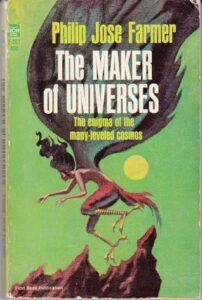
When Robert Wolff found a strange horn in an empty house, he held the key to a different universe. To blow that horn would open up a door through space-time and permit entry to a cosmos whose dimensions and laws were not those our starry galaxy knows.
For that other universe was a place of tiers, world upon world piled upon each other like the landings of a sky-piercing mountain. The one to blow that horn would ascend those steps, from creation to creation, until he would come face to face with the being whose brain-child it was.
But what if that maker of universes was a madman? Or an imposter? Or a super-criminal hiding from the wrath of his own superiors?
The Maker of Universes is unlike any science-fiction novel you have ever read, it is wonderfully unique.

To Your Scattered Bodies Go is the Hugo Award-winning beginning to the story of Riverworld, Philip José Farmer's unequaled tale about life after death. When famous adventurer Sir Richard Francis Burton dies, the last thing he expects to do is awaken naked on a foreign planet along the shores of a seemingly endless river. But that's where Burton and billions of other humans (plus a few nonhumans) find themselves as the epic Riverworld saga begins. It seems that all of Earthly humanity has been resurrected on the planet, each with an indestructible container that provides three meals a day, cigarettes, alcoholic beverages, a lighter, and the odd tube of lipstick. But why? And by whom?
That's what Burton and a handful of fellow adventurers are determined to discover as they construct a boat and set out in search of the river's source, thought to be millions of miles away. Although there are many hardships during the journey--including an encounter with the infamous Hermann Goring--Burton's resolve to complete his quest is strengthened by a visit from the Mysterious Stranger, a being who claims to be a renegade within the very group that created the Riverworld. The stranger tells Burton that he must make it to the river's headwaters, along with a dozen others the Stranger has selected, to help stop an evil experiment at the end of which humanity will simply be allowed to die. --Craig E. Engler