

A Wizard of Earthsea
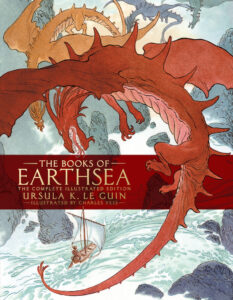
The Books of Earthsea

The Earthsea Trilogy

The Tombs of Atuan
The Farthest Shore
Tales from Earthsea
The Other Wind
More by Ursula K. Le Guin

Some inhabitants of a peaceful kingdom cannot tolerate the act of cruelty that underlies its happiness.
The story 'Omelas" was first published in 'New Dimensions 3' (1973), a hard-cover science fiction anthology edited by Robert Silverberg, in October 1973, and the following year it won the prestigious Hugo Award for best short story.
The work was subsequently printed in Le Guin's short story collection 'The Wind's Twelve Quarters' (1975).
Ursula K Le Guin
(1929–2018) was an American writer who published twenty-two novels, eleven volumes of short stories, four collections of essays, twelve books for children, six volumes of poetry & four of translation, and has received many awards: Hugo, Nebula, National Book Award, PEN-Malamud, and more. She was known for her treatment of gender ('The Left Hand of Darkness' (1969), 'The Matter of Seggri' (1994)), political systems ('The Telling' (2000), 'The Dispossessed' (1974)) and difference/otherness in any other form.
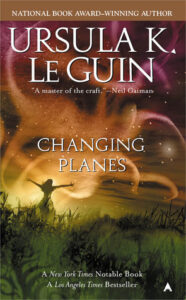
Sita Dulip has missed her flight. But instead of listening to garbled announcements in the airport, she has found a method of bypassing the crowds at the desks, the long lines at the toilets, the nasty lunch, the whimpering children and punitive parents, the bookless bookstores, and the blue plastic chairs bolted to the floor.
This method - changing planes - enables Sita to visit fifteen societies not found on Earth. She will encounter cultures where the babble of children fades over time into the silence of adults; where whole towns exist solely for holiday shopping; where personalities are ruled by rage; where genetic experiments produce less than desirable results. And many other exotic landscapes whose denizens are fundamentally human...

The recipient of numerous literary prizes, including the National Book Award, the Kafka Award, and the Pushcart Prize, Ursula K. Le Guin is renowned for her lyrical writing, rich characters, and diverse worlds. The Wind's Twelve Quarters collects seventeen powerful stories, each with an introduction by the author, ranging from fantasy to intriguing scientific concepts, from medieval settings to the future.
Including an insightful foreword by Le Guin, describing her experience, her inspirations, and her approach to writing, this stunning collection explores human values, relationships, and survival, and showcases the myriad talents of one of the most provocative writers of our time.

The recipient of numerous literary prizes, including the National Book Award, the Kafka Award, five Hugo Awards and five Nebula Awards, the renowned writer Ursula K. Le Guin has, in each story and novel, created a provocative, ever-evolving universe filled with diverse worlds and rich characters reminiscent of our earthly selves. Now, in The Birthday of the World, this gifted artist returns to these worlds in eight brilliant short works, including a never-before-published novella, each of which probes the essence of humanity.

Once a culturally rich world, the planet Aka has been utterly transformed by technology. Records of the past have been destroyed, and citizens are strictly monitored. But an official observer from Earth named Sutty has learned of a group of outcasts who live in the wilderness. They still believe in the ancient ways and still practice its lost religion - the Telling.
Intrigued by their beliefs, Sutty joins them on a sacred pilgrimage into the mountains...and into the dangerous terrain of her own heart, mind, and soul.

Wizardry, transforming its master into a cloud of fine mist...cloning, duplicating the ideal man ten times over...Utopia, in a city where almost everyone is perfectly happy...
Ursula Le Guin, author of The Earthsea Trilogy, has a special way of blending stirring adventure with fantasy that has made comparison with such masters as C.S. Lewis and J.R.R. Tolkien inevitable.
Now, in The Wind's Twelve Quarters, seventeen of her favorite stories reaffirm Ursula Le Guin as one of America's outstanding writers.
CONTENTS:
Foreword
Semley's Necklace
April in Paris
The Masters
Darkness Box
The Word of Unbinding
The Rule of Names
Winter's King
The Good Trip
Nine Lives
Things
A Trip to the Head
Vaster than Empires and More Slow
The Stars Below
The Field of Vision
Direction of the Road
The Ones Who Walk Away from Omelas
The Day Before the Revolution

The Earth colony of Landin has been stranded on Werel for ten years. But ten of Werel's years are over 600 terrestrial years.
The lonely and dwindling human settlement is beginning to feel the strain. Every winter—a season that lasts for 15 years—the Earthmen have neighbors: the humanoid hilfs, a nomadic people who only settle down for the cruel cold spell. The hilfs fear the Earthmen, whom they think of as witches and call the farborns.
But hilfs and farborns have common enemies: the hordes of ravaging barbarians called gaals and eerie preying snow ghouls. Will they join forces or be annihilated?

A collection of stories highlight such objects of the imagination as a starship that sails on the wings of song, musical instruments that are played at funerals only, and orbiting arks designed to save a doomed humanity.

Ursula K. Le Guin's Always Coming Home is a major work of the imagination from one of America's most respected writers. More than five years in creation, it is a novel unlike any other.
A rich and complex interweaving of story and fable, poem, artwork, and music, it totally immerses the reader in the culture of the Kesh, a peaceful people of the far future who inhabit a place called the Valley on the Northern Pacific Coast. The author makes the inhabitants of the valley as familiar, as immediate, as wholly human as our own friends or family.
Spiraling outward from the dramatic life story of a woman called Stone Telling, Le Guin's Always Coming Home interweaves wry wit, deep insight and extraordinary compassion into a compelling unity of vision.

A world shared by three native humanoid races - the cavern-dwelling Gdemiar, elvish Fiia, and warrior clan, Liuar - is suddenly invaded and conquered by a fleet of ships from the stars. Earth scientist Rocannon is on that world, and he sees his friends murdered and his spaceship destroyed. Marooned among alien peoples, he leads the battle to free this new world - and finds that legends grow around him even as he fights.

Ursula K. Le Guin revisits her popular Hainish universe with four interconnected stories that together weave a tapestry of revolution and political turmoil. Le Guin tells the tale of two worlds where decades of slavery and class distinction are about to come to an end. She begins at the end with the story of a woman who survived the perilous times and now must face what comes after. Then in turn come tales of a naive envoy, an aloof observer forced to choose sides, and a young slave who wins freedom, only to confront the bonds of her own mind.
Contents:
Betrayals (1994)
Forgiveness Day (1994)
A Man of the People (1995)
A Woman's Liberation (1995)

He was a fully grown man, alone in dense forest, with no trail to show where he had come from and no memory to tell who — or what — he was.
His eyes were not the eyes of a human.
The forest people took him in and raised him almost as a child, teaching him to speak, training him in forest lore, giving him all the knowledge they had. But they could not solve the riddle of his past, and at last he had to set out on a perilous quest to Es Toch, the City of the Shining, the Liars of Earth, the Enemy of Mankind.
There he would find his true self ... and a universe of danger.
Cover illustration by Jack Gaughan