

More by Isaac Asimov
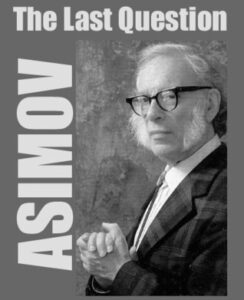
¿Es posible revertir el inevitable final del Universo, o el mundo debe acabar de todas formas? es la pregunta que desde un día del siglo XXI, hasta generaciones y generaciones posteriores en el tiempo, hacen los humanos a los ordenadores.
En un relato aparentemente sencillo sobre un asunto sobrecogedor, el fin de los días, Asimov demuestra, una vez más, una mente preclara y una mano maestra para sobrecoger al lector y dejarlo en vilo, incluso después de la lectura.
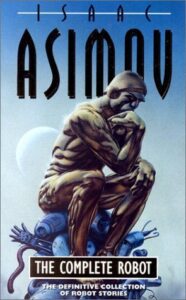
THE COMPLETE ROBOT is the definitive anthology of Asimov's stunning visions of a robotic future…
In these stories, Isaac Asimov creates the Three Laws of Robotics and ushers in the Robot Age: when Earth is ruled by master-machines and when robots are more human than mankind.
Contents
9 • Introduction (The Complete Robot) • (1982) • essay by Isaac Asimov
15 • A Boy's Best Friend • (1975) • short story by Isaac Asimov
19 • Sally • (1953) • short story by Isaac Asimov
41 • Someday • (1956) • short story by Isaac Asimov
55 • Point of View • [Multivac] • (1975) • short story by Isaac Asimov
59 • Think! • (1977) • short story by Isaac Asimov
70 • True Love • (1977) • short story by Isaac Asimov
77 • Robot AL-76 Goes Astray • (1942) • short story by Isaac Asimov
93 • Victory Unintentional • (1942) • short story by Isaac Asimov
117 • Stranger in Paradise • (1974) • novelette by Isaac Asimov
151 • Light Verse • (1973) • short story by Isaac Asimov
157 • Segregationist • (1967) • short story by Isaac Asimov
164 • Robbie • (1940) • short story by Isaac Asimov (variant of Strange Playfellow)
191 • Let's Get Together • (1957) • short story by Isaac Asimov
211 • Mirror Image • [Elijah Bailey / R. Daneel Olivaw] • (1972) • short story by Isaac Asimov
231 • The Tercentenary Incident • (1976) • short story by Isaac Asimov
253 • First Law • [Mike Donovan] • (1956) • short story by Isaac Asimov
257 • Runaround • [Mike Donovan] • (1942) • novelette by Isaac Asimov
280 • Reason • [Mike Donovan] • (1941) • short story by Isaac Asimov
302 • Catch That Rabbit • [Mike Donovan] • (1944) • short story by Isaac Asimov
329 • Liar! • [Susan Calvin] • (1941) • short story by Isaac Asimov
350 • Satisfaction Guaranteed • [Susan Calvin] • (1951) • short story by Isaac Asimov
368 • Lenny • [Susan Calvin] • (1958) • short story by Isaac Asimov
385 • Galley Slave • [Susan Calvin] • (1957) • novelette by Isaac Asimov
427 • Little Lost Robot • [Susan Calvin] • (1947) • novelette by Isaac Asimov
459 • Risk • [Susan Calvin] • (1955) • novelette by Isaac Asimov
490 • Escape! • [Susan Calvin] • (1945) • short story by Isaac Asimov
518 • Evidence • [Susan Calvin] • (1946) • novelette by Isaac Asimov
546 • The Evitable Conflict • [Susan Calvin] • (1950) • novelette by Isaac Asimov
575 • Feminine Intuition • [Susan Calvin] • (1969) • novelette by Isaac Asimov
605 • ... That Thou Art Mindful of Him • (1974) • novelette by Isaac Asimov (variant of —That Thou Art Mindful of Him!)
635 • The Bicentennial Man • (1976) • novelette by Isaac Asimov
683 • A Last Word • (1982) • essay by Isaac Asimov
THE COMPLETE ROBOT is the ultimate collection of timeless, amazing and amusing robot stories from the greatest science fiction writer of all time, offering golden insights into robot thought processes. Asimov's Three Laws of Robotics were programmed into real computers thirty years ago at the Massachusetts Institute of Technology - with surprising results. Readers of today still have many surprises in store...
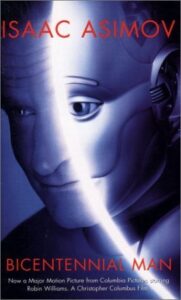
Andrew was one of Earth's first house robot domestic servants—smoothly designed and functional. But when Andrew started to develop special talents which exceeded the confines of his allotted positronic pathways, he abandoned his domestic duties in favour of more intellectual pursuits. As time passed, Andrew acquired knowledge, feelings and ambitions way beyond anything ever experienced by any other mechanical men. And he found himself launched on to a career which would bring him fame fortune — and danger. For a robot who wants to be human must also be prepared to die...
In the Bicentennial Man, Isaac Asimov returns to his first and most enduring love — robotics. The result is a brilliant book of first-class entertainment and mind-spinning ideas which confirm Asimov's supreme status as Grand Master of science fiction.
Content
"Feminine Intuition" (1969)
"Waterclap" (1970)
"That Thou Art Mindful of Him" (1974)
"Stranger in Paradise" (1974)
"The Life and Times of Multivac" (1975)
"The Winnowing" (1976)
"The Bicentennial Man" (1976)
"Marching In" (1976)
"Old-Fashioned" (1976)
"The Tercentenary Incident" (1976)
"Birth of a Notion" (1976)
Cover Illustration: Don Dixon
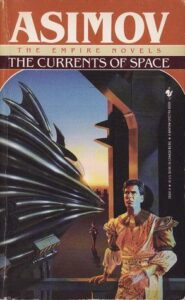
High above the planet Florinia, the Squires of Sark live in unimaginable wealth and comfort. Down in the eternal spring of the planet, however, the native Florinians labor ceaselessly to produce the precious kyrt that brings prosperity to their Sarkite masters. Rebellion is unthinkable and impossible. Not only do the Florinians no longer have a concept of freedom, any disruption of the vital kyrt trade would cause other planets to rise in protest, ultimately destabilizing trade and resulting in a galactic war. So the Trantorian Empire, whose grand plan is to unite all humanity in peace, prosperity, and freedom, has stood aside and allowed the oppression to continue. Living among the workers of Florinia, Rik is a man without a memory or a past. He has been abducted and brainwashed. Barely able to speak or care for himself when he was found, Rik is widely regarded as a simpleton by the worker community where he lives. But as his memories begin to return, Rik finds himself driven by a cryptic message he is determined to deliver: Everyone on Florinia is doomed . . . the Currents of Space are bringing destruction. But if the planet is evacuated, the power of Sark will end--so some would finish the job and would kill the messenger. The fate of the Galaxy hangs in the balance.
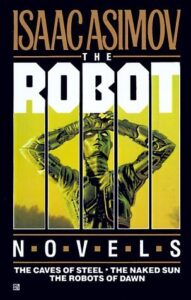
Lije Baley and R. Daneel Olivaw, a robot, investigate the murders of a famous robotocist, an isolated inhabitant of Solaria, and Jander Panell, an advanced robot

One moment Joseph Schwartz is a happily retired tailor in 1949 Chicago. The next he's a helpless stranger on Earth during the heyday of the first Galactic Empire. Earth, he soon learns, is a backwater, just a pebble in the sky, despised by all the other 200 million planets of the Empire because its people dare to claim it's the original home of man. And Earth is poor, with great areas of radioactivity ruining much of its soil--so poor that everyone is sentenced to death at the age of sixty.
Joseph Schwartz is sixty-two.
This is young Isaac Asimov's first novel, full of wonders and ideas, the book that launched the novels of the Galactic Empire, culminating in the Foundation books and novels. It is also one of that select group of SF adventures that since the early 1950s has hooked generations of teenagers on reading science fiction. This is Golden Age SF at its finest.
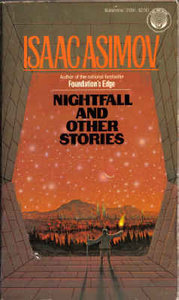
A collection of science fiction stories which examine various reactions to altered environmental conditions or bizarre psychological situations
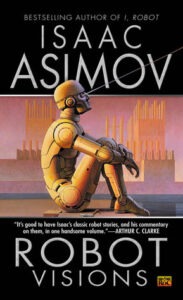
From Isaac Asimov, the Hugo Award-winning Grand Master of Science Fiction whose name is synonymous with the science of robotics, comes five decades of robot visions: thirty-four landmark stories and essays—including three rare tales—gathered together in one volume.
Meet all of Asimov’s most famous creations including: Robbie, the very first robot that his imagination brought to life; Susan Calvin, the original robot psychologist; Stephen Byerley, the humanoid robot; and the famous human/robot detective team of Lije Bailey and R. Daneel Olivaw, who have appeared in such bestselling novels as The Robots of Dawn and Robots and Empire.
Let the master himself guide you through the key moments in the fictional history of robot-human relations—from the most primitive computers and mobile machines to the first robot to become a man.
(back cover)
Contents:
Robot Visions • cover and interior artwork by Ralph McQuarrie
Introduction: The Robot Chronicles • essay by Isaac Asimov
Robot Visions / short story by Isaac Asimov
Too Bad! (1989) / short story by Isaac Asimov
Robbie (1940) / short story by Isaac Asimov (variant of Strange Playfellow)
Reason [Mike Donovan] (1941) / short story by Isaac Asimov
Liar! [Susan Calvin] (1941) / short story by Isaac Asimov
Runaround [Mike Donovan] (1942) / novelette by Isaac Asimov
Evidence [Susan Calvin] (1946) / novelette by Isaac Asimov
Little Lost Robot [Susan Calvin] (1947) / novelette by Isaac Asimov
The Evitable Conflict [Susan Calvin] (1950) / novelette by Isaac Asimov
Feminine Intuition [Susan Calvin] (1969) / novelette by Isaac Asimov
The Bicentennial Man (1976) / novelette by Isaac Asimov
Someday (1956) / short story by Isaac Asimov
Think! (1977) / short story by Isaac Asimov
Segregationist (1967) / short story by Isaac Asimov
Mirror Image [Elijah Bailey/R. Daneel Olivaw] (1972) / short story by Isaac Asimov
Lenny [Susan Calvin] (1958) / short story by Isaac Asimov
Galley Slave [Susan Calvin] (1957) / novelette by Isaac Asimov
Christmas Without Rodney (1988) / short story by Isaac Asimov
Essays by Isaac Asimov: Robots I Have Known (1954); The New Teachers (1976); Whatever You Wish (1977); The Friends We Make (1977); Our Intelligent Tools (1977); The Laws of Robotics (1979); Future Fantastic (1989); The Machine and the Robot (1978); The New Profession (1979); The Robot As Enemy? (1979); Intelligences Together (1979); My Robots (1987); The Laws of Humanics (1987); Cybernetic Organism (1987); The Sense of Humor (1988); Robots in Combination (1988).
The volume features many black-and-white illustrations by Ralph McQuarrie.
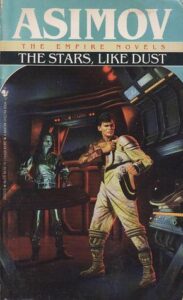
Biron Farrell was young and naïve, but he was growing up fast. A radiation bomb planted in his dorm room changed him from an innocent student at the University of Earth to a marked man, fleeing desperately from an unknown assassin.
He soon discovers that, many light-years away, his father, the highly respected Rancher of Widemos, has been murdered. Stunned, grief-stricken, and outraged, Biron is determined to uncover the reasons behind his father’s death, and becomes entangled in an intricate saga of rebellion, political intrigue, and espionage.
The mystery takes him deep into space where he finds himself in a relentless struggle with the power-mad despots of Tyrann. Now it is not just a case of life or death for Biron, but a question of freedom for the galaxy.

Librarian's Note: Alternate cover for this ISBN can be found here
Here, from a grand master of science fiction, is the long awaited final novel of the greatest series ever told. Completed just before his death, Forward The Foundation is the crowning achievement of a great writer's life, a stirring testament to the creative genius of Isaac Asimov.
As Hari Seldon struggles to perfect his revolutionary theory of psychohistory and ensure a place for humanity among the stars, the great Galactic Empire totters on the brink of apocalyptic collapse. Caught in the maelstrom are Seldon and all he holds dear, pawns in the struggle for dominance. Whoever can control Seldon will control psychohistory—and with it the future of the Galaxy.
Among those seeking to turn psychohistory into the greatest weapon known to man are a populist political demagogue, the weak-willed Emperor Cleon I, and a ruthless militaristic general. In his last act of service to humankind, Hari Seldon must somehow save his life's work from their grasp as he searches for his true heirs—a search the begins with his own granddaughter and the dream of a new Foundation.
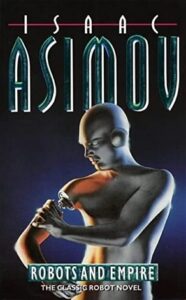
Long after his humiliating defeat at the hands of Earthman Elijah Baley, Keldon Amadiro embarked on a plan to destroy planet Earth. But even after his death, Baley's vision continued to guide his robot partner, R. Daneel Olivaw, who had the wisdom of a great man behind him and an indestructable will to win....
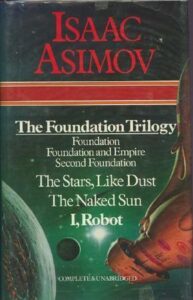
In this landmark of imaginative fiction, winner of a special Hugo Award as Best All Time Science Fiction Series, Asimov has brilliantly conceived a whole new world for mankind, set far in the future and spanning a period of more than a thousand years.
Foundation, describes how one man creates a new force for civilised life as the old Galactic Empire crumbles into barbarism.
Foundation and Empire is the story of the mighty conflict for mastery of the stars between these two major powers.
Second Foundation
A new and even more terrifying threat to the future of humanity arises in the form of a dangerous mutant, capable of manipulating men's minds and destroying the universe. . .
The Stars, Like DustA masterpiece of suspense and drama: Biron Farrill sets out on a dangerous quest through the galaxies to find "Rebellion World" and its key to man's future peace.
The Naked Sun
Earth's very existence is at stake when a murder takes place on power-hungry Solaria. One of the greatest detective stories in the science fiction canon.
I, Robot
The classic vision of a future where robots are so sophisticated that mankind is threatened with redundancy. Stories include: Robbie, Runaround, Reason, Catch That Rabbit, Liar!, Little Lost Robot, Escape!, Evidence, and The Evitable Conflict.