

More by H.P. Lovecraft

“H. P. Lovecraft has yet to be surpassed as the 20th century’s greatest practitioner of the classic horror tale.”―Stephen King The most important tales of the godfather of the modern horror genre―a master who influenced the works of a generation of writers including Stephen King and Anne Rice―are gathered in one volume by National Book Award-winning author Joyce Carol Oates. Combining the 19th-century gothic sensibility of Edgar Allan Poe with a daring internal vision, Lovecraft’s tales foretold a psychically troubled world to come. Set in a meticulously wrought, historically grounded New England landscape, his harrowing stories explore the collapse of sanity beneath the weight of chaotic events. Lovecraft’s universe is a frightening shadow world were reality and nightmare intertwine, and redemption can come only from below. For aficionados and a new generation of 21st-century readers , Tales of H. P. Lovecraft is a classic not to be missed.
H. P. Lovecraft was one of the greatest horror writers of all time. His seminal work appeared in the pages of legendary Weird Tales and has influenced countless writer of the macabre. This is one of those stories.

A man, newly arrived in New York, learns that a reclusive doctor lives in the apartment above his own. While suffering a heart attack, he is taken to the doctor’s door, and soon becomes friends with the bizarre and isolated man who claims he must live in a refrigerated environment for his health. But as the man spends more time with the doctor, he begins to understand the horrifying truth about his friend’s strange medical condition.

Beyond the Wall of Sleep" is a short story by American writer H. P. Lovecraft written in 1919 and first published in the amateur publication Pine Cones in October 1919. Inspiration Lovecraft said the story was inspired by an April 27, 1919 article in the New York Tribune. Reporting on the New York state police, the article cited a family named Slater or Slahter as representative of the backwards Catskills population. The nova mentioned at the end of Lovecraft's story is a real star, known as GK Persei; the quotation is from Garrett P. Serviss' Astronomy with the Naked Eye (1908). The title of the story may have been influenced by Ambrose Bierce's "Beyond the Wall"; Lovecraft was known to be reading Bierce in 1919. Jack London's 1906 novel Before Adam, which concerns the concept of hereditary memory, contains the passage, "Nor...did any of my human kind ever break through the wall of my sleep.

a selection from the beginning of the story:
The horrible conclusion which had been gradually intruding itself upon my confused and reluctant mind was now an awful certainty. I was lost, completely, hopelessly lost in the vast and labyrinthine recess of the Mammoth Cave. Turn as I might, in no direction could my straining vision seize on any object capable of serving as a guidepost to set me on the outward path. That nevermore should I behold the blessed light of day, or scan the pleasant hills and dales of the beautiful world outside, my reason could no longer entertain the slightest unbelief. Hope had departed. Yet, indoctrinated as I was by a life of philosophical study, I derived no small measure of satisfaction from my unimpassioned demeanour; for although I had frequently read of the wild frenzies into which were thrown the victims of similar situations, I experienced none of these, but stood quiet as soon as I clearly realised the loss of my bearings.
Nor did the thought that I had probably wandered beyond the utmost limits of an ordinary search cause me to abandon my composure even for a moment. If I must die, I reflected, then was this terrible yet majestic cavern as welcome a sepulchre as that which any churchyard might afford, a conception which carried with it more of tranquillity than of despair.
Starving would prove my ultimate fate; of this I was certain. Some, I knew, had gone mad under circumstances such as these, but I felt that this end would not be mine. My disaster was the result of no fault save my own, since unknown to the guide I had separated myself from the regular party of sightseers; and, wandering for over an hour in forbidden avenues of the cave, had found myself unable to retrace the devious windings which I had pursued since forsaking my companions.
Already my torch had begun to expire; soon I would be enveloped by the total and almost palpable blackness of the bowels of the earth. As I stood in the waning, unsteady light, I idly wondered over the exact circumstances of my coming end. I remembered the accounts which I had heard of the colony of consumptives, who, taking their residence in this gigantic grotto to find health from the apparently salubrious air of the underground world, with its steady, uniform temperature, pure air, and peaceful quiet, had found, instead, death in strange and ghastly form. I had seen the sad remains of their ill-made cottages as I passed them by with the party, and had wondered what unnatural influence a long sojourn in this immense and silent cavern would exert upon one as healthy and vigorous as I. Now, I grimly told myself, my opportunity for settling this point had arrived, provided that want of food should not bring me too speedy a departure from this life.

This Halcyon Classics ebook is H.P. Lovecraft's classic occult tale of horror THE DREAMS IN THE WITCH-HOUSE.
The story follows Walter Gilman, who takes a room in the Witch House, an accursed house in Arkham, Lovecraft's fictional New England town. The house once harbored Keziah Mason, a witch who disappeared mysteriously from a Salem jail in 1692. Gilman discovers that over the centuries most of its occupants have died prematurely. In his dreams while at the house, Gilman travels to the city of Elder Things and communes with the evil witch and her henchmen.

"Dagon" is the second story of the writer H.P.Lovecraft, written in 1917 and published ,for the first time, in 1919. The work takes its title from the mythological God Dagon, and tells a disturbing story, happened years before to a man with the obsession of suicide. Before throwing himself from the window of his attic, this man writes some notes related to his mental state. Then, he began to recall an old story that happened in the years of the First World War: suddenly, he finds himself a prisoner of a German ship in the Pacific Ocean. After only five days, the protagonist manages to escape with a raft. Wandering for days, adrift in the sea, one afternoon he finds himself stranded on a disquieting and apparently deserted island. Immediately he notices that in the mud, a lot of rotting fish are stranded...
"The Nameless City" is a horror story written by H. P. Lovecraft in January 1921 and first published in the November 1921 issue of the amateur press journal The Wolverine. It is often considered the first Cthulhu Mythos story.
The Nameless City of the story's title is an ancient ruin located somewhere in the deserts of the Arabian Peninsula and is older than any human civilization.
interpreted dreams, and the gods have laughed. One man with Oriental eyes has said that all time and space are relative, and men have laughed. But even that man with Oriental eyes has done no more than suspect. I had wished and tried to do more than suspect, and my friend had tried and partly succeeded. Then we both tried together, and with exotic drugs courted terrible and forbidden dreams in the tower studio chamber of the old manor-house in hoary Kent.
Among the agonies of these after days is that chief of torments- inarticulateness. What I learned and saw in those hours of impious exploration can never be told- for want of symbols or suggestions in any language. I say this because from first to last our discoveries partook only of the nature of sensations; sensations correlated with no impression which the nervous system of normal humanity is capable of receiving. They were sensations, yet within them lay unbelievable elements of time and space- things which at bottom possess no distinct and definite existence. Human utterance can best convey the general character of our experiences by calling them plungings or soarings; for in every period of revelation some part of our minds broke boldly away from all that is real and present, rushing aerially along shocking, unlighted, and fear-haunted abysses,
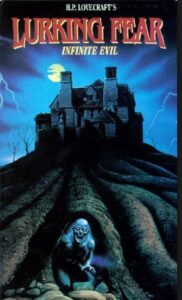
"The Lurking Fear" is a horror short story by American writer H. P. Lovecraft. Written in November 1922, it was first published in the January through April 1923 issues of Home Brew.
The story is narrated by an unnamed seeker of strange horrors who is investigating the massacre of a community of some six dozen backwoods degenerates in an obscure region of the Catskills, a massacre which occurred during a particularly violent electrical storm and seems to have been perpetrated by an unidentified clawed beast. The narrator soon discovers that the most sinister legends of the region center around the abandoned Martense mansion, and he decides together with two companionsto spend the night in the big old house...

"From Beyond" is a short story by science fiction and horror fiction writer H. P. Lovecraft. It was written in 1920 and was first published in The Fantasy Fan in June 1934 (Vol. 1, No. 10).
The story is told from the first person perspective of an unnamed narrator and details his experiences with a scientist named Crawford Tillinghast. Tillinghast creates an electronic device that emits a resonance wave, which stimulates an affected person’s pineal gland, thereby allowing them to perceive planes of existence outside the scope of accepted reality.

The story is told by Albert N. Wilmarth, an instructor of literature at Miskatonic University in Arkham. When local newspapers report strange things seen floating in rivers during a historic Vermont flood, Wilmarth becomes embroiled in a controversy about the reality and significance of the sightings, though he sides with the skeptics. Wilmarth uncovers old legends about monsters living in the uninhabited hills who abduct people who venture or settle too close to their territory.