

More by Arthur C. Clarke

An alternative cover edition for this ISBN can be found here.
Rama Revealed (1993) is a science fiction novel by Arthur C. Clarke and Gentry Lee. It is the last of three sequels to Clarke's Rendezvous with Rama by these authors. The book picks up the story immediately after the end of The Garden of Rama. The book follows the story of Nicole Wakefield and her escape from imprisonment left at the cliffhanger of the previous book.
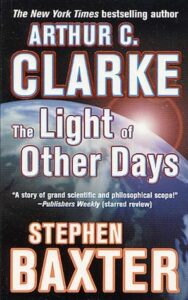
Then, as society reels, the same technology proves able to look backwards in time as well. What happens next is a story only Arthur C. Clarke and Stephen Baxter could tell. The Light of Other Days is a novel that will change your view of what it is to be human.
Few masters of science fiction have brought us glimpses of the near future as vividly as Arthur C. Clarke. It is the startling realism of his vision that has made classics of his novels, such as CHILDHOOD'S END and 2001: A SPACE ODYSSEY. It has also made Clarke himself one of the genre's most successful writers. The trade paperback was published to commemorate the arrival of the year 2001, one of the most notable dates in science fiction history. THE SENTINEL is a brilliant collection of Clarke's highest calibre short fiction.

Imperial Earth is the fascinating odyssey of Duncan Makenzie, traveling from Titan, a moon of Saturn, to Earth, as a diplomatic guest of the United States for the celebration of its Quincentennial in the year 2276. Titan, an independent republic, was originally colonized from Earth three generations earlier. Duncan's initial challenge is to prepare, physically and intellectually, for the 500-million-mile trip to Earth. Once there, he is caught up in a sweep of new experiences, including the social and political whirl in Washington, a strange visit to a carefully preserved ancient city once prominent in the 20th century, and a search for and meeting with a woman he loved since she visited Titan years before.
From outside it was simply an ordinary-looking London pub, a place you'd have to be guided to more than once before you memorized its location, somewhere between Fleet Street and the Embankment. But if, by chance, an insider led you to the White Hart on a Wednesday night, you would have found yourself in the midst of a select gathering or writers, editors, scientists and interested laymen—drinking, swapping odd bits of information, and, like as not, listening to Harry Purvis' memorable stories.
A scientist by profession, Harry Purvis has had or heard about some of the most astonishing experiences—like the story of the carnivorous orchid that was used in a murder plot, or the one about the military computer that was converted to pacifism. There's SILENCE PLEASE, involving a spurned lover and a device that was supposed to destroy sound; and BIG GAME HUNT, in which an ambitious researcher becomes so wrapped up in his latest projest—controlling animal behavior with electrical impulses— that he overlooks one tiny important detail. Such stories may challenge your powers of logic and strain your imagination. Yet even if you doubt their veracity, they're guaranteed to provide you with hours of SF reading. Baron Munchausen, step aside.
Contains: Silence Please; Big Game Hunt; Patent Pending; Armaments Race; Critical Mass; The Ultimate Melody; The Pacifist; The Next Tenants; Moving Spirit; The Man Who Ploughed the Sea; The Reluctant Orchid; Cold War; What Goes Up; Sleeping Beauty & The Defenestration of Ermintrude
Rama est revenu ! Rama, ou plutôt son double, son clone, son jumeau : Rama II. Soixante-dix ans plus tôt, un mystérieux engin extraterrestre traversait brièvement le système solaire, donnant corps à cette fabuleuse révélation : l'homme n'était pas seul dans l'Univers. Et voilà qu'en cette année 2196, le scénario se répète ! Un deuxième vaisseau interstellaire, exactement semblable au précédent, se matérialise dans l'espace... L'humanité, pour la seconde fois de son histoire, envoie une équipe de savants à la rencontre du visiteur. Mission exaltante, bien sûr, mais les intentions des uns et des autres sont-elles aussi nobles qu'elles le paraissent ? Sans oublier celles de l'étranger : pourquoi la nef infléchit-elle brusquement sa course vers la Terre ? Que dissimulent les flancs de Rama II ? Des merveilles... ou un danger mortel ?
ONE BILLION YEARS FROM NOW . . .
Mankind has reached the heights of civilization. Men live thousands of years in perfect freedom and leisure—their wants are attended to by ingenious machines—peace and culture flourish in ways undreamed of in our time. And yet ... mankind is dying. The price of peace has been the loss of the needed human qualities of curiosity and drive—they have been bred out of the human race. So when young Alvin of Diaspar began asking questions, he was looked on as a dangerous freak, a throwback. But Alvin kept asking, kept looking, kept seeking out the truth ...
... and what he found offered his people a dreadful choice—battle and destruction, or a new and richer destiny!

In the year 2130 a mysterious spaceship, Rama, arrived in the solar system. It was huge - big enough to contain a city and a sea - and empty, apparently abandoned. By the time Rama departed for its next, unknown, destination many wonders had been uncovered, but few mysteries solved. Only one thing was clear: everything the enigmatic builders of Rama did, they did in threes.
Eighty years later the second alien craft arrived in the solar system. This time, Earth had been waiting. But all the years of preparation were not enough to unlock the Raman enigma.
Now Rama II is on its way out of the solar system. Aboard it are three humans, two men and a woman, left behind when the expedition departed. Ahead of them lies the unknown, a voyage no human has ever experienced. And at the end of it - and who could tell how many years away that might be? - may lie the truth about Rama...
Just a few islands in a planetwide ocean, Thalassa was a veritable paradise—home to one of the small colonies founded centuries before by robot Mother Ships when the Sun had gone nova and mankind had fled Earth.
Mesmerized by the beauty of Thalassa and overwhelmed by its vast resources, the colonists lived an idyllic existence, unaware of the monumental evolutionary event slowly taking place beneath their seas...
Then the Magellan arrived in orbit carrying one million refugees from the last, mad days on Earth. And suddenly uncertainty and change had come to the placid paradise that was Thalassa.
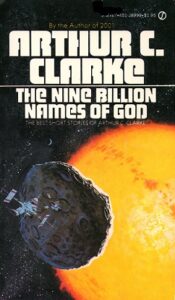
ARTHUR C. CLARKE'S FAVORITE STORIES
THE NINE BILLION NAMES OF GOD -- A short-term course for computer the way to God.
TROUBLE WITH TIME -- Martian time proves that crimes doesn't pay!
NO MORNING AFTER -- Drink, drink and be merry, for tomorrow there will be no morning after...
THE POSSESSED -- Or, why the lemmings drowned.
ENCOUNTER AT DAWN -- The day the gods came to Earth.
THE SENTINEL -- The story which inspired 2001: A SPACE ODYSSEY; when man sets off the galactic burglar alarm, who will answer the call?
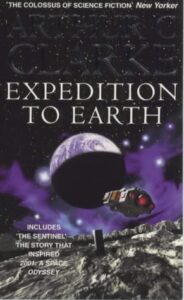
A collection of science fiction short stories by Arthur C. Clarke.
Contents:
Second Dawn
If I Forget Thee, Oh Earth
Breaking Strain
History Lesson (as "Expedition to Earth" in the British Edition, Sidgwick & Jackson, 1954)
Superiority
Exile of the Eons
Hide-and-Seek
Expedition to Earth (as "Encounter in the Dawn" in the British Edition, Sidgwick & Jackson, 1954)
Loophole
Inheritance
The Sentinel (basis for 2001)
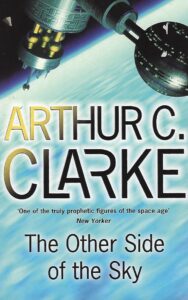
The Other Side of the Sky presents a glimpse of our future: a future where reality is no longer contained in earthly dimensions, where man has learned to exist with the knowledge that he is not alone in the universe. These stories of other planets and galactic adventures show Arthur C Clarke at the peak of his powers: sometimes disturbing, always intriguing.